QUESTION IMAGE
Question
case study 2: dumisani
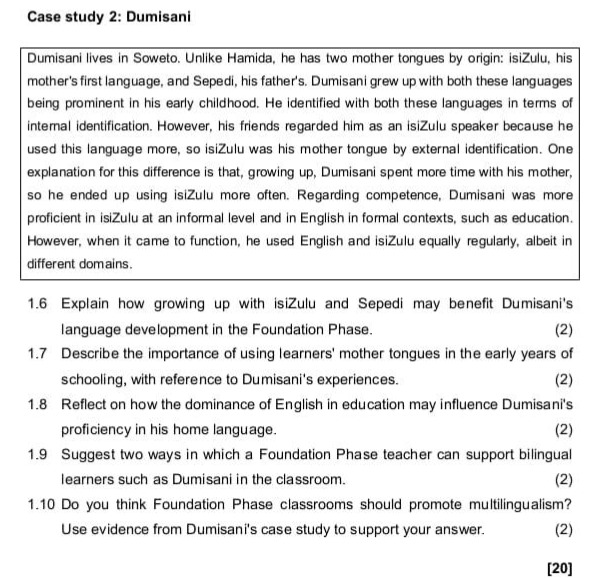
dumisani lives in soweto. unlike hamida, he has two mother tongues by origin: isizulu, his mothers first language, and sepedi, his fathers. dumisani grew up with both these languages being prominent in his early childhood. he identified with both these languages in terms of internal identification. however, his friends regarded him as an isizulu speaker because he used this language more, so isizulu was his mother tongue by external identification. one explanation for this difference is that, growing up, dumisani spent more time with his mother, so he ended up using isizulu more often. regarding competence, dumisani was more proficient in isizulu at an informal level and in english in formal contexts, such as education. however, when it came to function, he used english and isizulu equally regularly, albeit in different domains.
1.6 explain how growing up with isizulu and sepedi may benefit dumisanis language development in the foundation phase. (2)
1.7 describe the importance of using learners mother tongues in the early years of schooling, with reference to dumisanis experiences. (2)
1.8 reflect on how the dominance of english in education may influence dumisanis proficiency in his home language. (2)
1.9 suggest two ways in which a foundation phase teacher can support bilingual learners such as dumisani in the classroom. (2)
1.10 do you think foundation phase classrooms should promote multilingualism? use evidence from dumisanis case study to support your answer. (2)
20
🆕 New Concept Discovered: Bilingualism and Multilingual Education
How learning and using multiple home languages shapes cognitive development and classroom learning.
Step 1: Benefits of growing up with two languages (Question 1.6)
Growing up bilingual (with isiZulu and Sepedi) provides cognitive and linguistic advantages. In the Foundation Phase, this dual exposure enhances metalinguistic awareness—meaning Dumisani can understand how language structures work more easily because he can compare two different systems. It also builds a stronger cognitive foundation, making it easier for him to acquire additional languages (like English) and develop flexible thinking skills.
Step 2: Importance of mother tongue in early schooling (Question 1.7)
Using a learner's mother tongue in early education provides a psychological and cognitive bridge from home to school. For Dumisani, his mother tongues (isiZulu and Sepedi) represent his identity and primary tools for thinking. When schools validate and use these languages, it prevents learning gaps, boosts self-esteem, and ensures that early literacy concepts are grasped quickly because they are taught in a familiar medium.
Step 3: Influence of English dominance on home language proficiency (Question 1.8)
When English dominates formal education, it can lead to "subtractive bilingualism." Because Dumisani uses English for formal, academic, and educational contexts, his academic vocabulary and formal literacy skills in isiZulu and Sepedi may not develop fully. Over time, his home languages might remain restricted to informal, conversational domains, reducing his overall academic proficiency in them.
Step 4: Classroom support strategies for bilingual learners (Question 1.9)
A Foundation Phase teacher can support bilingual learners like Dumisani by:
- Implementing translanguaging practices: Allowing learners to use both of their home languages (isiZulu and Sepedi) alongside English to discuss, clarify, and express academic concepts during group work.
- Creating a multilingual print-rich environment: Displaying classroom labels, posters, and reading books in isiZulu, Sepedi, and English to validate their linguistic identities and support dual-literacy development.
Step 5: Promoting multilingualism in Foundation Phase classrooms (Question 1.10)
Yes, Foundation Phase classrooms should promote multilingualism.
Evidence from the case study: Dumisani naturally navigates different languages for different functions (using English for formal education and isiZulu/Sepedi for personal identity and informal communication). Promoting multilingualism in the classroom aligns school practices with his real-world linguistic reality, ensuring he does not have to abandon his cultural identity or home-language competence to succeed academically.

Snap & solve any problem in the app
Get step-by-step solutions on Sovi AI
Photo-based solutions with guided steps
Explore more problems and detailed explanations
1.6 Benefits of growing up with isiZulu and Sepedi
- Cognitive and Linguistic Flexibility: Growing up with two languages enhances Dumisani's metalinguistic awareness, making it easier for him to understand grammatical structures and learn additional languages like English.
- Expanded Communication Skills: It allows him to navigate different social environments and communicate effectively with a wider range of family members and community peers.
---
1.7 Importance of using mother tongues in early schooling
- Cognitive Continuity: Using a child's mother tongue (such as isiZulu or Sepedi for Dumisani) ensures that early academic concepts are built on familiar linguistic foundations, preventing learning gaps.
- Identity and Emotional Security: It validates the learner's cultural identity and home life, boosting confidence and ease of transition into the formal school environment.
---
1.8 Influence of English dominance on home language proficiency
- Subtractive Bilingualism: Because English is used exclusively for formal education, Dumisani's academic and formal vocabulary in isiZulu and Sepedi may remain underdeveloped.
- Domain Restriction: His home languages may become restricted only to informal, conversational contexts, limiting his ability to read, write, or discuss complex academic topics in his mother tongues.
---
1.9 Two ways a teacher can support bilingual learners
- Encourage Translanguaging: Allow learners to use their home languages (isiZulu and Sepedi) to discuss and clarify difficult concepts with peers before translating their thoughts into English.
- Multilingual Resources: Provide bilingual storybooks, dictionaries, and classroom signage in English, isiZulu, and Sepedi to foster a welcoming and inclusive learning environment.
---
1.10 Should classrooms promote multilingualism? (With evidence)
Yes. Dumisani's case study shows that he naturally uses English and isiZulu equally regularly across different domains (English for formal/educational contexts and isiZulu for informal/social contexts). Promoting multilingualism in classrooms supports this natural linguistic repertoire, ensuring that learners do not lose their home language proficiency while acquiring academic English.