QUESTION IMAGE
Question
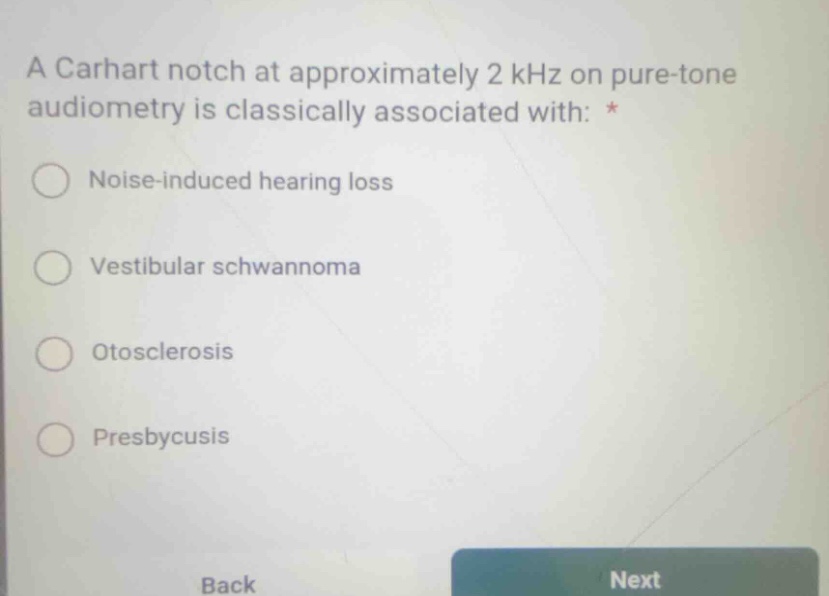
a carhart notch at approximately 2 khz on pure-tone audiometry is classically associated with: *
noise-induced hearing loss
vestibular schwannoma
otosclerosis
presbycusis
<pre_analysis>
{
"quality": "clear",
"question_count": 1,
"skills_matched": [
"direct_cot",
"multiple_choice_formatter",
"explain_then_answer",
"tutor"
],
"needs_drawing": false,
"concepts_used": [],
"new_concepts": [
"Carhart Notch",
"Otosclerosis"
],
"current_concepts": [
"Carhart Notch",
"Otosclerosis",
"Clinical Audiometry"
]
}
</pre_analysis>
<reasoning>
Define the Carhart notch
The Carhart notch is a classic audiological sign characterized by a specific decrease in bone-conduction thresholds, most pronounced at \(2\text{ kHz}\).
Identify the underlying pathology
This phenomenon is not a true sensorineural loss, but rather a mechanical artifact. It occurs due to the loss of the middle ear inertial contribution to bone conduction when the stapes footplate becomes fixed.
Match with clinical conditions
Using the Clinical Audiometry knowledge point, we evaluate the options:
- Otosclerosis is a metabolic bone disease of the inner ear and otic capsule that leads to fixation of the stapes footplate, directly causing this mechanical artifact.
- Noise-induced hearing loss typically presents with an air- and bone-conduction notch around \(4\text{ kHz}\).
- Vestibular schwannoma typically presents with asymmetrical retrocochlear signs.
- Presbycusis presents as a bilateral, sloping high-frequency sensorineural hearing loss.
</reasoning>
<answer>
<mcq-option>(A) Noise-induced hearing loss</mcq-option>
<mcq-option>(B) Vestibular schwannoma</mcq-option>
<mcq-correct>(C) Otosclerosis</mcq-correct>
<mcq-option>(D) Presbycusis</mcq-option>
</answer>
<post_analysis>
{
"subject": "Natural Science",
"question_type": "Multiple Choice",
"knowledge_point": [
"Natural Science",
"Medicine",
"Audiology"
]
}
</post_analysis>
Snap & solve any problem in the app
Get step-by-step solutions on Sovi AI
Photo-based solutions with guided steps
Explore more problems and detailed explanations
<pre_analysis>
{
"quality": "clear",
"question_count": 1,
"skills_matched": [
"direct_cot",
"multiple_choice_formatter",
"explain_then_answer",
"tutor"
],
"needs_drawing": false,
"concepts_used": [],
"new_concepts": [
"Carhart Notch",
"Otosclerosis"
],
"current_concepts": [
"Carhart Notch",
"Otosclerosis",
"Clinical Audiometry"
]
}
</pre_analysis>
<reasoning>
Define the Carhart notch
The Carhart notch is a classic audiological sign characterized by a specific decrease in bone-conduction thresholds, most pronounced at \(2\text{ kHz}\).
Identify the underlying pathology
This phenomenon is not a true sensorineural loss, but rather a mechanical artifact. It occurs due to the loss of the middle ear inertial contribution to bone conduction when the stapes footplate becomes fixed.
Match with clinical conditions
Using the Clinical Audiometry knowledge point, we evaluate the options:
- Otosclerosis is a metabolic bone disease of the inner ear and otic capsule that leads to fixation of the stapes footplate, directly causing this mechanical artifact.
- Noise-induced hearing loss typically presents with an air- and bone-conduction notch around \(4\text{ kHz}\).
- Vestibular schwannoma typically presents with asymmetrical retrocochlear signs.
- Presbycusis presents as a bilateral, sloping high-frequency sensorineural hearing loss.
</reasoning>
<answer>
<mcq-option>(A) Noise-induced hearing loss</mcq-option>
<mcq-option>(B) Vestibular schwannoma</mcq-option>
<mcq-correct>(C) Otosclerosis</mcq-correct>
<mcq-option>(D) Presbycusis</mcq-option>
</answer>
<post_analysis>
{
"subject": "Natural Science",
"question_type": "Multiple Choice",
"knowledge_point": [
"Natural Science",
"Medicine",
"Audiology"
]
}
</post_analysis>