QUESTION IMAGE
Question
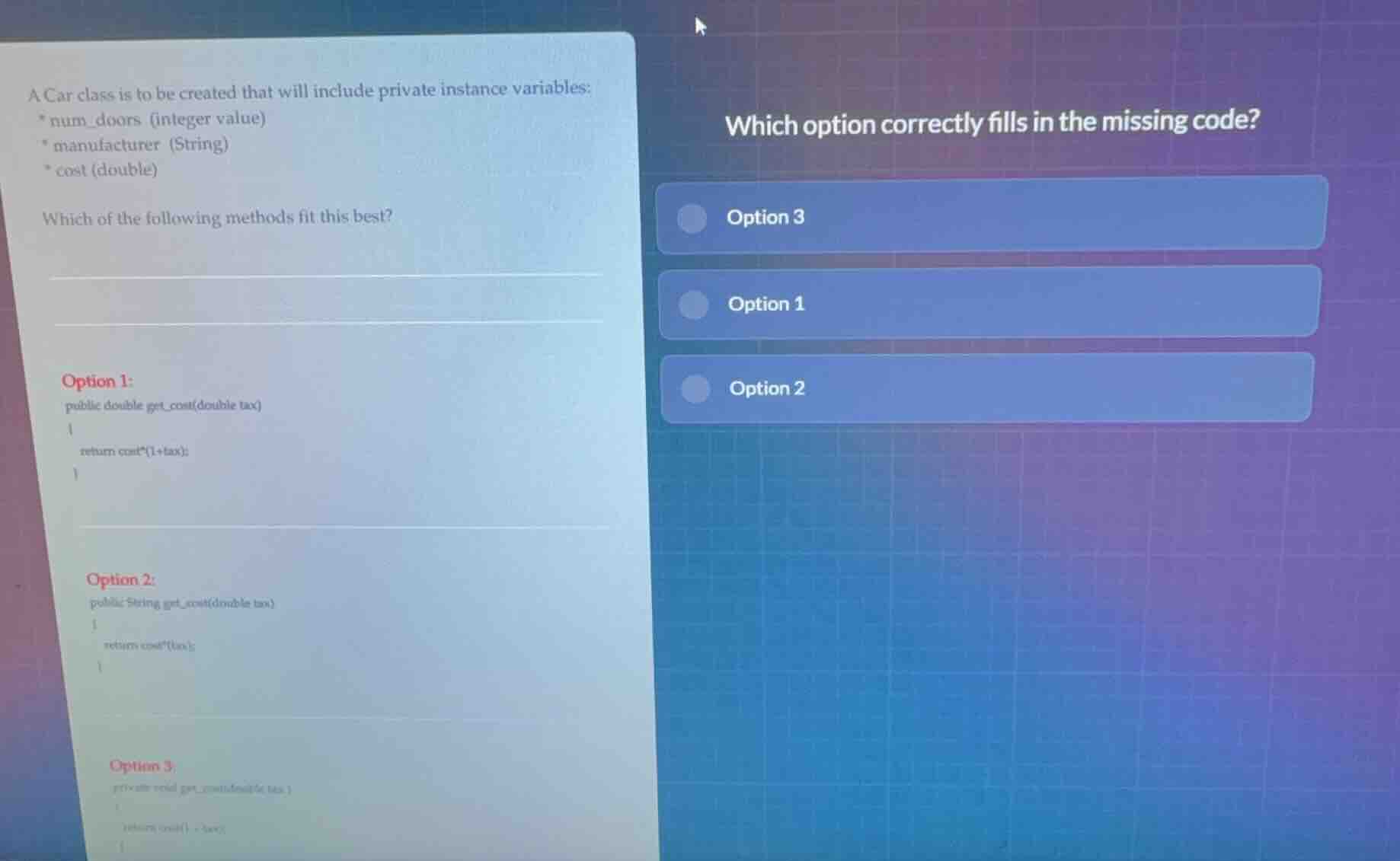
a car class is to be created that will include private instance variables:
- num_doors (integer value)
- manufacturer (string)
- cost (double)
which of the following methods fit this best?
option 1:
public double get_cost(double tax)
{
    return cost * (1 + tax);
}
option 2:
public string get_cost(double tax)
{
return cost * tax;
}
option 3:
private void get_cost(double tax)
{
return cost * (1 - tax);
}
which option correctly fills in the missing code?
🆕 New Concept Discovered: Object-Oriented Method Design
Designing methods with correct return types and access modifiers.
Step 1: Analyze the requirements and instance variables
The Car class has three private instance variables:
num_doors(integer)manufacturer(String)cost(double)
We need to evaluate which of the three options is a correctly designed method for this class.
Step 2: Evaluate Option 1
Let's look at the code for Option 1:
public double get_cost(double tax)
{
return cost * (1 + tax);
}- Access Modifier:
publicallows external classes to access this getter-style calculation. - Return Type:
double. Sincecostis adoubleandtaxis adouble, multiplying them results in adouble. This matches the return type. - Logic: It correctly calculates and returns the total cost including tax.
Step 3: Evaluate Option 2
Let's look at the code for Option 2:
public String get_cost(double tax)
{
    return cost * (1 + tax);
}- Return Type:
String. - Issue: The expression
cost * (1 + tax)evaluates to a numericdoublevalue, not aString. This will cause a compilation error because adoublecannot be directly returned from a method declared to return aString.
Step 4: Evaluate Option 3
Let's look at the code for Option 3:
private void get_cost(double tax)
{
    return cost * (1 + tax);
}- Return Type:
void. - Issue: A
voidmethod cannot return any value. Attempting to usereturnwith an expression in avoidmethod causes a compilation error.

Snap & solve any problem in the app
Get step-by-step solutions on Sovi AI
Photo-based solutions with guided steps
Explore more problems and detailed explanations
Option 1