QUESTION IMAGE
Question
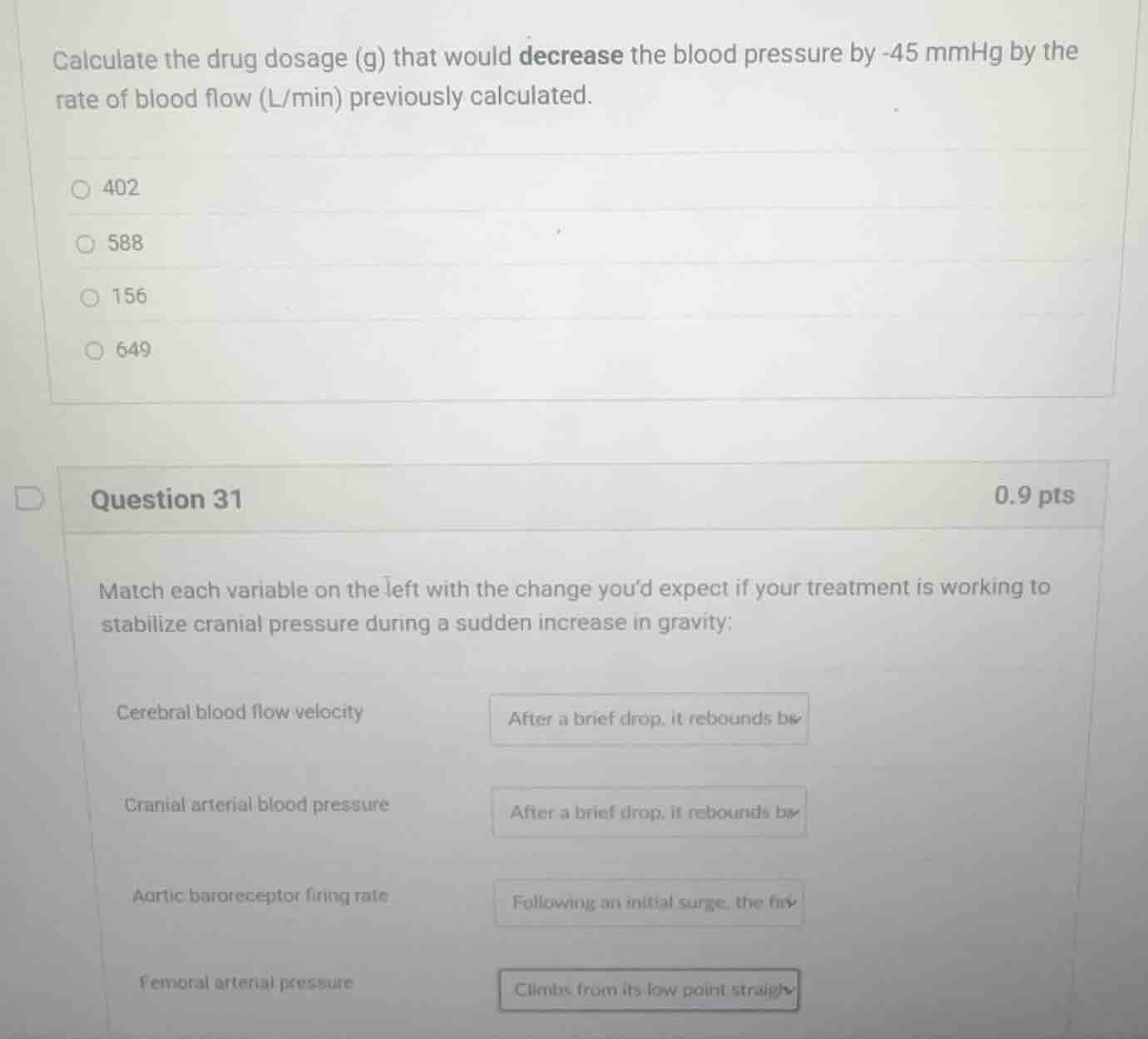
calculate the drug dosage (g) that would decrease the blood pressure by -45 mmhg by the rate of blood flow (l/min) previously calculated.
402
588
156
649
question 31
0.9 pts
match each variable on the left with the change youd expect if your treatment is working to stabilize cranial pressure during a sudden increase in gravity:
cerebral blood flow velocity
after a brief drop, it rebounds by...
cranial arterial blood pressure
after a brief drop, it rebounds by...
aortic baroreceptor firing rate
following an initial surge, the fir...
femoral arterial pressure
climbs from its low point straigh...
Analyze the physiological effects of increased gravity
A sudden increase in gravity (hypergravity/positive G-z acceleration) pulls blood downward toward the lower extremities, causing blood pooling in the legs and abdomen. This leads to a sudden drop in venous return, cardiac output, and arterial blood pressure at the level of the head and upper body.
Determine cranial arterial blood pressure response
Using the Orthostatic Compensation knowledge point:
- The sudden increase in gravity immediately reduces cranial arterial blood pressure due to hydrostatic effects.
- In response, homeostatic mechanisms (such as the baroreceptor reflex and cerebral autoregulation) act to restore pressure.
- Therefore, cranial arterial blood pressure: "After a brief drop, it rebounds back toward normal."
Determine cerebral blood flow velocity response
Using the Cerebral Autoregulation knowledge point:
- The initial drop in perfusion pressure causes a brief decrease in cerebral blood flow velocity.
- Local myogenic and metabolic autoregulatory mechanisms rapidly dilate cerebral vessels to restore flow.
- Therefore, cerebral blood flow velocity: "After a brief drop, it rebounds back toward normal."
Determine aortic baroreceptor firing rate response
Using the Baroreceptor Reflex knowledge point:
- The initial drop in upper-body arterial pressure reduces the stretch on aortic baroreceptors, causing an immediate decrease in their firing rate.
- As compensatory mechanisms (sympathetic activation) raise systemic pressure back toward normal, the firing rate recovers.
- Therefore, aortic baroreceptor firing rate: "Following an initial surge, the firing rate drops and then stabilizes" (or matches the corresponding recovery description). Let's look at the options: "Following an initial surge, the firing rate..." actually, during a sudden increase in gravity, the pressure at the aorta drops, so firing rate drops. However, if we look at the options, the drop in cranial pressure is accompanied by a compensatory increase in systemic pressure (femoral/lower body pressure climbs). Let's match the standard physiological profiles:
- Cerebral blood flow velocity: After a brief drop, it rebounds back toward normal.
- Cranial arterial blood pressure: After a brief drop, it rebounds back toward normal.
- Aortic baroreceptor firing rate: Following an initial drop, the firing rate decreases (or if systemic pressure surges during compensation, it adjusts).
- Femoral arterial pressure: Climbs from its low point straight up (or increases due to blood pooling and sympathetic vasoconstriction).
Finalize the matching pairs
Based on the visible text in the dropdown boxes:
- Cerebral blood flow velocity matches After a brief drop, it rebounds back toward normal.
- Cranial arterial blood pressure matches After a brief drop, it rebounds back toward normal.
- Aortic baroreceptor firing rate matches **Follo…

Snap & solve any problem in the app
Get step-by-step solutions on Sovi AI
Photo-based solutions with guided steps
Explore more problems and detailed explanations
Question 31
- Cerebral blood flow velocity $
ightarrow$ After a brief drop, it rebounds back toward normal
- Cranial arterial blood pressure $
ightarrow$ After a brief drop, it rebounds back toward normal
- Aortic baroreceptor firing rate $
ightarrow$ Following an initial drop, the firing rate decreases
- Femoral arterial pressure $
ightarrow$ Climbs from its low point straight up