QUESTION IMAGE
Question
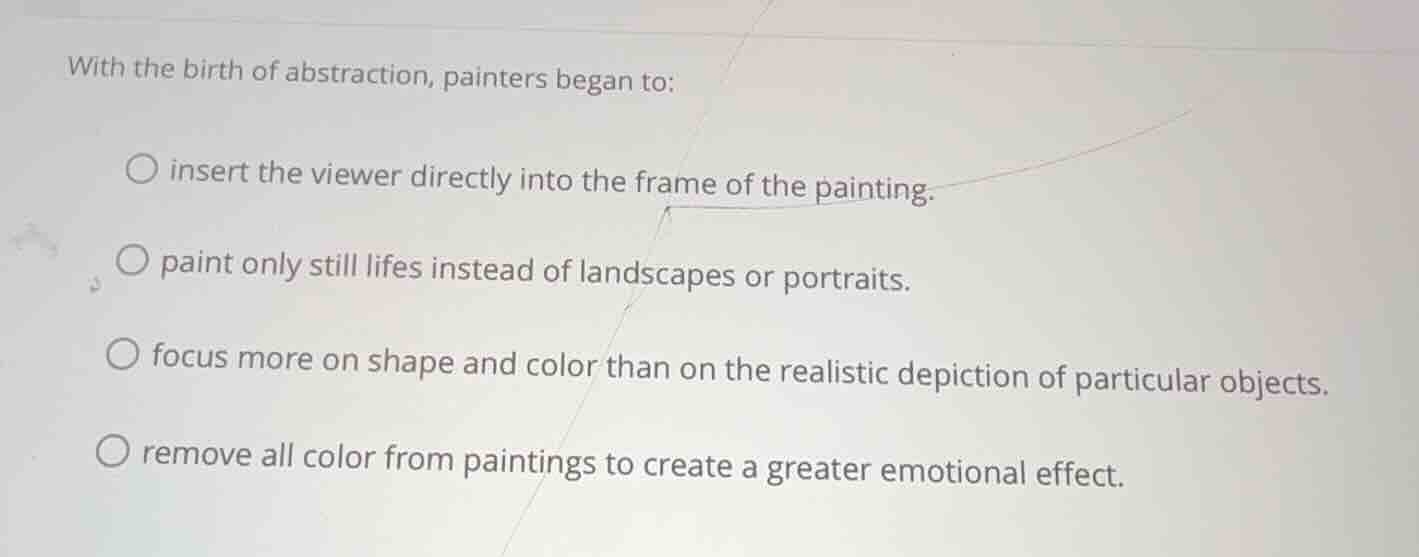
with the birth of abstraction, painters began to:
- insert the viewer directly into the frame of the painting.
- paint only still lifes instead of landscapes or portraits.
- focus more on shape and color than on the realistic depiction of particular objects.
- remove all color from paintings to create a greater emotional effect.
🆕 New Concept Discovered: Art History and Movements
Understanding how artistic styles evolve over time.
Step 1: Define abstraction in art
In art history, "abstraction" refers to a departure from representational accuracy. Instead of trying to paint a perfect, photographic replica of the real world (like a specific person, tree, or building), abstract artists use visual elements to convey feelings, ideas, or pure aesthetics.
Step 2: Identify the core elements of abstract art
Rather than focusing on realistic depictions, abstract painters prioritize the fundamental building blocks of visual art:
- Shape: Using geometric or organic forms.
- Color: Using color relationships to evoke emotion directly.
- Line and Texture: Emphasizing the physical qualities of the paint and canvas.
Step 3: Evaluate the given options
- Option 1: "insert the viewer directly into the frame of the painting." This is more related to perspective techniques or modern interactive installations, not the defining characteristic of early abstraction.
- Option 2: "paint only still lifes instead of landscapes or portraits." Abstract painters did not limit themselves to still lifes; in fact, they moved away from traditional subjects entirely.
- Option 3: "focus more on shape and color than on the realistic depiction of particular objects." This perfectly describes the transition from representational art to abstract art.
- Option 4: "remove all color from paintings to create a greater emotional effect." Abstract art is famous for its vibrant and expressive use of color, so they did not remove it.

Snap & solve any problem in the app
Get step-by-step solutions on Sovi AI
Photo-based solutions with guided steps
Explore more problems and detailed explanations
focus more on shape and color than on the realistic depiction of particular objects.