QUESTION IMAGE
Question
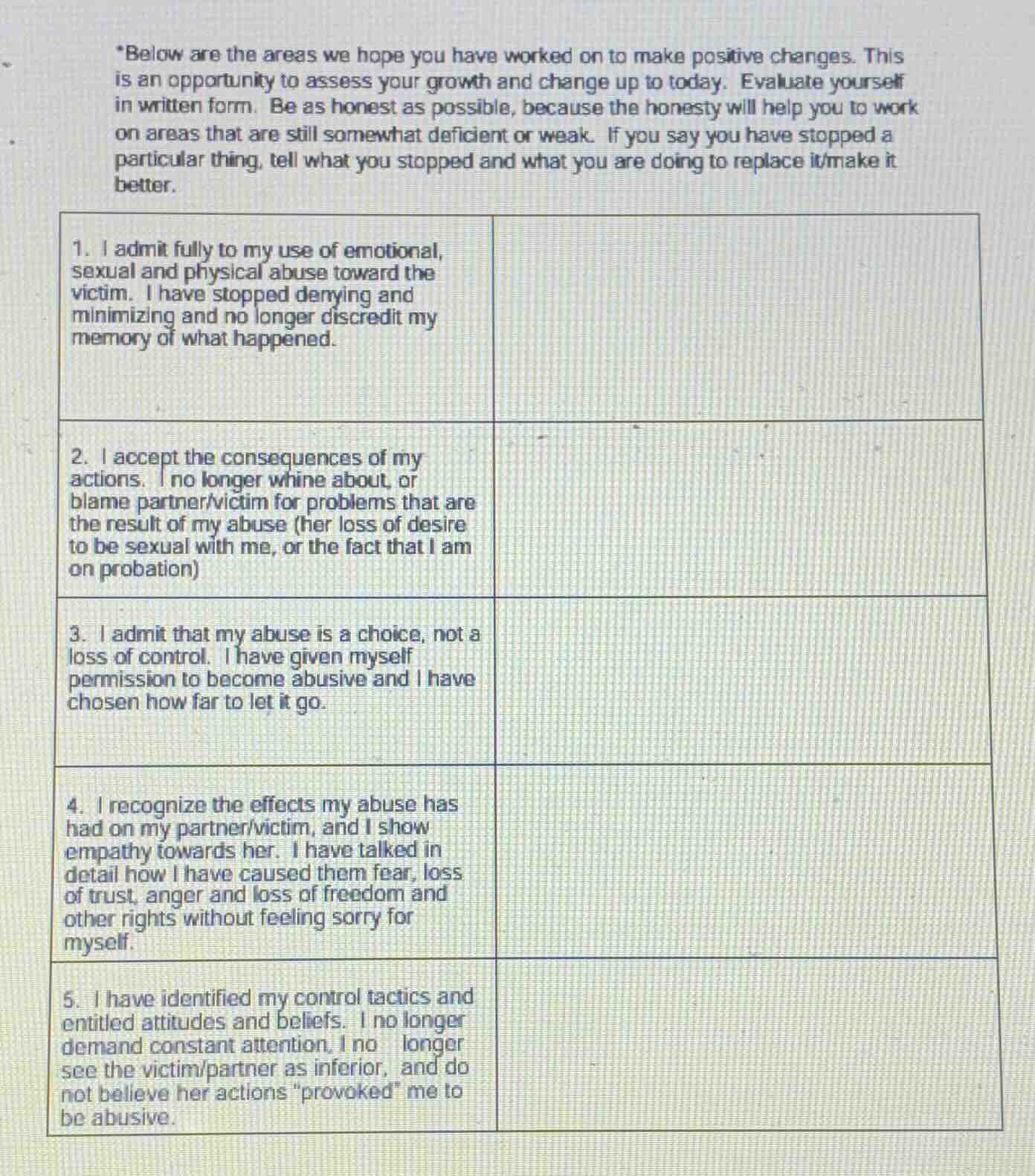
*below are the areas we hope you have worked on to make positive changes. this is an opportunity to assess your growth and change up to today. evaluate yourself in written form. be as honest as possible, because the honesty will help you to work on areas that are still somewhat deficient or weak. if you say you have stopped a particular thing, tell what you stopped and what you are doing to replace it/make it better.
- i admit fully to my use of emotional, sexual and physical abuse toward the victim. i have stopped denying and minimizing and no longer discredit my memory of what happened.
- i accept the consequences of my actions. i no longer whine about, or blame partner/victim for problems that are the result of my abuse (her loss of desire to be sexual with me, or the fact that i am on probation)
- i admit that my abuse is a choice, not a loss of control. i have given myself permission to become abusive and i have chosen how far to let it go.
- i recognize the effects my abuse has had on my partner/victim, and i show empathy towards her. i have talked in detail how i have caused them fear, loss of trust, anger and loss of freedom and other rights without feeling sorry for myself.
- i have identified my control tactics and entitled attitudes and beliefs. i no longer demand constant attention, i no longer see the victim/partner as inferior, and do not believe her actions \provoked\ me to be abusive.
Analyze the worksheet structure and prompt
The worksheet presents five statements related to taking personal responsibility, recognizing abusive behaviors, and understanding their impact. The instructions ask the user to evaluate themselves in written form on these areas, stating what they have stopped doing and what they are doing to replace or improve those behaviors.
Formulate concise self-evaluation responses
For each of the five numbered areas, a corresponding reflective response is generated to fill the blank right-hand column:
- Admitting abuse and stopping denial: Focus on complete honesty, acknowledging past actions without minimization, and validating the victim's memory.
- Accepting consequences without blaming: Focus on accepting legal and relational outcomes (like probation or loss of intimacy) without complaining or shifting blame.
- Recognizing abuse as a choice: Focus on dismantling the excuse of "losing control" and taking ownership of the conscious decisions made to act abusively.
- Recognizing effects and showing empathy: Focus on understanding the specific emotional and psychological damage caused to the partner (fear, broken trust) without self-pity.
- Identifying control tactics and entitled beliefs: Focus on identifying specific manipulation tactics, rejecting the belief of superiority, and stopping the justification of provocation.

Snap & solve any problem in the app
Get step-by-step solutions on Sovi AI
Photo-based solutions with guided steps
Explore more problems and detailed explanations
| No. | Answer |
|---|---|
| 2 | I accept my probation and relationship changes without complaining or blaming my partner. |
| 3 | I acknowledge that my anger is a choice, and I am learning to de-escalate before reacting. |
| 4 | I listen to my partner's pain and focus entirely on her healing rather than my own guilt. |
| 5 | I have stopped demanding constant attention and no longer view my partner as inferior. |