QUESTION IMAGE
Question
before you read
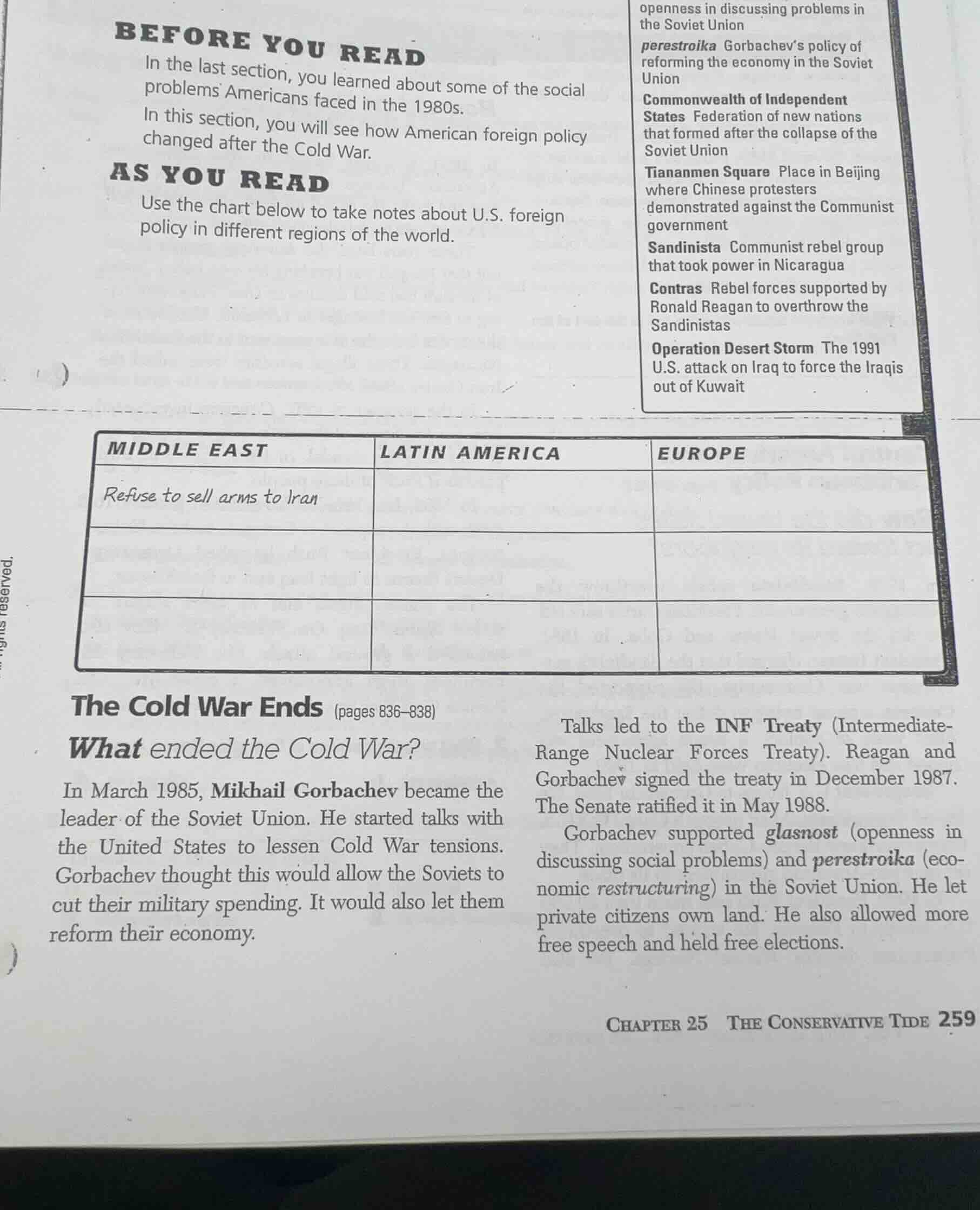
in the last section, you learned about some of the social problems americans faced in the 1980s.
in this section, you will see how american foreign policy changed after the cold war.
as you read
use the chart below to take notes about u.s. foreign policy in different regions of the world.
middle east | latin america | europe
refuse to sell arms to iran | |
the cold war ends (pages 836-838)
what ended the cold war?
in march 1985, mikhail gorbachev became the leader of the soviet union. he started talks with the united states to lessen cold war tensions. gorbachev thought this would allow the soviets to cut their military spending. it would also let them reform their economy.
talks led to the inf treaty (intermediate-range nuclear forces treaty). reagan and gorbachev signed the treaty in december 1987. the senate ratified it in may 1988.
gorbachev supported glasnost (openness in discussing social problems) and perestroika (economic restructuring) in the soviet union. he let private citizens own land. he also allowed more free speech and held free elections.
Identify the task
The student is asked to use the provided reading material and vocabulary definitions to complete a note-taking chart about U.S. foreign policy in different regions of the world during the late Cold War era (specifically the Middle East, Latin America, and Europe).
Analyze Middle East policy
Using the Iran-Contra Affair context and the pre-filled note "Refuse to sell arms to Iran", we can identify other key Middle East policies. The vocabulary list mentions "Operation Desert Storm: The 1991 U.S. attack on Iraq to force the Iraqis out of Kuwait."
Analyze Latin America policy
Using the U.S. Foreign Policy context, the vocabulary list defines:
- "Sandinista: Communist rebel group that took power in Nicaragua"
- "Contras: Rebel forces supported by Ronald Reagan to overthrow the Sandinistas"
Thus, U.S. policy in Latin America involved opposing the communist Sandinistas and supporting the Contras in Nicaragua.
Analyze Europe policy
Using the Cold War End, Gorbachev Reforms, and INF Treaty knowledge points:
- The text states that Reagan and Gorbachev signed the INF Treaty in December 1987 to lessen Cold War tensions.
- Gorbachev introduced reforms like glasnost and perestroika.
- U.S. policy in Europe focused on negotiating nuclear arms reductions (INF Treaty) and supporting democratic transitions as the Cold War ended.
Summarize chart entries
We will organize the notes clearly for each of the three columns: Middle East, Latin America, and Europe.

Snap & solve any problem in the app
Get step-by-step solutions on Sovi AI
Photo-based solutions with guided steps
Explore more problems and detailed explanations
Based on the provided text and vocabulary definitions, here are the completed notes for the U.S. foreign policy chart:
| MIDDLE EAST | LATIN AMERICA | EUROPE |
|---|