QUESTION IMAGE
Question
before you read
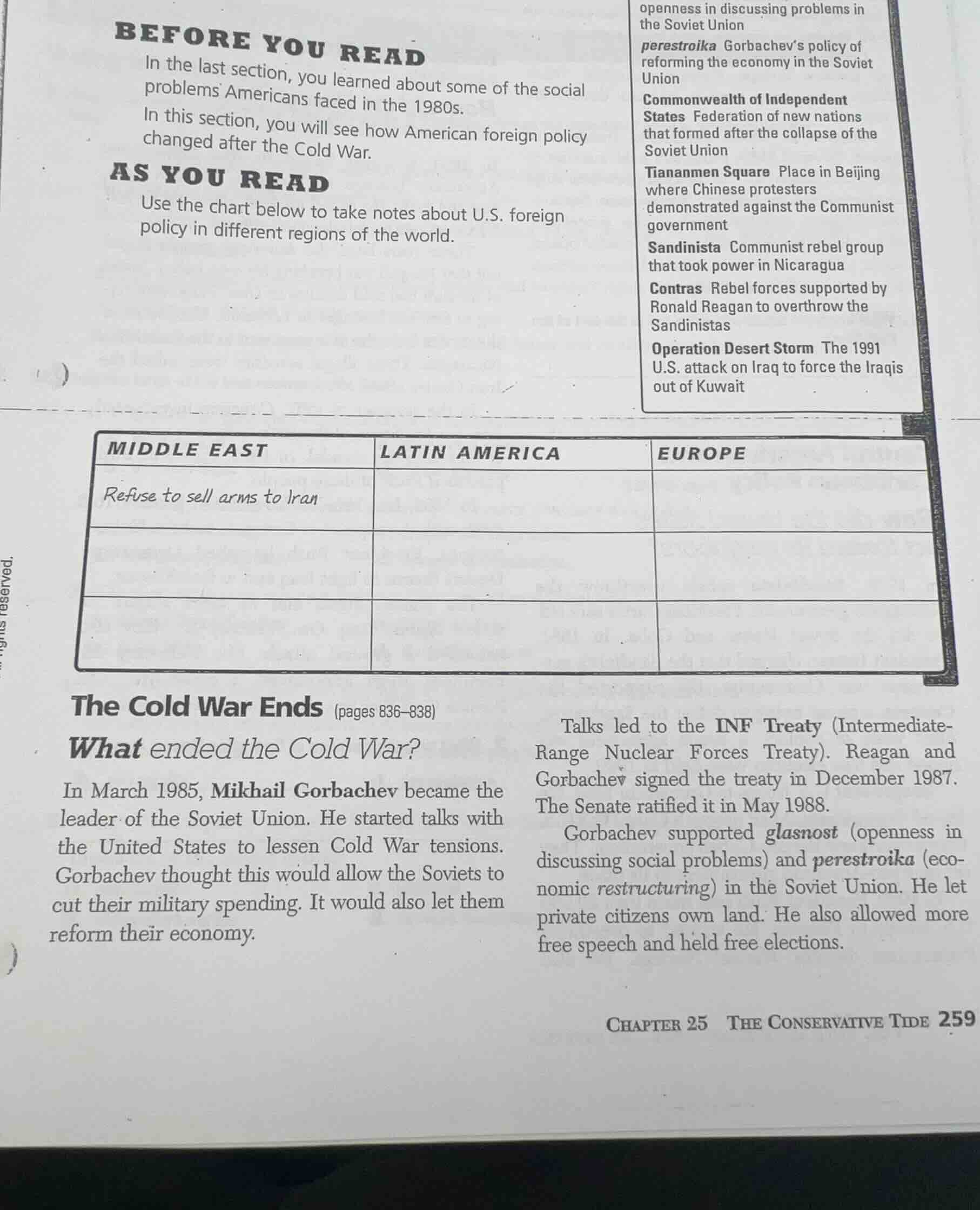
in the last section, you learned about some of the social problems americans faced in the 1980s.
in this section, you will see how american foreign policy changed after the cold war.
as you read
use the chart below to take notes about u.s. foreign policy in different regions of the world.
middle east | latin america | europe
refuse to sell arms to iran | |
the cold war ends (pages 836-838)
what ended the cold war?
in march 1985, mikhail gorbachev became the leader of the soviet union. he started talks with the united states to lessen cold war tensions. gorbachev thought this would allow the soviets to cut their military spending. it would also let them reform their economy.
talks led to the inf treaty (intermediate-range nuclear forces treaty). reagan and gorbachev signed the treaty in december 1987. the senate ratified it in may 1988.
gorbachev supported glasnost (openness in discussing social problems) and perestroika (economic restructuring) in the soviet union. he let private citizens own land. he also allowed more free speech and held free elections.
Identify the question prompt
The main question prompt is located under the heading "The Cold War Ends" on page 259: "What ended the Cold War?".
Analyze the provided text
The text explains that in March 1985, Mikhail Gorbachev became the leader of the Soviet Union and initiated talks with the United States to lessen Cold War tensions. This was done to cut military spending and reform the Soviet economy.
Identify key actions and treaties
The text highlights key developments:
- Gorbachev and Reagan signed the INF Treaty (Intermediate-Range Nuclear Forces Treaty) in December 1987.
- Gorbachev introduced Gorbachev Reforms including glasnost (openness in discussing social problems) and perestroika (economic restructuring).
- These reforms allowed private land ownership, more free speech, and free elections, which ultimately led to the easing of tensions and the Cold War End.
Synthesize the final answer
To answer "What ended the Cold War?" based on the provided text, we must focus on the initiatives taken by Mikhail Gorbachev, the signing of the INF Treaty, and the implementation of democratic and economic reforms (glasnost and perestroika) that reduced tensions between the superpowers.

Snap & solve any problem in the app
Get step-by-step solutions on Sovi AI
Photo-based solutions with guided steps
Explore more problems and detailed explanations
Based on the provided text, the Cold War ended due to a series of diplomatic efforts and internal reforms initiated in the mid-to-late 1980s:
- Gorbachev's Initiatives: Mikhail Gorbachev became the Soviet leader in 1985 and began talks with the United States to reduce Cold War tensions, aiming to cut military spending and reform the Soviet economy.
- The INF Treaty: In December 1987, President Ronald Reagan and Gorbachev signed the Intermediate-Range Nuclear Forces (INF) Treaty to eliminate a class of nuclear weapons, which was ratified by the U.S. Senate in May 1988.
- Internal Soviet Reforms: Gorbachev introduced glasnost (openness in discussing social problems) and perestroika (economic restructuring), which allowed private land ownership, increased free speech, and led to free elections, ultimately dismantling the rigid control of the Soviet state.