QUESTION IMAGE
Question
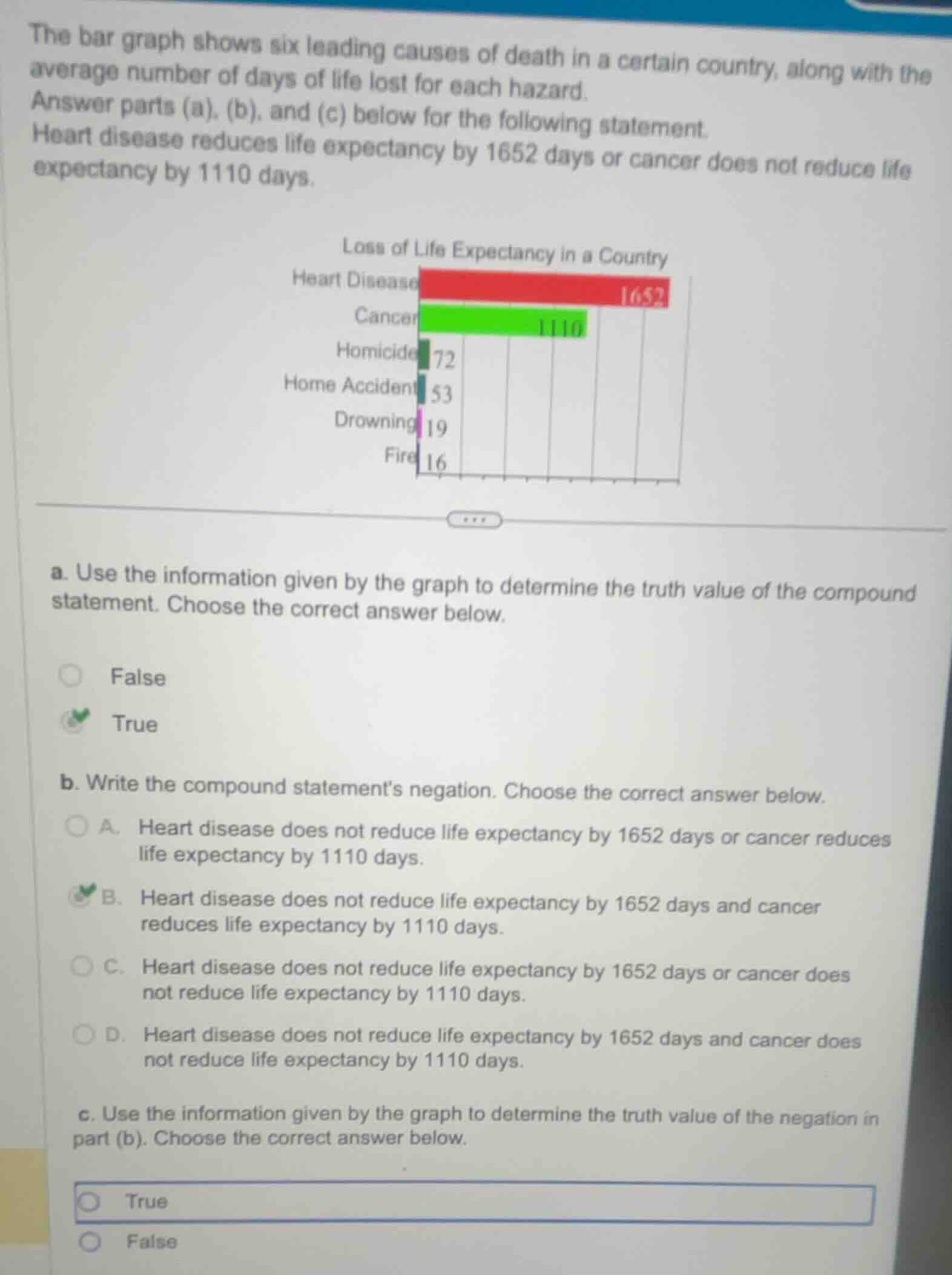
the bar graph shows six leading causes of death in a certain country, along with the average number of days of life lost for each hazard.
answer parts (a), (b), and (c) below for the following statement.
heart disease reduces life expectancy by 1652 days or cancer does not reduce life expectancy by 1110 days.
a. use the information given by the graph to determine the truth value of the compound statement. choose the correct answer below.
false
true
b. write the compound statements negation. choose the correct answer below.
a. heart disease does not reduce life expectancy by 1652 days or cancer reduces life expectancy by 1110 days.
b. heart disease does not reduce life expectancy by 1652 days and cancer reduces life expectancy by 1110 days.
c. heart disease does not reduce life expectancy by 1652 days or cancer does not reduce life expectancy by 1110 days.
d. heart disease does not reduce life expectancy by 1652 days and cancer does not reduce life expectancy by 1110 days.
c. use the information given by the graph to determine the truth value of the negation in part (b). choose the correct answer below.
true
false
Identify the component statements
Let the component statements be:
- \(p\): Heart disease reduces life expectancy by 1652 days.
- \(q\): Cancer reduces life expectancy by 1110 days.
The given compound statement is: "Heart disease reduces life expectancy by 1652 days or cancer does not reduce life expectancy by 1110 days."
In symbolic form, this is \(p \lor
eg q\).
Determine truth values of components
From the bar graph:
- Heart Disease value is 1652. Thus, \(p\) is True (\(\text{T}\)).
- Cancer value is 1110. Thus, \(q\) is True (\(\text{T}\)), which means \(
eg q\) is False (\(\text{F}\)).
Evaluate the compound statement
The compound statement is \(p \lor
eg q\).
Substituting the truth values:
Therefore, the truth value of the compound statement in part (a) is True.
Formulate the negation
The negation of the compound statement \(p \lor
eg q\) is:
Translating \(
eg p \land q\) back into words:
"Heart disease does not reduce life expectancy by 1652 days and cancer reduces life expectancy by 1110 days."
This matches option B.
Evaluate the negation's truth value
Since the original statement \(p \lor
eg q\) is True, its negation \(
eg(p \lor
eg q)\) must be False.
Alternatively, evaluating \(
eg p \land q\):
- \(
eg p\) is False.
- \(q\) is True.
- \(\text{F} \land \text{T} \equiv \text{F}\).
Therefore, the truth value of the negation in part (c) is False.

Snap & solve any problem in the app
Get step-by-step solutions on Sovi AI
Photo-based solutions with guided steps
Explore more problems and detailed explanations
Question a
- False
- True (Correct answer)
Question b
- A. Heart disease does not reduce life expectancy by 1652 days or cancer reduces life expectancy by 1110 days.
- B. Heart disease does not reduce life expectancy by 1652 days and cancer reduces life expectancy by 1110 days. (Correct answer)
- C. Heart disease does not reduce life expectancy by 1652 days or cancer does not reduce life expectancy by 1110 days.
- D. Heart disease does not reduce life expectancy by 1652 days and cancer does not reduce life expectancy by 1110 days.
Question c
- True
- False (Correct answer)