Sovi.AI - AI Math Tutor

Scan to solve math questions

QUESTION IMAGE

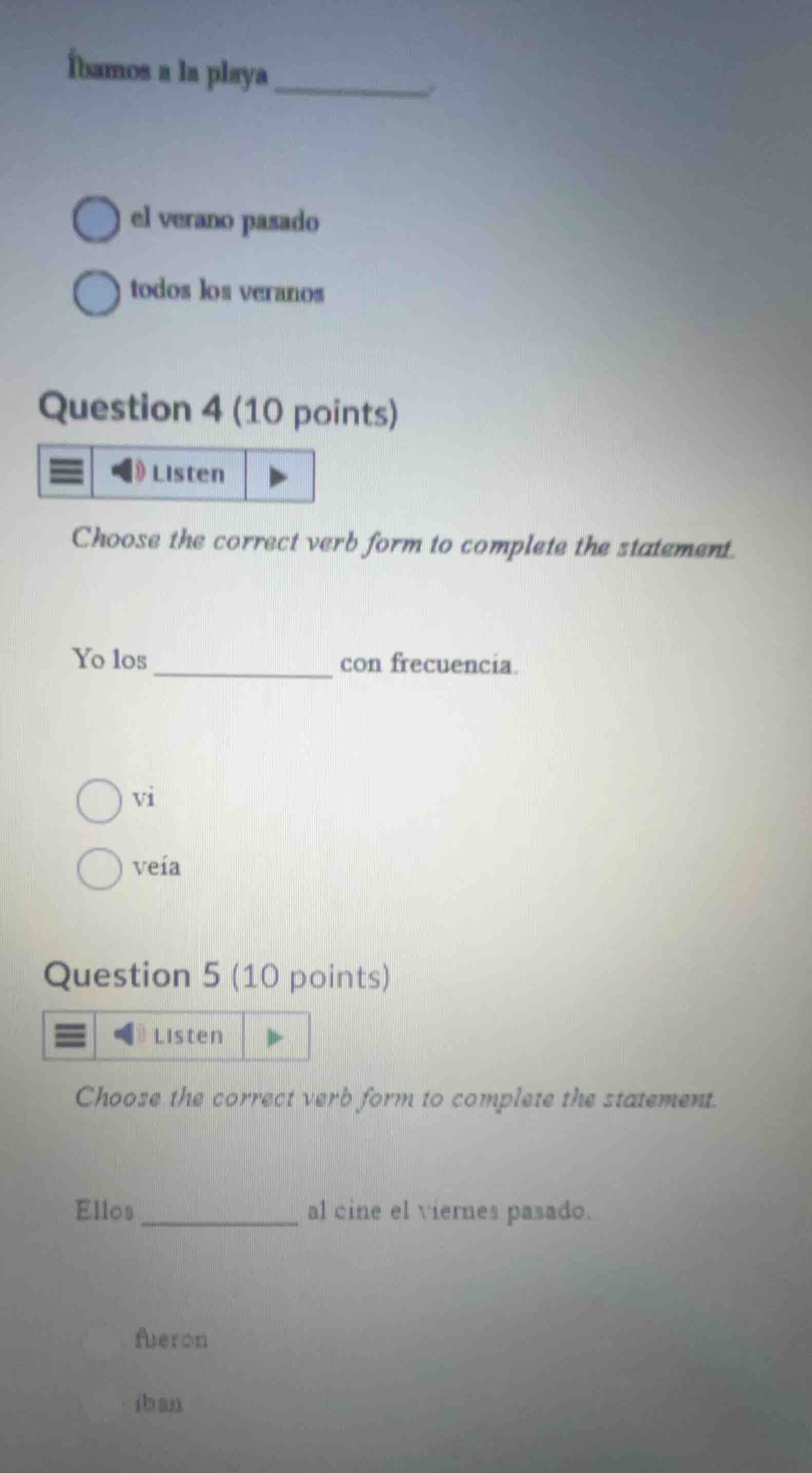
íbamos a la playa _______ el verano pasado todos los veranos question 4…

Question

íbamos a la playa _______

el verano pasado
todos los veranos

question 4 (10 points)
choose the correct verb form to complete the statement.

yo los _______ con frecuencia.

vi
veía

question 5 (10 points)
choose the correct verb form to complete the statement.

ellos _______ al cine el viernes pasado.

fueron
íban

Explanation:

Response

<pre_analysis>
{
"quality": "clear",
"question_count": 3,
"skills_matched": [
"direct_cot",
"multiple_choice_formatter",
"explain_then_answer",
"quick"
],
"needs_drawing": false,
"concepts_used": [
"Spanish Preterite vs Imperfect"
],
"new_concepts": [],
"current_concepts": [
"Spanish Preterite vs Imperfect",
"Spanish Verb Conjugation"
]
}
</pre_analysis>

<reasoning>

Analyze the first question

The sentence is "Íbamos a la playa ________".

  • "Íbamos" is the imperfect tense of "ir" (we used to go / we were going), which indicates a habitual or ongoing action in the past.
  • "el verano pasado" (last summer) is a specific, completed time frame associated with the preterite.
  • "todos los veranos" (every summer) indicates a habitual, repeated action in the past, which triggers the imperfect tense.
  • Therefore, "todos los veranos" is the correct choice.

Analyze Question 4

The sentence is "Yo los ________ con frecuencia."

  • "con frecuencia" (frequently) indicates a habitual or repeated action in the past, which triggers the imperfect tense.
  • "vi" is the preterite form of "ver" (I saw).
  • "veía" is the imperfect form of "ver" (I used to see / I saw habitually).
  • Therefore, "veía" is the correct choice.

Analyze Question 5

The sentence is "Ellos ________ al cine el viernes pasado."

  • "el viernes pasado" (last Friday) is a specific, completed time frame in the past, which triggers the preterite tense.
  • "fueron" is the preterite form of "ir" (they went).
  • "iban" is the imperfect form of "ir" (they used to go).
  • Therefore, "fueron" is the correct choice.

</reasoning>

<answer>

Question 1

<mcq-option>(A) el verano pasado</mcq-option>
<mcq-correct>(B) todos los veranos</mcq-correct>

Question 4

<mcq-option>(A) vi</mcq-option>
<mcq-correct>(B) veía</mcq-correct>

Question 5

<mcq-correct>(A) fueron</mcq-correct>
<mcq-option>(B) iban</mcq-option>
</answer>

<post_analysis>
{
"subject": "Others",
"question_type": "Multiple Choice",
"knowledge_point": [
"Others",
"Spanish",
"Spanish Preterite vs Imperfect"
]
}
</post_analysis>

Answer:

<pre_analysis>
{
"quality": "clear",
"question_count": 3,
"skills_matched": [
"direct_cot",
"multiple_choice_formatter",
"explain_then_answer",
"quick"
],
"needs_drawing": false,
"concepts_used": [
"Spanish Preterite vs Imperfect"
],
"new_concepts": [],
"current_concepts": [
"Spanish Preterite vs Imperfect",
"Spanish Verb Conjugation"
]
}
</pre_analysis>

<reasoning>

Analyze the first question

The sentence is "Íbamos a la playa ________".

  • "Íbamos" is the imperfect tense of "ir" (we used to go / we were going), which indicates a habitual or ongoing action in the past.
  • "el verano pasado" (last summer) is a specific, completed time frame associated with the preterite.
  • "todos los veranos" (every summer) indicates a habitual, repeated action in the past, which triggers the imperfect tense.
  • Therefore, "todos los veranos" is the correct choice.

Analyze Question 4

The sentence is "Yo los ________ con frecuencia."

  • "con frecuencia" (frequently) indicates a habitual or repeated action in the past, which triggers the imperfect tense.
  • "vi" is the preterite form of "ver" (I saw).
  • "veía" is the imperfect form of "ver" (I used to see / I saw habitually).
  • Therefore, "veía" is the correct choice.

Analyze Question 5

The sentence is "Ellos ________ al cine el viernes pasado."

  • "el viernes pasado" (last Friday) is a specific, completed time frame in the past, which triggers the preterite tense.
  • "fueron" is the preterite form of "ir" (they went).
  • "iban" is the imperfect form of "ir" (they used to go).
  • Therefore, "fueron" is the correct choice.

</reasoning>

<answer>

Question 1

<mcq-option>(A) el verano pasado</mcq-option>
<mcq-correct>(B) todos los veranos</mcq-correct>

Question 4

<mcq-option>(A) vi</mcq-option>
<mcq-correct>(B) veía</mcq-correct>

Question 5

<mcq-correct>(A) fueron</mcq-correct>
<mcq-option>(B) iban</mcq-option>
</answer>

<post_analysis>
{
"subject": "Others",
"question_type": "Multiple Choice",
"knowledge_point": [
"Others",
"Spanish",
"Spanish Preterite vs Imperfect"
]
}
</post_analysis>