QUESTION IMAGE
Question
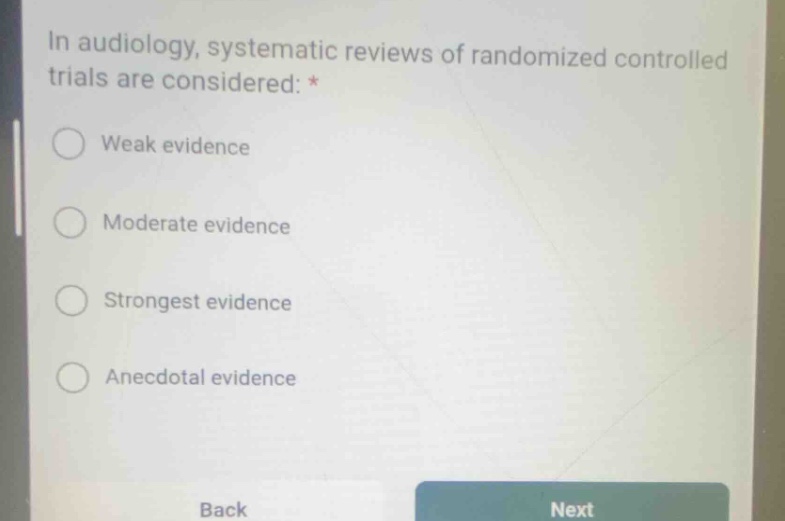
in audiology, systematic reviews of randomized controlled trials are considered: *
weak evidence
moderate evidence
strongest evidence
anecdotal evidence
<pre_analysis>
{
"quality": "clear",
"question_count": 1,
"skills_matched": [
"direct_cot",
"multiple_choice_formatter",
"explain_then_answer",
"tutor"
],
"needs_drawing": false,
"concepts_used": [],
"new_concepts": [
"Evidence-Based Practice",
"Levels of Evidence",
"Systematic Reviews"
],
"current_concepts": [
"Evidence-Based Practice",
"Levels of Evidence",
"Systematic Reviews"
]
}
</pre_analysis>
<reasoning>
Define evidence hierarchy
In clinical research and evidence-based practice, study designs are categorized hierarchically based on their susceptibility to bias and overall scientific validity.
Analyze systematic reviews
A systematic review of randomized controlled trials (RCTs) synthesizes the findings of multiple high-quality studies. This comprehensive synthesis minimizes bias and provides the most robust clinical conclusions.
Determine evidence level
Because they aggregate and critically appraise multiple randomized controlled trials, systematic reviews sit at the very top of the hierarchy of evidence, representing the highest level of clinical certainty.
Match with options
Comparing this hierarchy to the choices, "Strongest evidence" directly corresponds to the top-tier status of systematic reviews of RCTs.
</reasoning>
<answer>
<mcq-option>Weak evidence</mcq-option>
<mcq-option>Moderate evidence</mcq-option>
<mcq-correct>Strongest evidence</mcq-correct>
<mcq-option>Anecdotal evidence</mcq-option>
</answer>
<post_analysis>
{
"subject": "Natural Science",
"question_type": "Multiple Choice",
"knowledge_point": [
"Natural Science",
"Medicine and Health",
"Evidence-Based Practice"
]
}
</post_analysis>
Snap & solve any problem in the app
Get step-by-step solutions on Sovi AI
Photo-based solutions with guided steps
Explore more problems and detailed explanations
<pre_analysis>
{
"quality": "clear",
"question_count": 1,
"skills_matched": [
"direct_cot",
"multiple_choice_formatter",
"explain_then_answer",
"tutor"
],
"needs_drawing": false,
"concepts_used": [],
"new_concepts": [
"Evidence-Based Practice",
"Levels of Evidence",
"Systematic Reviews"
],
"current_concepts": [
"Evidence-Based Practice",
"Levels of Evidence",
"Systematic Reviews"
]
}
</pre_analysis>
<reasoning>
Define evidence hierarchy
In clinical research and evidence-based practice, study designs are categorized hierarchically based on their susceptibility to bias and overall scientific validity.
Analyze systematic reviews
A systematic review of randomized controlled trials (RCTs) synthesizes the findings of multiple high-quality studies. This comprehensive synthesis minimizes bias and provides the most robust clinical conclusions.
Determine evidence level
Because they aggregate and critically appraise multiple randomized controlled trials, systematic reviews sit at the very top of the hierarchy of evidence, representing the highest level of clinical certainty.
Match with options
Comparing this hierarchy to the choices, "Strongest evidence" directly corresponds to the top-tier status of systematic reviews of RCTs.
</reasoning>
<answer>
<mcq-option>Weak evidence</mcq-option>
<mcq-option>Moderate evidence</mcq-option>
<mcq-correct>Strongest evidence</mcq-correct>
<mcq-option>Anecdotal evidence</mcq-option>
</answer>
<post_analysis>
{
"subject": "Natural Science",
"question_type": "Multiple Choice",
"knowledge_point": [
"Natural Science",
"Medicine and Health",
"Evidence-Based Practice"
]
}
</post_analysis>