QUESTION IMAGE
Question
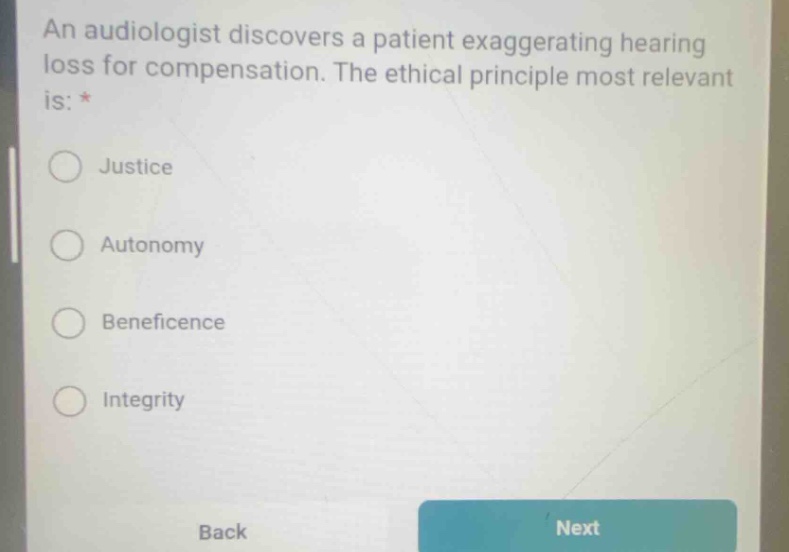
an audiologist discovers a patient exaggerating hearing loss for compensation. the ethical principle most relevant is: *
justice
autonomy
beneficence
integrity
<pre_analysis>
{
"quality": "clear",
"question_count": 1,
"skills_matched": [
"direct_cot",
"multiple_choice_formatter",
"explain_then_answer",
"tutor"
],
"needs_drawing": false,
"concepts_used": [
"Functional Hearing Loss"
],
"new_concepts": [
"Professional Ethics",
"Audiology Code of Ethics"
],
"current_concepts": [
"Functional Hearing Loss",
"Professional Ethics",
"Audiology Code of Ethics"
]
}
</pre_analysis>
<reasoning>
Analyze the clinical scenario
The scenario describes an audiologist who discovers a patient exaggerating their hearing loss (often referred to as Functional Hearing Loss, pseudohypacusis, or malingering) specifically to obtain financial or other forms of compensation.
Evaluate the ethical principles
- Justice: This principle relates to fairness, equity, and the distribution of resources. While obtaining unmerited compensation affects societal resources, it is not the primary professional ethical principle governing the clinician's direct conduct regarding truthfulness and honest reporting.
- Autonomy: This principle refers to the patient's right to self-determination and making their own healthcare decisions. It does not license dishonesty or falsifying clinical records.
- Beneficence: This principle involves acting in the best interest of the patient's health and well-being.
- Integrity: This principle requires honesty, truthfulness, and adherence to professional standards. For a clinician, discovering exaggeration for compensation directly challenges professional integrity. The clinician must maintain objective, honest, and accurate documentation and reporting, refusing to participate in or validate fraudulent claims.
Determine the most relevant principle
In professional codes of ethics (such as those from ASHA or AAA), maintaining utmost honesty, objective reporting, and avoiding representation of false claims falls directly under the core value of Integrity.
</reasoning>
<answer>
<mcq-option>Justice</mcq-option>
<mcq-option>Autonomy</mcq-option>
<mcq-option>Beneficence</mcq-option>
<mcq-correct>Integrity</mcq-correct>
</answer>
<post_analysis>
{
"subject": "Natural Science",
"question_type": "Multiple Choice",
"knowledge_point": [
"Natural Science",
"Others",
"Professional Ethics"
]
}
</post_analysis>
Snap & solve any problem in the app
Get step-by-step solutions on Sovi AI
Photo-based solutions with guided steps
Explore more problems and detailed explanations
<pre_analysis>
{
"quality": "clear",
"question_count": 1,
"skills_matched": [
"direct_cot",
"multiple_choice_formatter",
"explain_then_answer",
"tutor"
],
"needs_drawing": false,
"concepts_used": [
"Functional Hearing Loss"
],
"new_concepts": [
"Professional Ethics",
"Audiology Code of Ethics"
],
"current_concepts": [
"Functional Hearing Loss",
"Professional Ethics",
"Audiology Code of Ethics"
]
}
</pre_analysis>
<reasoning>
Analyze the clinical scenario
The scenario describes an audiologist who discovers a patient exaggerating their hearing loss (often referred to as Functional Hearing Loss, pseudohypacusis, or malingering) specifically to obtain financial or other forms of compensation.
Evaluate the ethical principles
- Justice: This principle relates to fairness, equity, and the distribution of resources. While obtaining unmerited compensation affects societal resources, it is not the primary professional ethical principle governing the clinician's direct conduct regarding truthfulness and honest reporting.
- Autonomy: This principle refers to the patient's right to self-determination and making their own healthcare decisions. It does not license dishonesty or falsifying clinical records.
- Beneficence: This principle involves acting in the best interest of the patient's health and well-being.
- Integrity: This principle requires honesty, truthfulness, and adherence to professional standards. For a clinician, discovering exaggeration for compensation directly challenges professional integrity. The clinician must maintain objective, honest, and accurate documentation and reporting, refusing to participate in or validate fraudulent claims.
Determine the most relevant principle
In professional codes of ethics (such as those from ASHA or AAA), maintaining utmost honesty, objective reporting, and avoiding representation of false claims falls directly under the core value of Integrity.
</reasoning>
<answer>
<mcq-option>Justice</mcq-option>
<mcq-option>Autonomy</mcq-option>
<mcq-option>Beneficence</mcq-option>
<mcq-correct>Integrity</mcq-correct>
</answer>
<post_analysis>
{
"subject": "Natural Science",
"question_type": "Multiple Choice",
"knowledge_point": [
"Natural Science",
"Others",
"Professional Ethics"
]
}
</post_analysis>