QUESTION IMAGE
Question
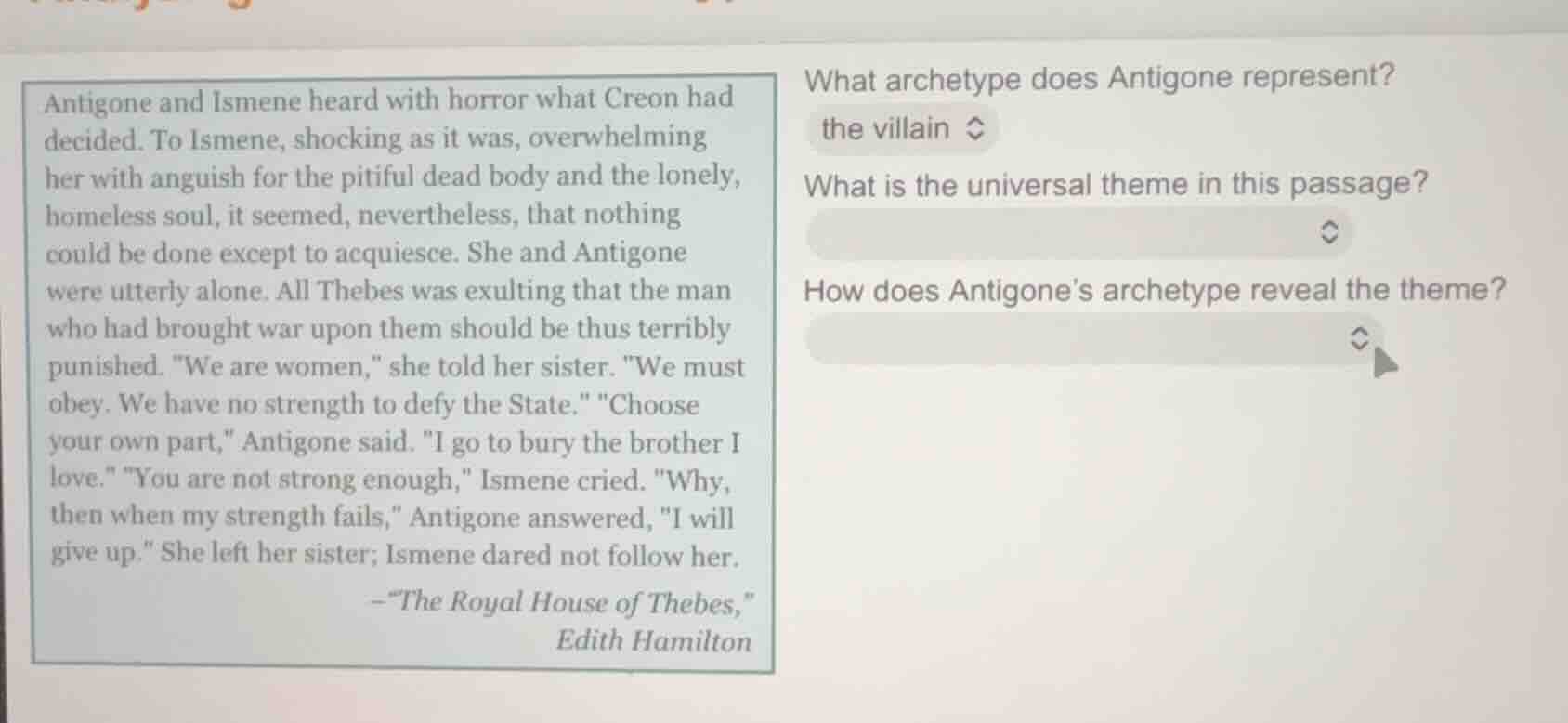
antigone and ismene heard with horror what creon had decided. to ismene, shocking as it was, overwhelming her with anguish for the pitiful dead body and the lonely, homeless soul, it seemed, nevertheless, that nothing could be done except to acquiesce. she and antigone were utterly alone. all thebes was exulting that the man who had brought war upon them should be thus terribly punished. \we are women,\ she told her sister. \we must obey. we have no strength to defy the state.\ \choose your own part,\ antigone said. \i go to bury the brother i love.\ \you are not strong enough,\ ismene cried. \why, then when my strength fails,\ antigone answered, \i will give up.\ she left her sister; ismene dared not follow her.
-\the royal house of thebes,\
edith hamilton
what archetype does antigone represent?
what is the universal theme in this passage?
how does antigones archetype reveal the theme?
Identify Antigone's archetype
Using the Tragic Hero Archetype knowledge point
Antigone represents the tragic hero. She possesses noble intentions, stands up for her moral beliefs against state authority, and is willing to face death or ruin to do what she believes is right.
Determine the universal theme
Using the Archetypal Theme Analysis knowledge point
The passage contrasts Ismene's submission to state law ("We have no strength to defy the State") with Antigone's determination to follow a higher moral law ("I go to bury the brother I love"). This establishes the universal theme: individual conscience and moral duty are more powerful than civil law.
Explain how the archetype reveals the theme
Using the Character Archetype Function knowledge point
As a tragic hero, Antigone's decision to defy Creon's decree to bury her brother, despite knowing the fatal consequences, demonstrates that personal moral conviction and familial duty outweigh the laws of the state.

Snap & solve any problem in the app
Get step-by-step solutions on Sovi AI
Photo-based solutions with guided steps
Explore more problems and detailed explanations
Question 1
the tragic hero
Question 2
Individual conscience is more powerful than civil law.
Question 3
Antigone's decision to defy the state's decree to bury her brother shows that moral duty is more important than civil law.