QUESTION IMAGE
Question
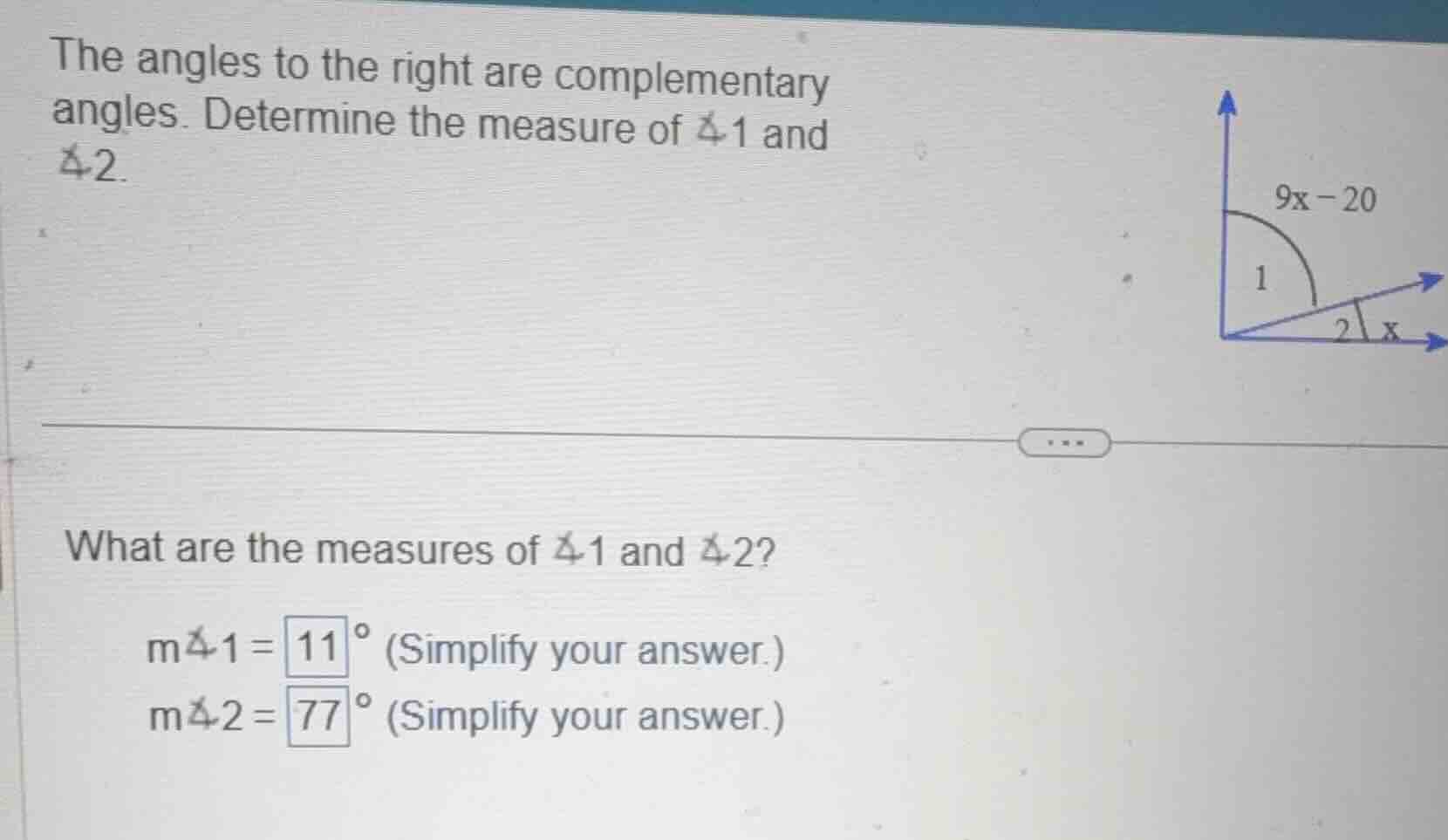
the angles to the right are complementary angles. determine the measure of \\(\measuredangle 1\\) and \\(\measuredangle 2\\).
what are the measures of \\(\measuredangle 1\\) and \\(\measuredangle 2\\)?
\\(m\measuredangle 1 = \boxed{\phantom{x}}^{\circ}\\) (simplify your answer.)
\\(m\measuredangle 2 = \boxed{\phantom{x}}^{\circ}\\) (simplify your answer.)
<pre_analysis>
{
"quality": "clear",
"question_count": 1,
"skills_matched": [
"step_cot",
"blank_filling_formatter",
"explain_then_answer",
"tutor"
],
"needs_drawing": false,
"concepts_used": [
"Complementary Angles"
],
"new_concepts": [],
"current_concepts": [
"Complementary Angles",
"Linear Equations"
]
}
</pre_analysis>
<reasoning>
Set up the angle relationship
Using the Complementary Angles knowledge point, we know that two angles are complementary if the sum of their measures is exactly \(90^\circ\). From the given diagram, the measures of the two adjacent angles are:
\[m\angle 1 = 9x - 20\]
\[m\angle 2 = x\]
Since they are complementary, we write the equation:
\[(9x - 20) + x = 90\]
Solve for x
We combine the like terms and solve the linear equation:
\[10x - 20 = 90\]
\[10x = 110\]
\[x = 11\]
Calculate the measure of angle 1
We substitute \(x = 11\) back into the expression for \(m\angle 1\):
\[m\angle 1 = 9(11) - 20\]
\[m\angle 1 = 99 - 20 = 79^\circ\]
Calculate the measure of angle 2
We substitute \(x = 11\) back into the expression for \(m\angle 2\):
\[m\angle 2 = x = 11^\circ\]
</reasoning>
<answer>
What are the measures of \(\angle 1\) and \(\angle 2\)?
\(m\angle 1 =\) <blank>\(79\)</blank>\(^\circ\) (Simplify your answer.)
\(m\angle 2 =\) <blank>\(11\)</blank>\(^\circ\) (Simplify your answer.)
</answer>
<post_analysis>
{
"subject": "Mathematics",
"question_type": "Fill-in-the-blank",
"knowledge_point": [
"Mathematics",
"Geometry",
"Complementary Angles"
]
}
</post_analysis>
Snap & solve any problem in the app
Get step-by-step solutions on Sovi AI
Photo-based solutions with guided steps
Explore more problems and detailed explanations
<pre_analysis>
{
"quality": "clear",
"question_count": 1,
"skills_matched": [
"step_cot",
"blank_filling_formatter",
"explain_then_answer",
"tutor"
],
"needs_drawing": false,
"concepts_used": [
"Complementary Angles"
],
"new_concepts": [],
"current_concepts": [
"Complementary Angles",
"Linear Equations"
]
}
</pre_analysis>
<reasoning>
Set up the angle relationship
Using the Complementary Angles knowledge point, we know that two angles are complementary if the sum of their measures is exactly \(90^\circ\). From the given diagram, the measures of the two adjacent angles are:
\[m\angle 1 = 9x - 20\]
\[m\angle 2 = x\]
Since they are complementary, we write the equation:
\[(9x - 20) + x = 90\]
Solve for x
We combine the like terms and solve the linear equation:
\[10x - 20 = 90\]
\[10x = 110\]
\[x = 11\]
Calculate the measure of angle 1
We substitute \(x = 11\) back into the expression for \(m\angle 1\):
\[m\angle 1 = 9(11) - 20\]
\[m\angle 1 = 99 - 20 = 79^\circ\]
Calculate the measure of angle 2
We substitute \(x = 11\) back into the expression for \(m\angle 2\):
\[m\angle 2 = x = 11^\circ\]
</reasoning>
<answer>
What are the measures of \(\angle 1\) and \(\angle 2\)?
\(m\angle 1 =\) <blank>\(79\)</blank>\(^\circ\) (Simplify your answer.)
\(m\angle 2 =\) <blank>\(11\)</blank>\(^\circ\) (Simplify your answer.)
</answer>
<post_analysis>
{
"subject": "Mathematics",
"question_type": "Fill-in-the-blank",
"knowledge_point": [
"Mathematics",
"Geometry",
"Complementary Angles"
]
}
</post_analysis>