QUESTION IMAGE
Question
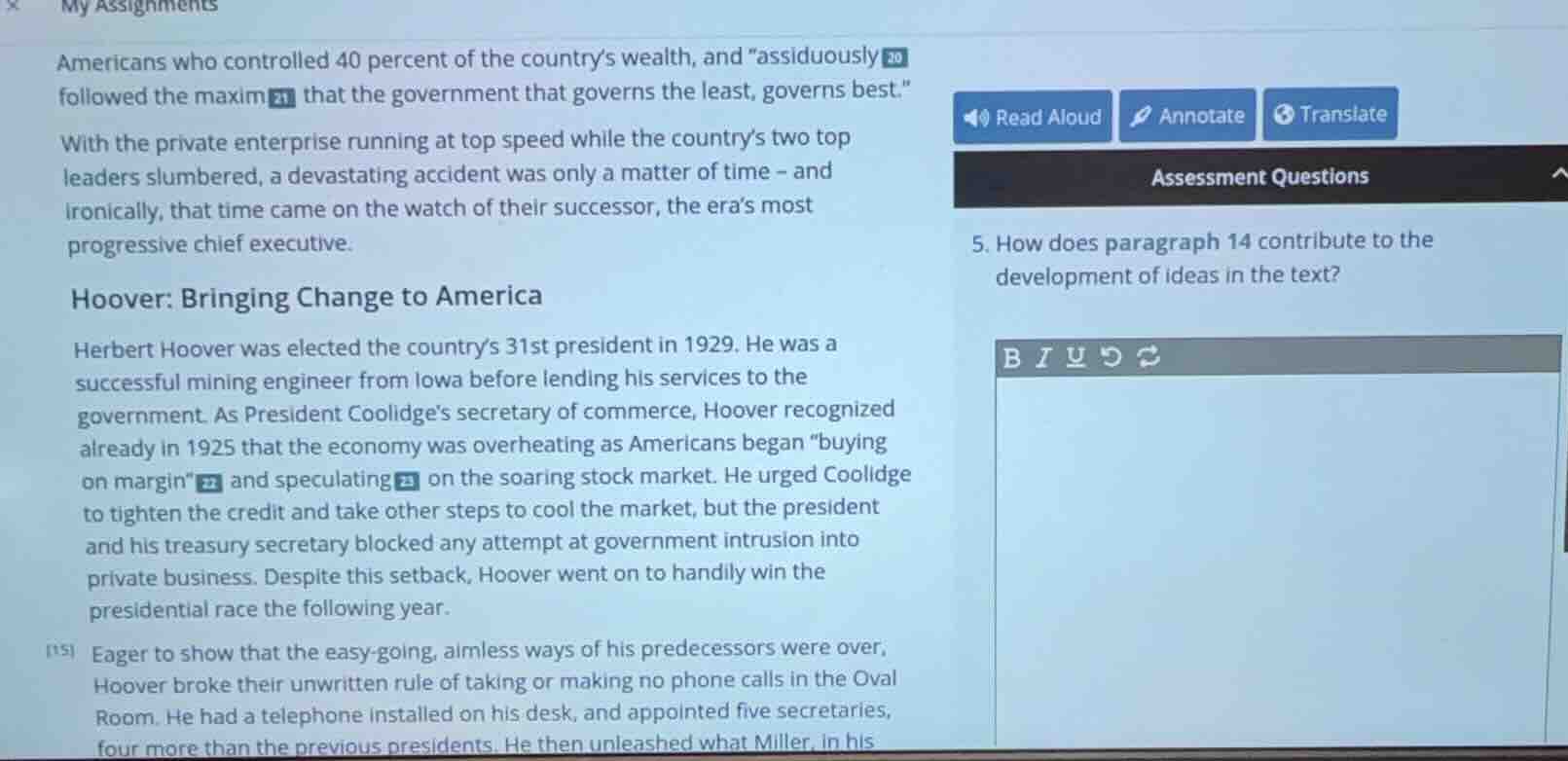
americans who controlled 40 percent of the country’s wealth, and “assiduously followed the maxim that the government that governs the least, governs best.” with the private enterprise running at top speed while the country’s two top leaders slumbered, a devastating accident was only a matter of time – and ironically, that time came on the watch of their successor, the era’s most progressive chief executive. hoover: bringing change to america herbert hoover was elected the country’s 31st president in 1929. he was a successful mining engineer from iowa before lending his services to the government. as president coolidge’s secretary of commerce, hoover recognized already in 1925 that the economy was overheating as americans began “buying on margin and speculating on the soaring stock market. he urged coolidge to tighten the credit and take other steps to cool the market, but the president and his treasury secretary blocked any attempt at government intrusion into private business. despite this setback, hoover went on to handily win the presidential race the following year. eager to show that the easy - going, aimless ways of his predecessors were over, hoover broke their unwritten rule of taking or making no phone calls in the oval room. he had a telephone installed on his desk, and appointed five secretaries, four more than the previous presidents. he then unleashed what miller, in his assessment questions 5. how does paragraph 14 contribute to the development of ideas in the text?
To answer how paragraph 14 (though the visible text has "Hoover: Bringing Change to America" section and later parts) contributes to the text's ideas, we analyze:
Step 1: Identify Key Content in the Section
The "Hoover: Bringing Change to America" section introduces Hoover’s background (mining engineer, Commerce Secretary), his 1925 warning about economic overheating (speculation, buying on margin), and his 1929 election. It establishes Hoover’s role as a leader who recognized economic risks before his presidency.
Step 2: Connect to Broader Text Ideas
If the text is about the lead - up to an economic crisis (e.g., the Great Depression) and presidential leadership, this section:
- Develops Hoover’s Character: Shows him as proactive (urged Coolidge to act) vs. predecessors (who “slumbered,” per earlier text).
- Sets Up Conflict/Context: Highlights the tension between Hoover’s warnings and the government’s hands - off approach to business, foreshadowing challenges (like the crisis) he would face as president.
- Structural Role: Bridges his pre - presidential actions to his presidency, showing continuity in his concern for the economy and contrasting with prior leadership.
To fully answer, we’d need the exact text of paragraph 14. But based on the visible content, this section builds Hoover’s leadership narrative, contrasts him with predecessors, and establishes economic - policy context for his presidency (and likely the crisis to come).
If we assume paragraph 14 is the “Hoover: Bringing Change…” section:
The "Hoover: Bringing Change to America" section (presumed as paragraph 14) introduces Hoover’s background, his 1925 warning about economic overheating, and his 1929 election. It develops his proactive leadership (contrasting with predecessors’ inaction), sets up the economic - policy tension (government vs. private business), and bridges his pre - presidential actions to his presidency, contextualizing his role in the lead - up to the economic crisis (e.g., Great Depression) and his governance approach.

Snap & solve any problem in the app
Get step-by-step solutions on Sovi AI
Photo-based solutions with guided steps
Explore more problems and detailed explanations
The "Hoover: Bringing Change to America" section (paragraph 14, as inferred) contributes by developing Hoover’s proactive leadership (contrasting with predecessors’ inaction), establishing economic - policy tension (government vs. private business), and bridging his pre - presidential warnings to his presidency, contextualizing his role in the lead - up to the economic crisis and governance challenges. (Final answer depends on the exact paragraph 14 text, but this is the analysis based on visible content.)