QUESTION IMAGE
Question
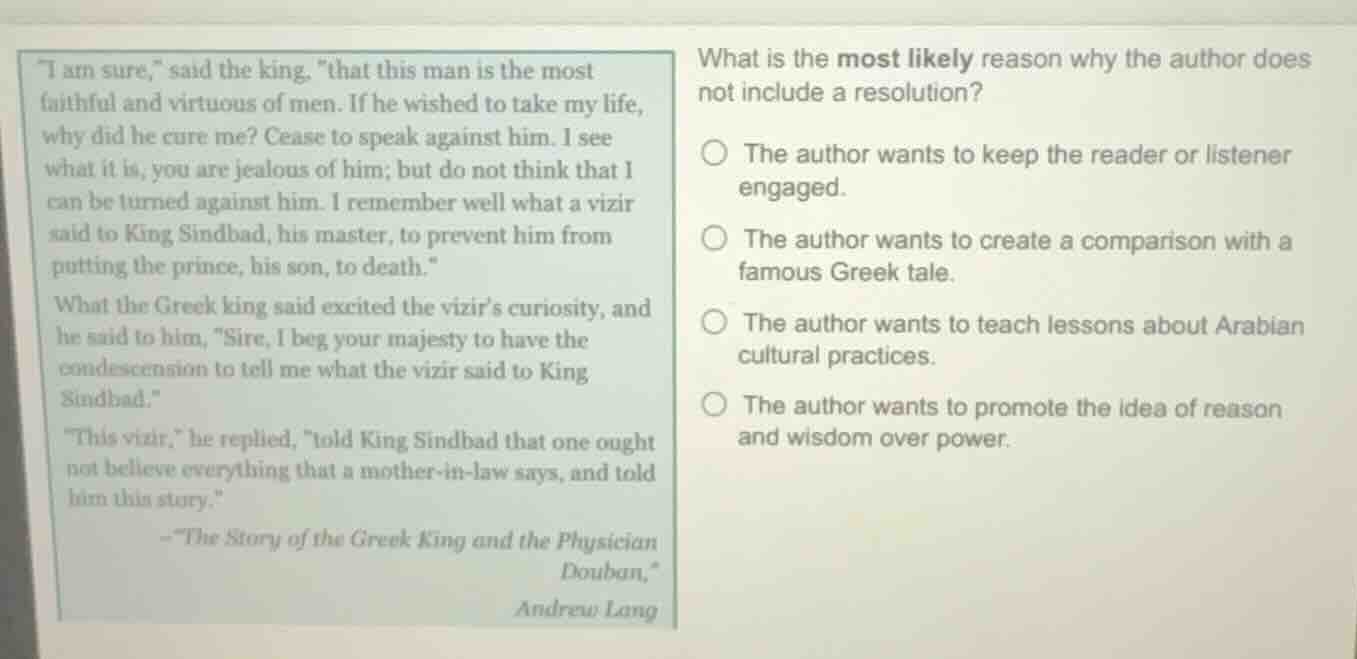
\i am sure,\ said the king, \that this man is the most faithful and virtuous of men. if he wished to take my life, why did he cure me? cease to speak against him. i see what it is, you are jealous of him; but do not think that i can be turned against him. i remember well what a vizir said to king sindbad, his master, to prevent him from putting the prince, his son, to death.\
what the greek king said excited the vizirs curiosity, and he said to him, \sire, i beg your majesty to have the condescension to tell me what the vizir said to king sindbad.\
\this vizir,\ he replied, \told king sindbad that one ought not believe everything that a mother-in-law says, and told him this story.\
-\the story of the greek king and the physician douban,\
andrew lang
what is the most likely reason why the author does not include a resolution?
- the author wants to keep the reader or listener engaged.
- the author wants to create a comparison with a famous greek tale.
- the author wants to teach lessons about arabian cultural practices.
- the author wants to promote the idea of reason and wisdom over power.
Analyze the narrative structure
Using the Frame Narrative and Story within a Story knowledge points, we identify that this excerpt is structured as a nested tale (from One Thousand and One Nights). The Greek king mentions a story about King Sindbad to his vizier, which excites the vizier's curiosity. The king then begins to tell that story, which itself introduces another story.
Determine the purpose of omitting a resolution
Using the Nested Stories knowledge point, we analyze why the author ends this section without resolving the main plot. By introducing a new story within the existing conversation and leaving the outcome of the outer story open, the author creates suspense. This structural technique is designed to keep the reader or listener eager to find out what happens next.
Evaluate the given options
- Option 1: Keeping the reader or listener engaged directly aligns with the suspense-building function of nested, unresolved framing devices.
- Option 2: There is no indication of comparing this to a Greek tale; the "Greek king" is simply a character.
- Option 3: The passage does not focus on teaching Arabian cultural practices.
- Option 4: While themes of wisdom exist, the structural choice of omitting a resolution specifically serves to maintain narrative momentum and engagement.

Snap & solve any problem in the app
Get step-by-step solutions on Sovi AI
Photo-based solutions with guided steps
Explore more problems and detailed explanations
- The author wants to keep the reader or listener engaged. (Correct answer)
- The author wants to create a comparison with a famous Greek tale.
- The author wants to teach lessons about Arabian cultural practices.
- The author wants to promote the idea of reason and wisdom over power.