QUESTION IMAGE
Question
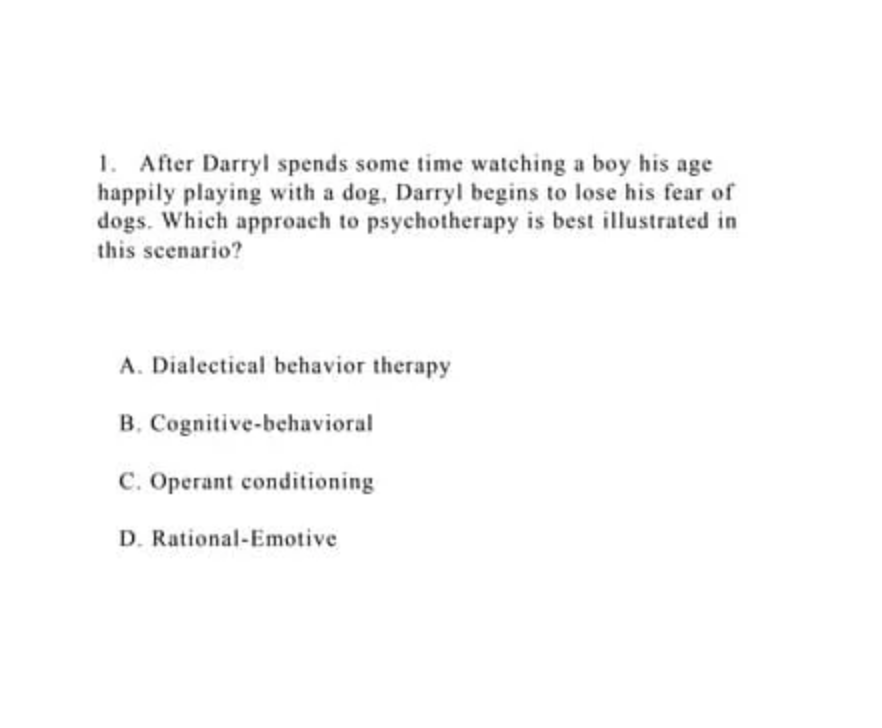
- after darryl spends some time watching a boy his age happily playing with a dog, darryl begins to lose his fear of dogs. which approach to psychotherapy is best illustrated in this scenario?
a. dialectical behavior therapy
b. cognitive-behavioral
c. operant conditioning
d. rational-emotive
🆕 New Concept Discovered: Observational Learning in Therapy
Learning by watching others overcome fears.
Step 1: Analyze the scenario
Darryl reduces his fear of dogs by watching another boy of his age interact happily and safely with a dog. This process of learning or changing a behavior by watching a peer model is known as modeling or observational learning.
Step 2: Evaluate the options
- A. Dialectical behavior therapy (DBT): A specific type of cognitive-behavioral therapy designed to help people manage intense emotions, commonly used for borderline personality disorder. It is not the primary framework illustrated here.
- B. Cognitive-behavioral: Behavioral therapies frequently use observational learning and modeling (such as participant modeling or vicarious desensitization) to modify learned behaviors and phobias. By observing a model interact safely with the feared stimulus, the observer's cognitive appraisal of the threat changes, leading to a reduction in fear.
- C. Operant conditioning: This involves learning through direct rewards or punishments following one's own actions. Darryl is not being directly reinforced or punished here.
- D. Rational-Emotive: A form of cognitive therapy (REBT) focused on identifying and actively challenging irrational beliefs through philosophical disputation, rather than through observational modeling.
Step 3: Select the best fit
Since modeling is a core technique within the broader scope of cognitive-behavioral approaches to treating phobias, option B is the most accurate and appropriate choice among the options provided.

Snap & solve any problem in the app
Get step-by-step solutions on Sovi AI
Photo-based solutions with guided steps
Explore more problems and detailed explanations
B. Cognitive-behavioral