QUESTION IMAGE
Question
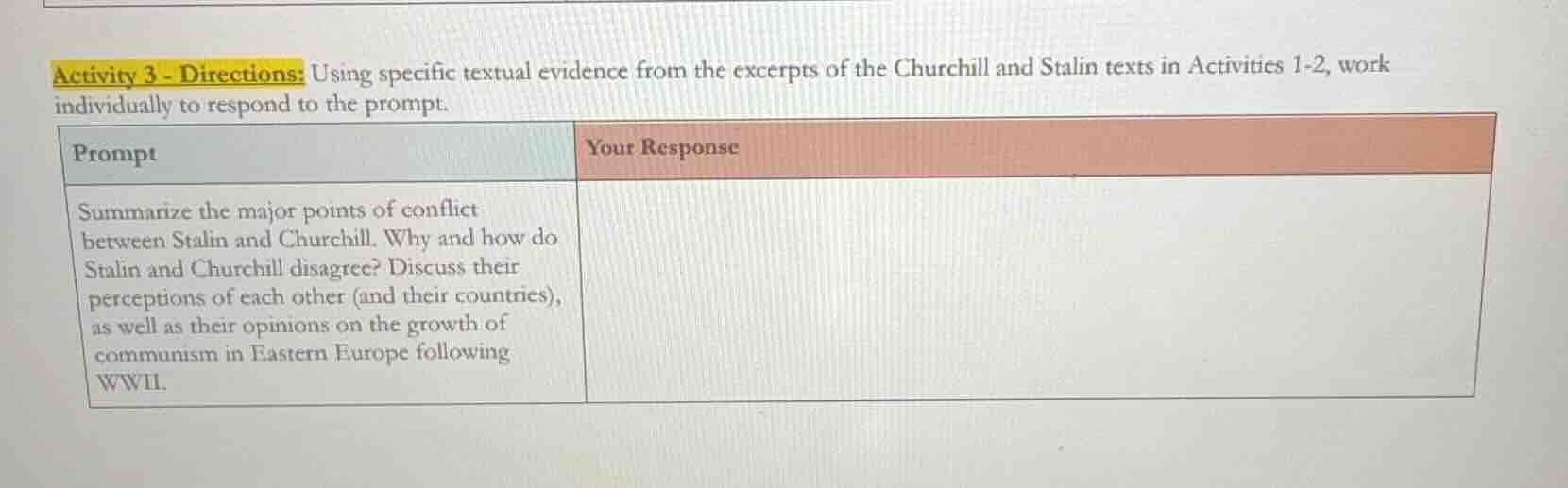
activity 3 - directions: using specific textual evidence from the excerpts of the churchill and stalin texts in activities 1-2, work individually to respond to the prompt.
| prompt | your response |
|---|
Brief Explanations
To answer this, we analyze the ideological and geopolitical conflicts. Stalin, representing the Soviet Union (a communist state), sought to expand communism in Eastern Europe to create a buffer against future Western aggression and spread socialist ideology. Churchill, representing the UK (a capitalist democracy), viewed Soviet expansion as a threat to Western - style democracy and the balance of power.
Perceptions of Each Other (and Their Countries)
- Stalin’s Perception of Churchill/UK: Stalin likely saw Churchill (and the UK) as representatives of capitalist imperialism. He may have believed that the Western powers, including the UK, were more concerned with their own economic and political interests (like maintaining colonial empires) than with the post - war security of the Soviet Union. He might have also been wary of the UK's historical anti - communist stance.
- Churchill’s Perception of Stalin/USSR: Churchill saw Stalin (and the USSR) as a threat to the democratic world order. He was concerned that the spread of communism would lead to the suppression of individual freedoms and the establishment of totalitarian regimes in Eastern Europe, which would also undermine the influence of Western democracies.
Opinions on the Growth of Communism in Eastern Europe
- Stalin’s Opinion: Stalin supported the growth of communism in Eastern Europe. The Soviet Red Army had liberated many Eastern European countries during WWII, and Stalin saw this as an opportunity to install communist - leaning governments. These governments would be loyal to the Soviet Union, help in the reconstruction of the war - torn Soviet Union (through trade and resource sharing), and create a defensive belt against potential future attacks from the West. For example, in countries like Poland, Hungary, and Czechoslovakia, the Soviet Union exerted influence to ensure communist - dominated governments came to power.
- Churchill’s Opinion: Churchill opposed the growth of communism in Eastern Europe. He believed in the principles of self - determination and democratic governance. He was worried that the imposition of communist regimes in Eastern Europe would lead to the loss of freedom for the people in those countries. The “Iron Curtain” speech by Churchill in 1946 was a clear indication of his concern, where he described the division between the communist - controlled East and the democratic West. He also feared that the spread of communism would lead to an expansion of Soviet power, which would upset the post - war balance of power in Europe.
Why and How They Disagreed
- Why They Disagreed: The fundamental disagreement was based on ideological differences (capitalism vs. communism) and conflicting geopolitical goals. The Soviet Union wanted to expand its sphere of influence and ideology, while the UK (and other Western powers) wanted to preserve the existing (or establish new) democratic and capitalist order in Europe.
- How They Disagreed: The disagreement played out in several ways. Diplomatic tensions were high, with both sides using rhetoric to criticize each other's policies. The Soviet Union used its military presence in Eastern Europe to influence the political makeup of those countries, while the Western powers, including the UK, provided support (both political and, in some cases, economic) to anti - communist forces in Europe. The division of Germany and the Berlin Blockade (a few years after WWII, but related to the broader East - West tensions) were also manifestations of this disagreement.
Major Points of Conflic…

Snap & solve any problem in the app
Get step-by-step solutions on Sovi AI
Photo-based solutions with guided steps
Explore more problems and detailed explanations
Major Points of Conflict, Disagreement (Why/How), Perceptions, and Opinions on Communist Growth in Eastern Europe
1. Major Points of Conflict
- Ideological: Conflict between capitalist (UK - led Western democratic ideology) and communist (Soviet - led socialist ideology) systems. The Soviet Union advocated for a class - less, state - controlled economic and social system, while the UK supported private ownership, free - market capitalism, and democratic governance.
- Geopolitical: Struggle for influence in Eastern Europe. The Soviet Union sought to establish a sphere of influence in Eastern Europe, while the UK (and Western allies) aimed to prevent complete Soviet domination to maintain a European balance of power.
- Post - War Vision: Different goals for the post - WWII world. Stalin prioritized Soviet security and communist expansion, Churchill prioritized Western democracy and balance of power preservation.
2. Why and How They Disagreed
- Why: Rooted in conflicting ideologies (capitalism vs. communism) and geopolitical goals (Soviet security/expansion vs. Western balance of power/democracy preservation).
- How:
- Diplomatically: Through critical rhetoric (e.g., Churchill’s “Iron Curtain” speech criticizing Soviet expansion).
- Geopolitically: Soviets used military presence in Eastern Europe to install communist - leaning governments; Western powers (including UK) supported anti - communist forces and pushed for democratic self - determination in the region.
3. Perceptions of Each Other (and Their Countries)
- Stalin on Churchill/UK: Viewed Churchill (and UK) as representatives of capitalist imperialism, prioritizing their own economic/political interests (e.g., colonial empire maintenance) over Soviet post - war security, and as historically anti - communist.
- Churchill on Stalin/USSR: Saw Stalin (and USSR) as a threat to democratic world order, fearing communist expansion would suppress freedoms, install totalitarian regimes in Eastern Europe, and undermine Western democratic influence.
4. Opinions on Communist Growth in Eastern Europe
- Stalin: Supported it. Soviet Red Army’s WWII liberation of Eastern Europe allowed installation of communist - leaning governments to create a Soviet - loyal buffer against Western aggression, aid Soviet reconstruction, and spread socialism (e.g., in Poland, Hungary, Czechoslovakia).
- Churchill: Opposed it. Believed in self - determination/democratic governance; feared communist regimes would strip Eastern Europeans of freedom and upset Europe’s post - war power balance (evidenced by his “Iron Curtain” speech).