QUESTION IMAGE
Question
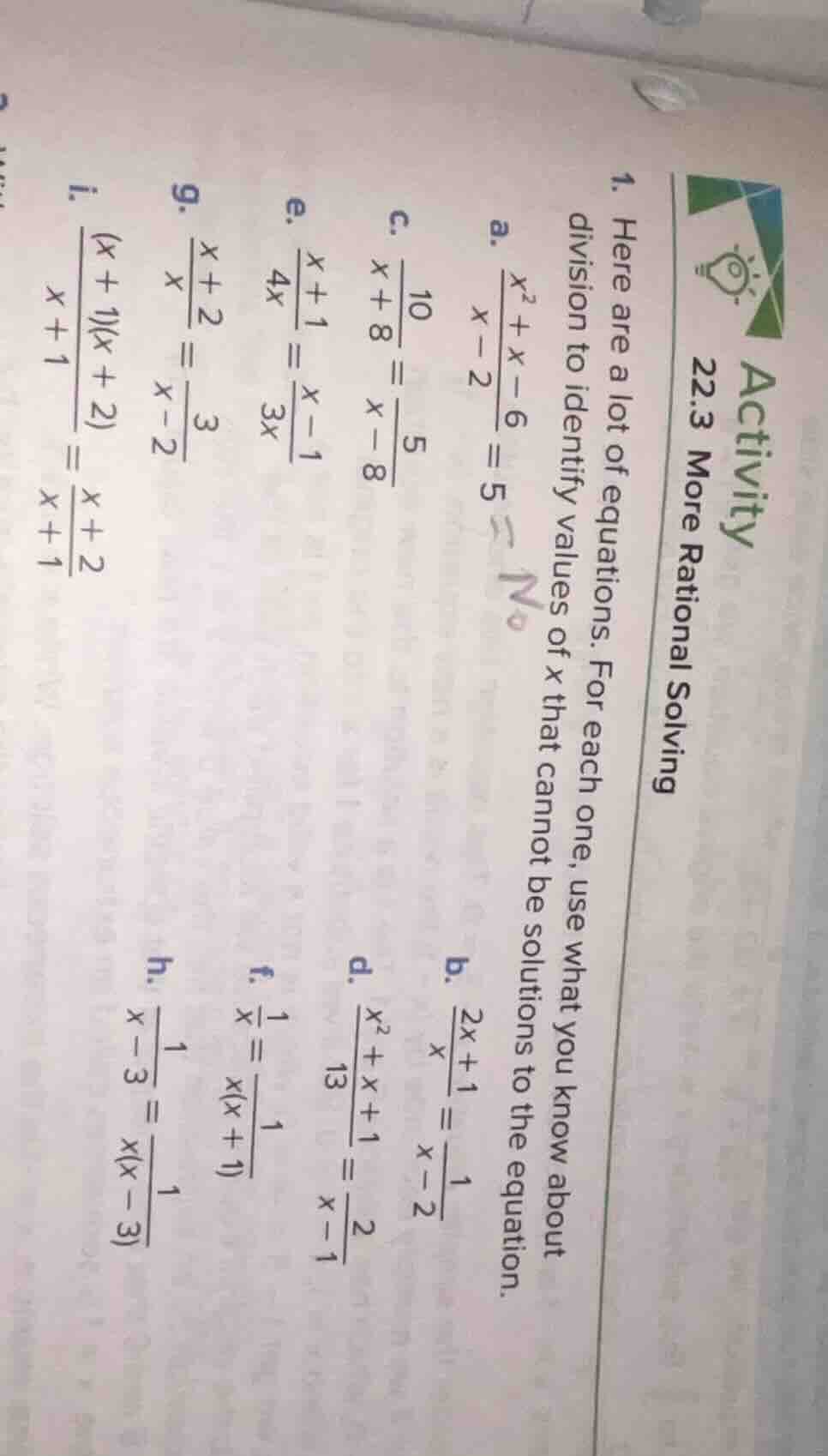
activity 22.3 more rational solving 1. here are a lot of equations. for each one, use what you know about division to identify values of x that cannot be solutions to the equation. a. \\(\frac{x^2 + x - 6}{x - 2} = 5\\) b. \\(\frac{2x + 1}{x} = \frac{1}{x - 2}\\) c. \\(\frac{10}{x + 8} = \frac{5}{x - 8}\\) d. \\(\frac{x^2 + x + 1}{13} = \frac{2}{x - 1}\\) e. \\(\frac{x + 1}{4x} = \frac{x - 1}{3x}\\) f. \\(\frac{1}{x} = \frac{1}{x(x + 1)}\\) g. \\(\frac{x + 2}{x} = \frac{3}{x - 2}\\) h. \\(\frac{1}{x - 3} = \frac{1}{x(x - 3)}\\) i. \\(\frac{(x + 1)(x + 2)}{x + 1} = \frac{x + 2}{x + 1}\\)
Step1: Identify undefined x-values (a)
Denominator cannot be 0: $x-2=0 \implies x=2$
Factor numerator: $x^2+x-6=(x+3)(x-2)$
Cancel common terms: $\frac{(x+3)(x-2)}{x-2}=x+3$ (for $x
eq2$)
Set equal to 5: $x+3=5$
Solve for x: $x=2$ (invalid, as it makes denominator 0)
Step2: Identify undefined x-values (b)
Denominators cannot be 0: $x=0$, $x-2=0 \implies x=2$
Cross-multiply: $(2x+1)(x-2)=x$
Expand: $2x^2-4x+x-2=x$
Simplify: $2x^2-4x-2=0 \implies x^2-2x-1=0$
Solve quadratic: $x=\frac{2\pm\sqrt{4+4}}{2}=1\pm\sqrt{2}$ (both valid, not 0/2)
Step3: Identify undefined x-values (c)
Denominator cannot be 0: $x+8=0 \implies x=-8$
Cross-multiply: $10(x-8)=5(x+8)$
Simplify: $10x-80=5x+40 \implies 5x=120 \implies x=24$ (valid, not -8)
Step4: Identify undefined x-values (d)
Denominator cannot be 0: $x-1=0 \implies x=1$
Cross-multiply: $x^2+x+1=26$
Simplify: $x^2+x-25=0$
Solve quadratic: $x=\frac{-1\pm\sqrt{1+100}}{2}=\frac{-1\pm\sqrt{101}}{2}$ (both valid, not 1)
Step5: Identify undefined x-values (e)
Denominators cannot be 0: $4x=0 \implies x=0$, $3x=0 \implies x=0$
Cross-multiply: $3x(x+1)=4x(x-1)$
Simplify: $3x^2+3x=4x^2-4x \implies x^2-7x=0 \implies x(x-7)=0$
Solutions: $x=0$ (invalid), $x=7$ (valid)
Step6: Identify undefined x-values (f)
Denominators cannot be 0: $x=0$, $x(x+1)=0 \implies x=0,-1$
Cross-multiply: $x+1=1 \implies x=0$ (invalid)
Step7: Identify undefined x-values (g)
Denominators cannot be 0: $x=0$, $x-2=0 \implies x=2$
Cross-multiply: $(x+2)(x-2)=3x$
Expand: $x^2-4=3x \implies x^2-3x-4=0$
Factor: $(x-4)(x+1)=0$
Solutions: $x=4$, $x=-1$ (both valid, not 0/2)
Step8: Identify undefined x-values (h)
Denominators cannot be 0: $x-3=0 \implies x=3$, $x(x-3)=0 \implies x=0,3$
Cross-multiply: $x=1$ (valid, not 0/3)
Step9: Identify undefined x-values (i)
Denominator cannot be 0: $x+1=0 \implies x=-1$
Cancel common terms: $\frac{(x+1)(x+2)}{x+1}=x+2$ (for $x
eq-1$)
Set equal to $\frac{x+2}{x+1}$: $x+2=\frac{x+2}{x+1}$
Multiply by $x+1$: $(x+2)(x+1)=x+2$
Simplify: $(x+2)(x+1-1)=0 \implies x(x+2)=0$
Solutions: $x=0$ (valid), $x=-2$ (valid), $x=-1$ (invalid)

Snap & solve any problem in the app
Get step-by-step solutions on Sovi AI
Photo-based solutions with guided steps
Explore more problems and detailed explanations
a. No valid solution (x=2 is excluded)
b. $x=1+\sqrt{2}$, $x=1-\sqrt{2}$; excluded: $x=0,2$
c. $x=24$; excluded: $x=-8$
d. $x=\frac{-1+\sqrt{101}}{2}$, $x=\frac{-1-\sqrt{101}}{2}$; excluded: $x=1$
e. $x=7$; excluded: $x=0$
f. No valid solution (x=0 is excluded)
g. $x=4$, $x=-1$; excluded: $x=0,2$
h. $x=1$; excluded: $x=0,3$
i. $x=0$, $x=-2$; excluded: $x=-1$