QUESTION IMAGE
Question
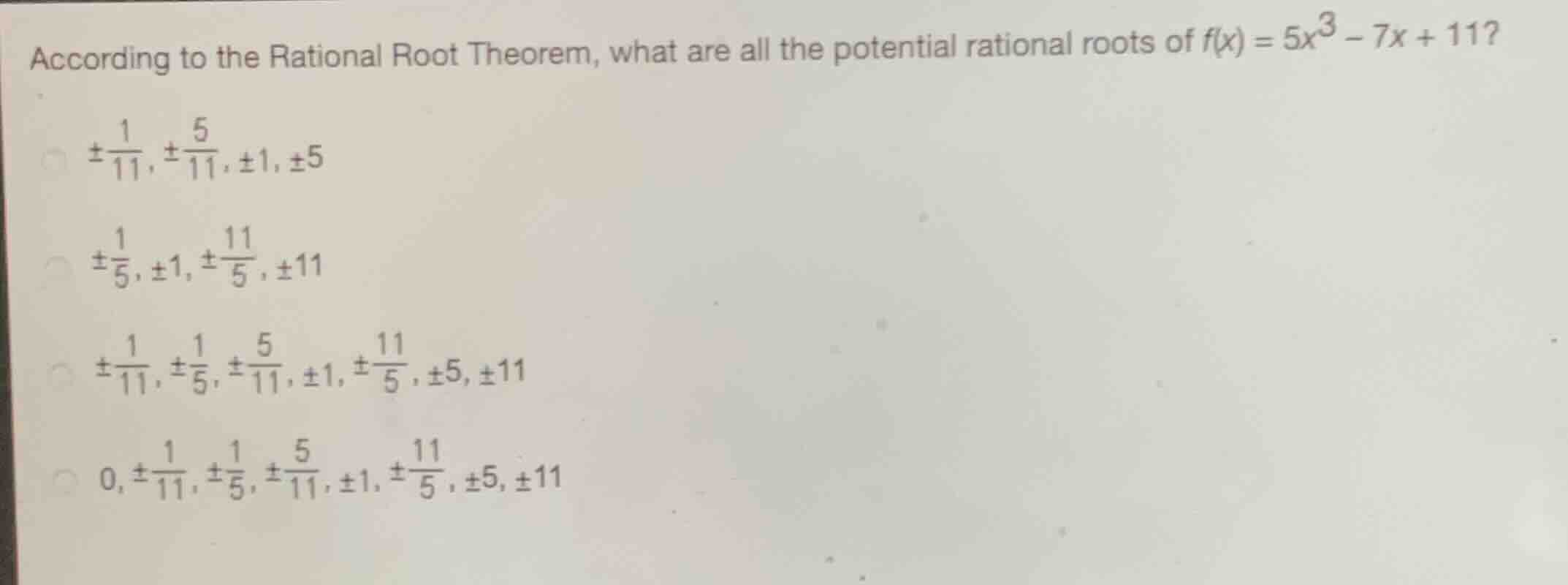
according to the rational root theorem, what are all the potential rational roots of \\(f(x) = 5x^3 - 7x + 11\\)?
\\(\pm \frac{1}{11}, \pm \frac{5}{11}, \pm 1, \pm 5\\)
\\(\pm \frac{1}{5}, \pm 1, \pm \frac{11}{5}, \pm 11\\)
\\(\pm \frac{1}{11}, \pm \frac{1}{5}, \pm \frac{5}{11}, \pm 1, \pm \frac{11}{5}, \pm 5, \pm 11\\)
\\(0, \pm \frac{1}{11}, \pm \frac{1}{5}, \pm \frac{5}{11}, \pm 1, \pm \frac{11}{5}, \pm 5, \pm 11\\)
Identify the coefficients of the polynomial
We are given the polynomial function:
The leading coefficient is \(a_n = 5\).
The constant term is \(a_0 = 11\).
Find the factors of the constant term and leading coefficient
According to the Rational Root Theorem, any potential rational root of the polynomial must be of the form \(\pm \frac{p}{q}\), where:
- \(p\) is a factor of the constant term \(a_0 = 11\).
- \(q\) is a factor of the leading coefficient \(a_n = 5\).
The factors of \(11\) are:
The factors of \(5\) are:
List all possible combinations of p/q
We form all possible fractions \(\pm \frac{p}{q}\) using the factors:
- For \(q = 1\):
- For \(q = 5\):
Combining these, the set of all potential rational roots is:
Match with the given options
Let's compare our list with the choices:
- Option 1: \(\pm \frac{1}{11}, \pm \frac{5}{11}, \pm 1, \pm 5\)
- Option 2: \(\pm \frac{1}{5}, \pm 1, \pm \frac{11}{5}, \pm 11\)
- Option 3: \(\pm \frac{1}{11}, \pm \frac{1}{5}, \pm \frac{5}{11}, \pm 1, \pm \frac{11}{5}, \pm 5, \pm 11\)
- Option 4: \(0, \pm \frac{1}{11}, \pm \frac{1}{5}, \pm \frac{5}{11}, \pm 1, \pm \frac{11}{5}, \pm 5, \pm 11\)
The correct list matches Option 2.

Snap & solve any problem in the app
Get step-by-step solutions on Sovi AI
Photo-based solutions with guided steps
Explore more problems and detailed explanations
- (A) \(\pm\frac{1}{11}, \pm\frac{5}{11}, \pm1, \pm5\)
- (B) \(\pm\frac{1}{5}, \pm1, \pm\frac{11}{5}, \pm11\) (Correct answer)
- (C) \(\pm\frac{1}{11}, \pm\frac{1}{5}, \pm\frac{5}{11}, \pm1, \pm\frac{11}{5}, \pm5, \pm11\)
- (D) \(0, \pm\frac{1}{11}, \pm\frac{1}{5}, \pm\frac{5}{11}, \pm1, \pm\frac{11}{5}, \pm5, \pm11\)