QUESTION IMAGE
Question
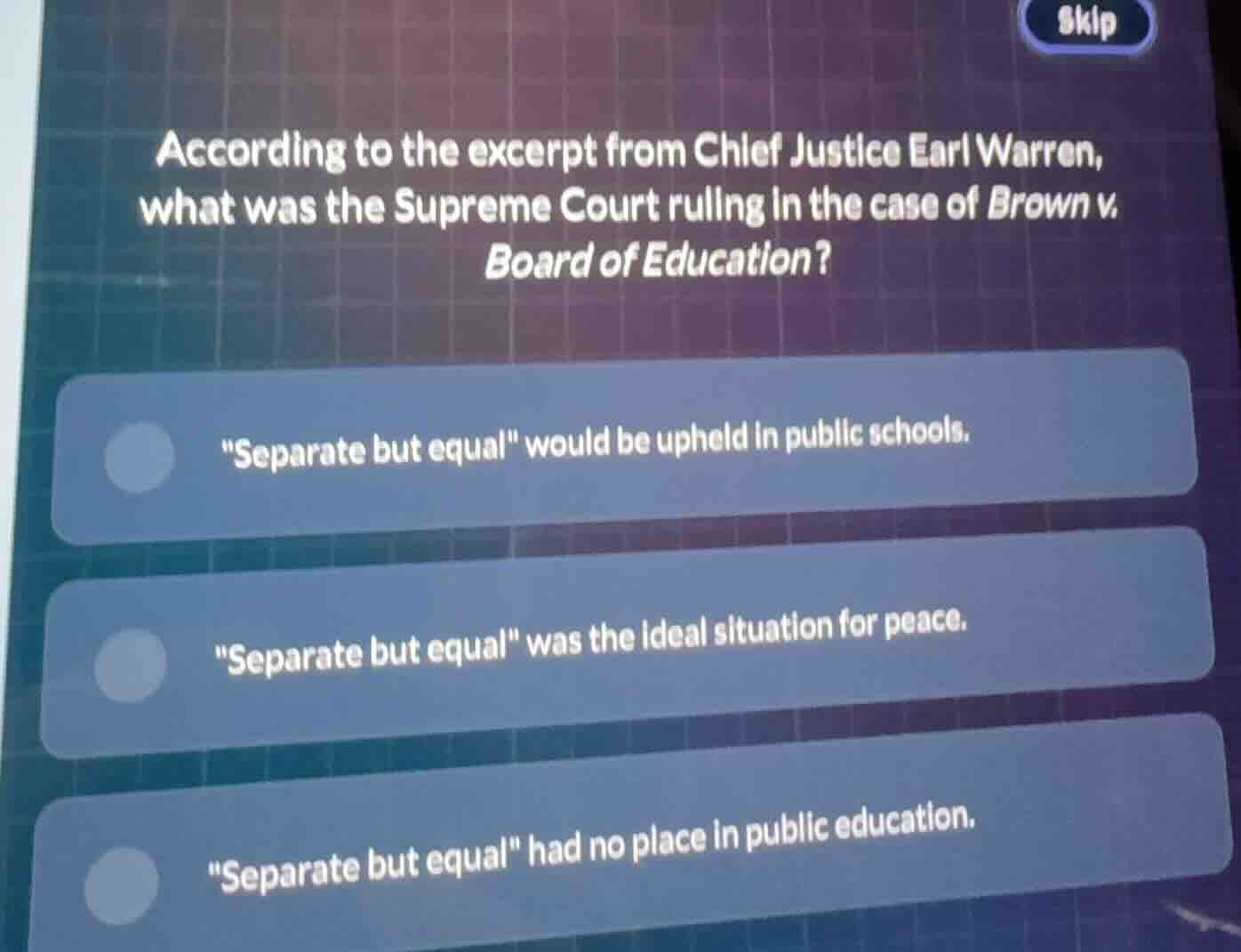
according to the excerpt from chief justice earl warren, what was the supreme court ruling in the case of brown v. board of education?
- \separate but equal\ would be upheld in public schools.
- \separate but equal\ was the ideal situation for peace.
- \separate but equal\ had no place in public education.
⚡ Using what you learned: core goals of the civil rights movement
Step 1: Analyze the ruling of Brown v. Board of Education
In the landmark 1954 case Brown v. Board of Education, the Supreme Court addressed the constitutionality of state-sponsored segregation in public schools. Chief Justice Earl Warren delivered the unanimous decision of the Court.
Step 2: Evaluate the options
- "Separate but equal" would be upheld in public schools.
- This is incorrect. The ruling overturned the "separate but equal" doctrine established by Plessy v. Ferguson (1896) for public education.
- "Separate but equal" was the ideal situation for peace.
- This is incorrect. The Court found that segregated schools were inherently unequal and harmful.
- "Separate but equal" had no place in public education.
- This is correct. Chief Justice Earl Warren famously wrote: "We conclude that in the field of public education the doctrine of 'separate but equal' has no place. Separate educational facilities are inherently unequal."

Snap & solve any problem in the app
Get step-by-step solutions on Sovi AI
Photo-based solutions with guided steps
Explore more problems and detailed explanations
"Separate but equal" had no place in public education.