QUESTION IMAGE
Question
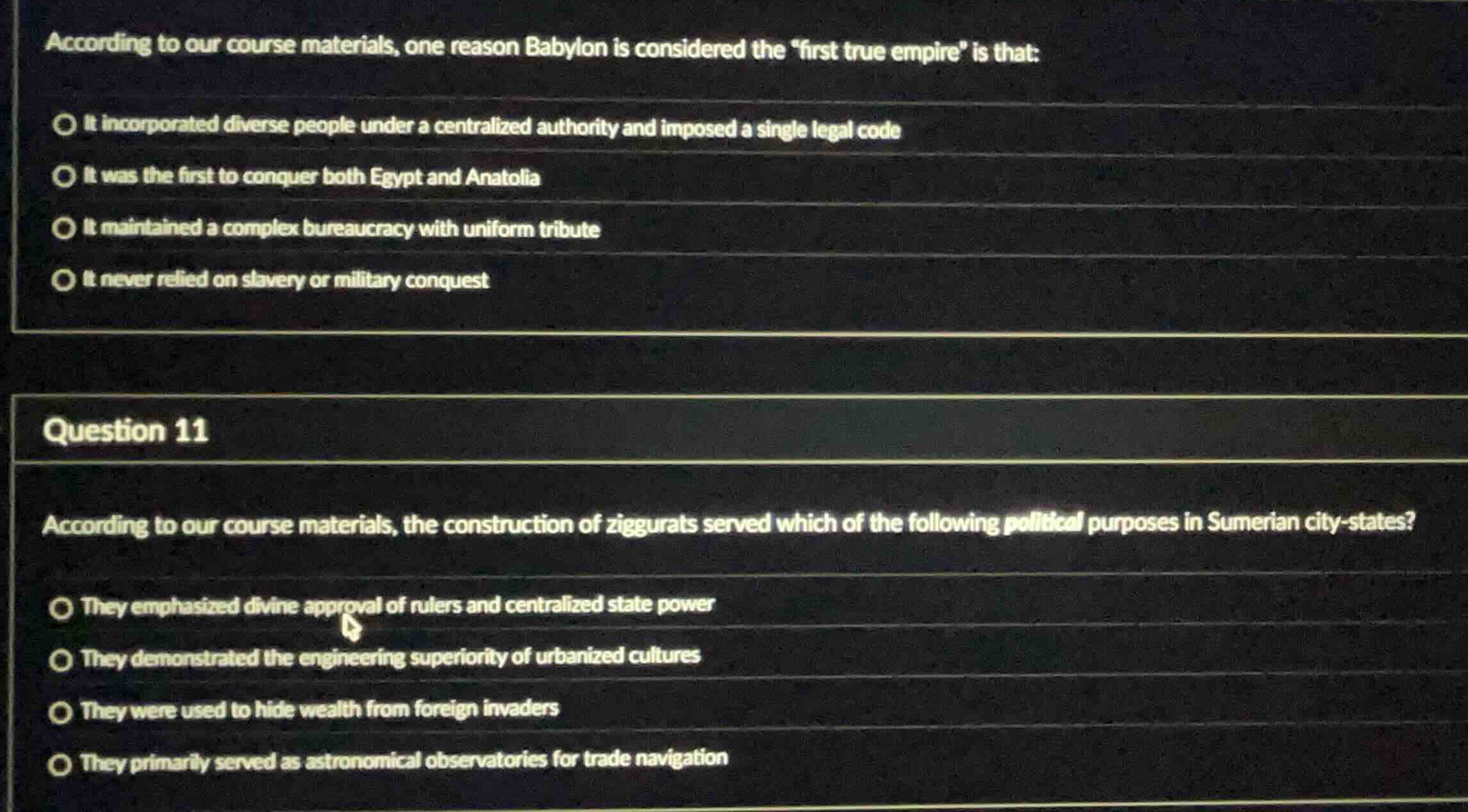
according to our course materials, one reason babylon is considered the \first true empire\ is that:
- it incorporated diverse people under a centralized authority and imposed a single legal code
- it was the first to conquer both egypt and anatolia
- it maintained a complex bureaucracy with uniform tribute
- it never relied on slavery or military conquest
question 11
according to our course materials, the construction of ziggurats served which of the following political purposes in sumerian city-states?
- they emphasized divine approval of rulers and centralized state power
- they demonstrated the engineering superiority of urbanized cultures
- they were used to hide wealth from foreign invaders
- they primarily served as astronomical observatories for trade navigation
<pre_analysis>
{
"quality": "clear",
"question_count": 2,
"skills_matched": [
"direct_cot",
"multiple_choice_formatter",
"explain_then_answer",
"quick"
],
"needs_drawing": false,
"concepts_used": [
"Babylonian Empire",
"Hammurabi Code Ideology"
],
"new_concepts": [
"Sumerian Ziggurats",
"Mesopotamian Statecraft"
],
"current_concepts": [
"Babylonian Empire",
"Hammurabi Code Ideology",
"Sumerian Ziggurats",
"Mesopotamian Statecraft"
]
}
</pre_analysis>
<reasoning>
Analyze the first question on Babylon as the "first true empire"
The first question asks why Babylon is considered the "first true empire." Under Hammurabi, the Babylonian Empire unified diverse Mesopotamian city-states under a single centralized administration and famously established a uniform legal system (the Code of Hammurabi) to govern all subjects. This matches the first option: "It incorporated diverse people under a centralized authority and imposed a single legal code."
Analyze the second question on the political purpose of Sumerian ziggurats
Question 11 asks about the political purpose of constructing ziggurats in Sumerian city-states. Ziggurats were massive religious temple towers. Politically, Sumerian rulers (who often functioned as priest-kings) used these monumental structures to visually and symbolically reinforce their divine connection and legitimacy, thereby consolidating centralized state power. This matches the first option: "They emphasized divine approval of rulers and centralized state power."
</reasoning>
<answer>
Question 1
<mcq-correct>(A) It incorporated diverse people under a centralized authority and imposed a single legal code</mcq-correct>
<mcq-option>(B) It was the first to conquer both Egypt and Anatolia</mcq-option>
<mcq-option>(C) It maintained a complex bureaucracy with uniform tribute</mcq-option>
<mcq-option>(D) It never relied on slavery or military conquest</mcq-option>
Question 2
<mcq-correct>(A) They emphasized divine approval of rulers and centralized state power</mcq-correct>
<mcq-option>(B) They demonstrated the engineering superiority of urbanized cultures</mcq-option>
<mcq-option>(C) They were used to hide wealth from foreign invaders</mcq-option>
<mcq-option>(D) They primarily served as astronomical observatories for trade navigation</mcq-option>
</answer>
<post_analysis>
{
"subject": "Social Science",
"question_type": "Multiple Choice",
"knowledge_point": [
"Social Science",
"History",
"Ancient Mesopotamian Civilizations"
]
}
</post_analysis>
Snap & solve any problem in the app
Get step-by-step solutions on Sovi AI
Photo-based solutions with guided steps
Explore more problems and detailed explanations
<pre_analysis>
{
"quality": "clear",
"question_count": 2,
"skills_matched": [
"direct_cot",
"multiple_choice_formatter",
"explain_then_answer",
"quick"
],
"needs_drawing": false,
"concepts_used": [
"Babylonian Empire",
"Hammurabi Code Ideology"
],
"new_concepts": [
"Sumerian Ziggurats",
"Mesopotamian Statecraft"
],
"current_concepts": [
"Babylonian Empire",
"Hammurabi Code Ideology",
"Sumerian Ziggurats",
"Mesopotamian Statecraft"
]
}
</pre_analysis>
<reasoning>
Analyze the first question on Babylon as the "first true empire"
The first question asks why Babylon is considered the "first true empire." Under Hammurabi, the Babylonian Empire unified diverse Mesopotamian city-states under a single centralized administration and famously established a uniform legal system (the Code of Hammurabi) to govern all subjects. This matches the first option: "It incorporated diverse people under a centralized authority and imposed a single legal code."
Analyze the second question on the political purpose of Sumerian ziggurats
Question 11 asks about the political purpose of constructing ziggurats in Sumerian city-states. Ziggurats were massive religious temple towers. Politically, Sumerian rulers (who often functioned as priest-kings) used these monumental structures to visually and symbolically reinforce their divine connection and legitimacy, thereby consolidating centralized state power. This matches the first option: "They emphasized divine approval of rulers and centralized state power."
</reasoning>
<answer>
Question 1
<mcq-correct>(A) It incorporated diverse people under a centralized authority and imposed a single legal code</mcq-correct>
<mcq-option>(B) It was the first to conquer both Egypt and Anatolia</mcq-option>
<mcq-option>(C) It maintained a complex bureaucracy with uniform tribute</mcq-option>
<mcq-option>(D) It never relied on slavery or military conquest</mcq-option>
Question 2
<mcq-correct>(A) They emphasized divine approval of rulers and centralized state power</mcq-correct>
<mcq-option>(B) They demonstrated the engineering superiority of urbanized cultures</mcq-option>
<mcq-option>(C) They were used to hide wealth from foreign invaders</mcq-option>
<mcq-option>(D) They primarily served as astronomical observatories for trade navigation</mcq-option>
</answer>
<post_analysis>
{
"subject": "Social Science",
"question_type": "Multiple Choice",
"knowledge_point": [
"Social Science",
"History",
"Ancient Mesopotamian Civilizations"
]
}
</post_analysis>