QUESTION IMAGE
Question
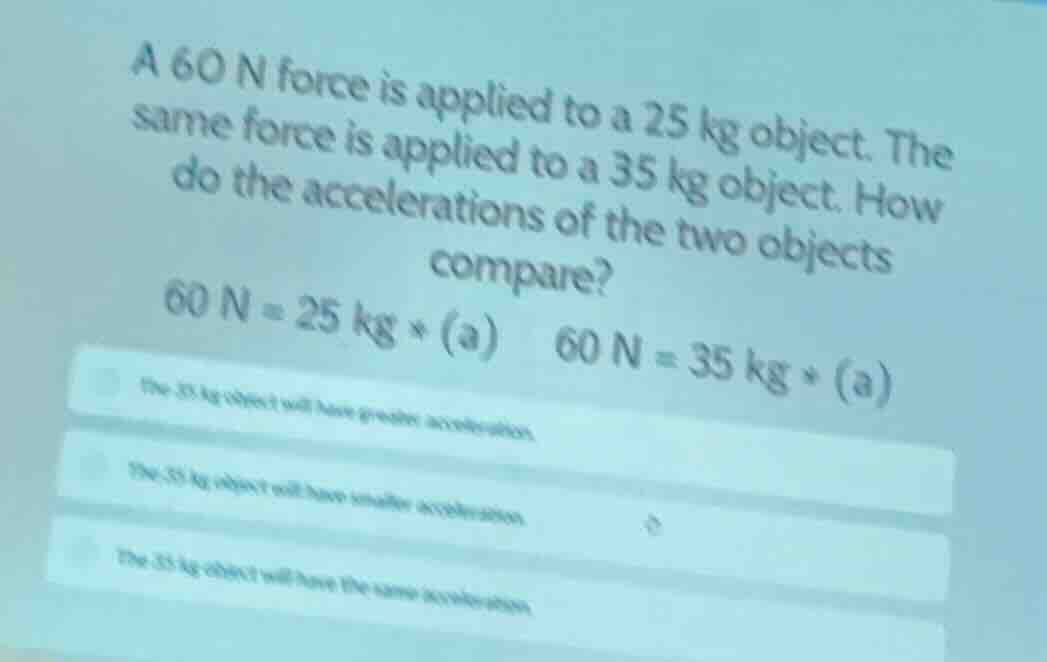
a 60 n force is applied to a 25 kg object. the same force is applied to a 35 kg object. how do the accelerations of the two objects compare?
(60\text{ n} = 25\text{ kg} \times (a))
(60\text{ n} = 35\text{ kg} \times (a))
- the 35 kg object will have greater acceleration.
- the 35 kg object will have smaller acceleration.
- the 35 kg object will have the same acceleration.
Calculate acceleration for the 25 kg object
$$
a_1 = \frac{F}{m_1} = \frac{60\text{ N}}{25\text{ kg}} = 2.4\text{ m/s}^2
$$
Calculate acceleration for the 35 kg object
$$
a_2 = \frac{F}{m_2} = \frac{60\text{ N}}{35\text{ kg}} \approx 1.71\text{ m/s}^2
$$
Compare the accelerations
$$
1.71\text{ m/s}^2 < 2.4\text{ m/s}^2 \implies a_2 < a_1
$$

Snap & solve any problem in the app
Get step-by-step solutions on Sovi AI
Photo-based solutions with guided steps
Explore more problems and detailed explanations
- (A) The 35 kg object will have greater acceleration.
- (B) The 35 kg object will have smaller acceleration. (Correct answer)
- (C) The 35 kg object will have the same acceleration.