QUESTION IMAGE
Question
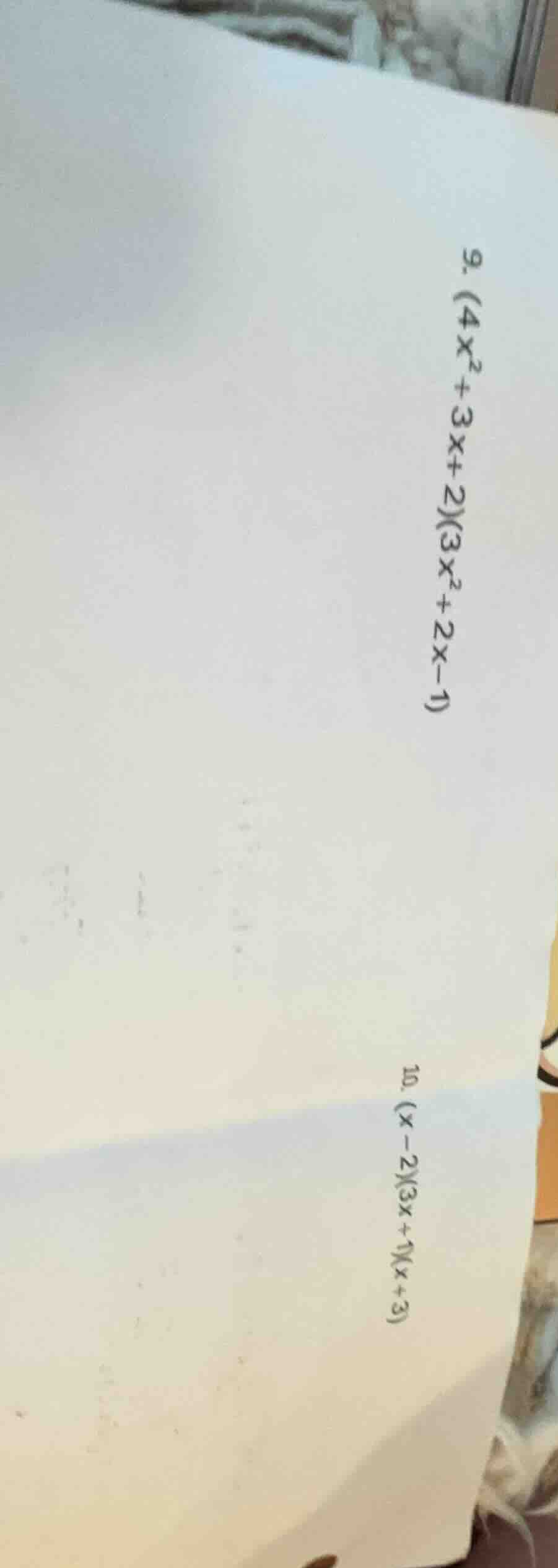
- (4x²+3x+2)(3x²+2x-1)
- (x-2)(3x+1)(x+3)
Problem 9: \((4x^2 + 3x + 2)(3x^2 + 2x - 1)\)
Step 1: Apply the distributive property (FOIL for polynomials)
Multiply each term in the first polynomial by each term in the second polynomial:
$$
LATEXBLOCK0
$$
Step 2: Combine like terms
- For \(x^4\): \(12x^4\)
- For \(x^3\): \(8x^3 + 9x^3 = 17x^3\)
- For \(x^2\): \(-4x^2 + 6x^2 + 6x^2 = 8x^2\)
- For \(x\): \(-3x + 4x = x\)
- Constant term: \(-2\)
Putting it all together: \(12x^4 + 17x^3 + 8x^2 + x - 2\)
Step 1: Multiply the first two binomials \((x - 2)(3x + 1)\)
Using the distributive property:
$$
LATEXBLOCK0
$$
Step 2: Multiply the result by \((x + 3)\)
$$
LATEXBLOCK1
$$
Step 3: Combine like terms
- For \(x^3\): \(3x^3\)
- For \(x^2\): \(9x^2 - 5x^2 = 4x^2\)
- For \(x\): \(-15x - 2x = -17x\)
- Constant term: \(-6\)
Putting it all together: \(3x^3 + 4x^2 - 17x - 6\)

Snap & solve any problem in the app
Get step-by-step solutions on Sovi AI
Photo-based solutions with guided steps
Explore more problems and detailed explanations
\(12x^4 + 17x^3 + 8x^2 + x - 2\)