QUESTION IMAGE
Question
32 mark for review
ap
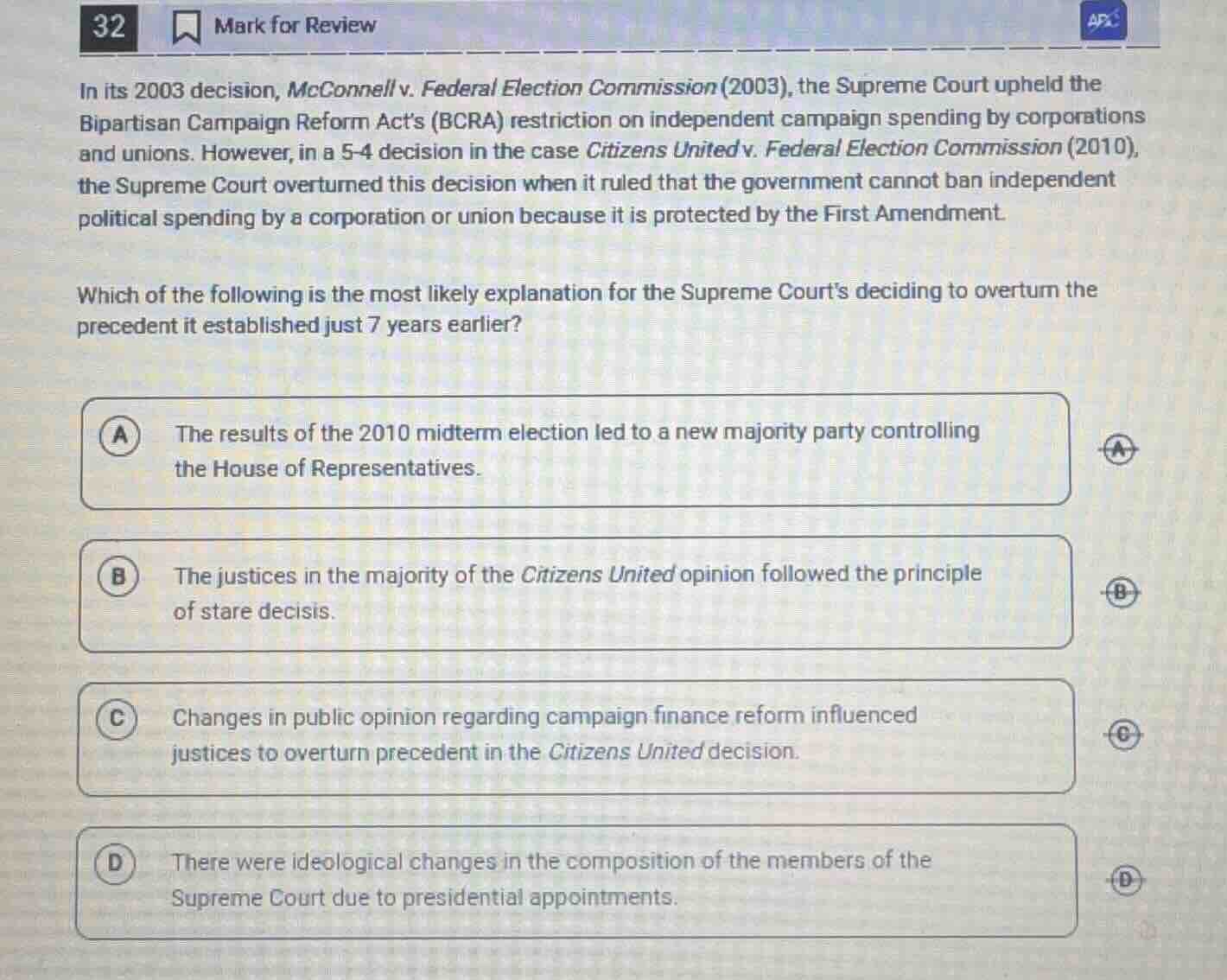
in its 2003 decision, mcconnell v. federal election commission (2003), the supreme court upheld the bipartisan campaign reform act’s (bcra) restriction on independent campaign spending by corporations and unions. however, in a 5-4 decision in the case citizens united v. federal election commission (2010), the supreme court overturned this decision when it ruled that the government cannot ban independent political spending by a corporation or union because it is protected by the first amendment.
which of the following is the most likely explanation for the supreme court’s deciding to overturn the precedent it established just 7 years earlier?
a the results of the 2010 midterm election led to a new majority party controlling the house of representatives.
b the justices in the majority of the citizens united opinion followed the principle of stare decisis.
c changes in public opinion regarding campaign finance reform influenced justices to overturn precedent in the citizens united decision.
d there were ideological changes in the composition of the members of the supreme court due to presidential appointments.
- Option A is incorrect because the 2010 midterm elections occurred after the Citizens United decision was issued in January 2010, so they could not have influenced the ruling.
- Option B is incorrect because stare decisis is the principle of upholding precedent, which the Court did not do when it overturned the 2003 McConnell decision.
- Option C is incorrect because while public opinion can influence the Court over time, the rapid reversal of precedent in 7 years is not primarily driven by public opinion shifts; ideological changes in the Court's membership are a more direct cause.
- Option D is correct: Between 2003 and 2010, presidential appointments changed the ideological composition of the Supreme Court. New conservative justices were added, shifting the Court's majority to one that interpreted the First Amendment to protect corporate independent political spending, leading to the reversal of the earlier precedent.

Snap & solve any problem in the app
Get step-by-step solutions on Sovi AI
Photo-based solutions with guided steps
Explore more problems and detailed explanations
D. There were ideological changes in the composition of the members of the Supreme Court due to presidential appointments.