QUESTION IMAGE
Question
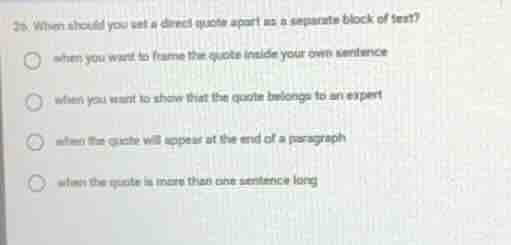
- when should you set a direct quote apart as a separate block of text?
when you want to frame the quote inside your own sentence
when you want to show that the quote belongs to an expert
when the quote will appear at the end of a paragraph
when the quote is more than one sentence long
Understand block quotation rules
A block quotation is used for longer direct quotes to set them apart from the main text. In standard style guides like MLA and APA, a quote is formatted as a block quote when it exceeds a certain length (such as more than four lines of prose in MLA, or 40 words in APA). This usually means the quote is more than one sentence long.
Evaluate the given options
- Option 1: "when you want to frame the quote inside your own sentence" — This describes an integrated quote, which is kept within the main paragraph text using quotation marks, not set apart as a block.
- Option 2: "when you want to show that the quote belongs to an expert" — Expert status is shown through signal phrases and citations, not by block formatting.
- Option 3: "when the quote will appear at the end of a paragraph" — Paragraph placement does not dictate block formatting.
- Option 4: "when the quote is more than one sentence long" — This aligns with the rule for longer quotes that require block formatting to maintain readability.
Apply mastered concepts
Using the Integrating Quotations knowledge point, we know that short quotes are integrated directly into the text with quotation marks, whereas longer quotes (typically spanning multiple sentences or lines) are set off as block quotes.

Snap & solve any problem in the app
Get step-by-step solutions on Sovi AI
Photo-based solutions with guided steps
Explore more problems and detailed explanations
- when you want to frame the quote inside your own sentence
- when you want to show that the quote belongs to an expert
- when the quote will appear at the end of a paragraph
- when the quote is more than one sentence long (Correct answer)