QUESTION IMAGE
Question
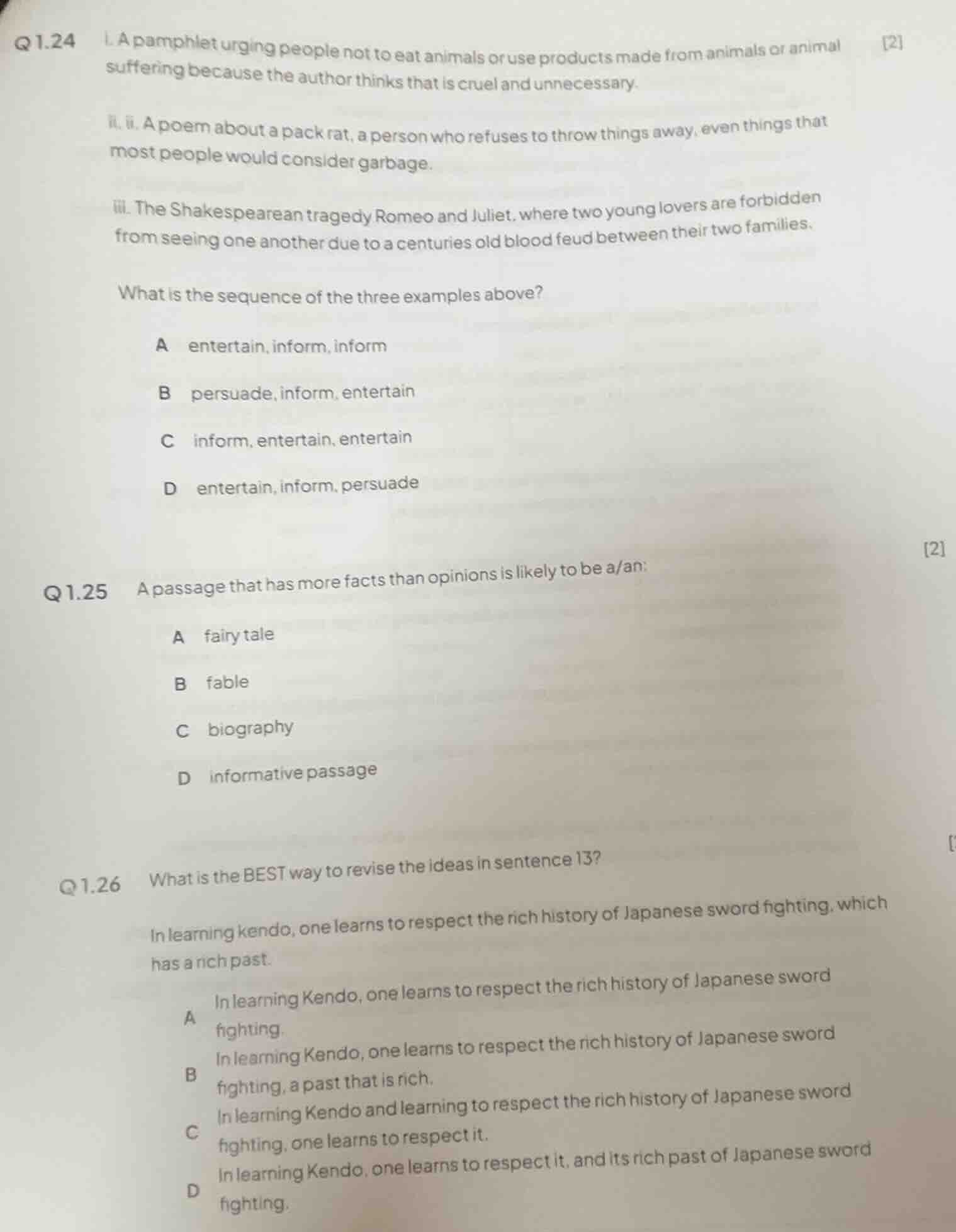
q 1.24 i. a pamphlet urging people not to eat animals or use products made from animals or animal suffering because the author thinks that is cruel and unnecessary.
ii. a poem about a pack rat, a person who refuses to throw things away, even things that most people would consider garbage.
iii. the shakespearean tragedy romeo and juliet, where two young lovers are forbidden from seeing one another due to a centuries old blood feud between their two families.
what is the sequence of the three examples above?
a entertain, inform, inform
b persuade, inform, entertain
c inform, entertain, entertain
d entertain, inform, persuade
q 1.25 a passage that has more facts than opinions is likely to be a/an:
a fairy tale
b fable
c biography
d informative passage
q 1.26 what is the best way to revise the ideas in sentence 13?
in learning kendo, one learns to respect the rich history of japanese sword fighting, which has a rich past.
a in learning kendo, one learns to respect the rich history of japanese sword fighting.
b in learning kendo, one learns to respect the rich history of japanese sword fighting, a past that is rich.
c in learning kendo and learning to respect the rich history of japanese sword fighting, one learns to respect it.
d in learning kendo, one learns to respect it, and its rich past of japanese sword fighting.
Analyze the purpose of the three examples in Q1.24
To find the correct sequence of purposes, let's examine each example:
- Example i: "A pamphlet urging people not to eat animals..." The word "urging" indicates an attempt to convince the reader to change their behavior or beliefs. This corresponds to the purpose of persuade.
- Example ii: "A poem about a pack rat..." A poem is a creative work of literature designed primarily to engage the reader's emotions and imagination, which corresponds to entertain.
- Example iii: "The Shakespearean tragedy Romeo and Juliet..." Plays and tragedies are works of literature meant to engage, move, and entertain the audience.
Therefore, the sequence is persuade, entertain, entertain. This matches option C (if we look closely at the options: A is "entertain, inform, inform", B is "persuade, inform, entertain", C is "inform, entertain, entertain", and D is "entertain, inform, persuade". Let's re-evaluate if there is a better fit or if we need to look at the options again. Wait, let's look at the options:
- A: entertain, inform, inform
- B: persuade, inform, entertain
- C: inform, entertain, entertain
- D: entertain, inform, persuade
Wait, let's re-read example i, ii, iii:
- i. A pamphlet urging... -> persuade.
- ii. A poem about a pack rat, a person who refuses to throw things away... -> This describes a pack rat (the animal) and then defines it as "a person who refuses to throw things away...". This could be seen as informative/educational about what a "pack rat" metaphorically is, or entertaining. If ii is "inform" (explaining what a pack rat is), then the sequence is persuade, inform, entertain. Let's check option B: "persuade, inform, entertain". This perfectly matches:
- i = persuade (urging people)
- ii = inform (explaining/defining a pack rat)
- iii = entertain (Romeo and Juliet)
Thus, option B is the correct choice.
Analyze the characteristics of text types in Q1.25
The question asks about a passage that has "more facts than opinions."
- A fairy tale and a fable are fictional genres meant to entertain or teach a moral lesson, containing mostly imaginary events rather than factual reporting.
- A biography is a factual account of a real person's life, but it can contain interpretations and narrative elements.
- An informative passage is specifically written to deliver factual information, objective data, and explanations about a topic, minimizing personal opinions.
Therefore, a passage with more facts than opinions is most likely to be an informative passage (Option D).
Identify redundancy and revise sentence 13 in Q1.26
The original sentence is: "In learning kendo, one learns to respect the rich history of Japanese sword fighting, which has a rich past."
- The phrase "rich history" and the clause "which has a rich past" are highly redundant because "history" and "past" mean the same thing, and "rich" is repeated.
- To improve the sentence, we must eliminate this redundancy while keeping the core meaning clear and grammatically correct.
- Option A: "In learning Kendo, one learns to respect the rich histor…

Snap & solve any problem in the app
Get step-by-step solutions on Sovi AI
Photo-based solutions with guided steps
Explore more problems and detailed explanations
Question 1.24
- (A) entertain, inform, inform
- (B) persuade, inform, entertain (Correct answer)
- (C) inform, entertain, entertain
- (D) entertain, inform, persuade
Question 1.25
- (A) fairy tale
- (B) fable
- (C) biography
- (D) informative passage (Correct answer)
Question 1.26
- (A) In learning Kendo, one learns to respect the rich history of Japanese sword fighting. (Correct answer)
- (B) In learning Kendo, one learns to respect the rich history of Japanese sword fighting, a past that is rich.
- (C) In learning Kendo and learning to respect the rich history of Japanese sword fighting, one learns to respect it.
- (D) In learning Kendo, one learns to respect it, and its rich past of Japanese sword fighting.