QUESTION IMAGE
Question
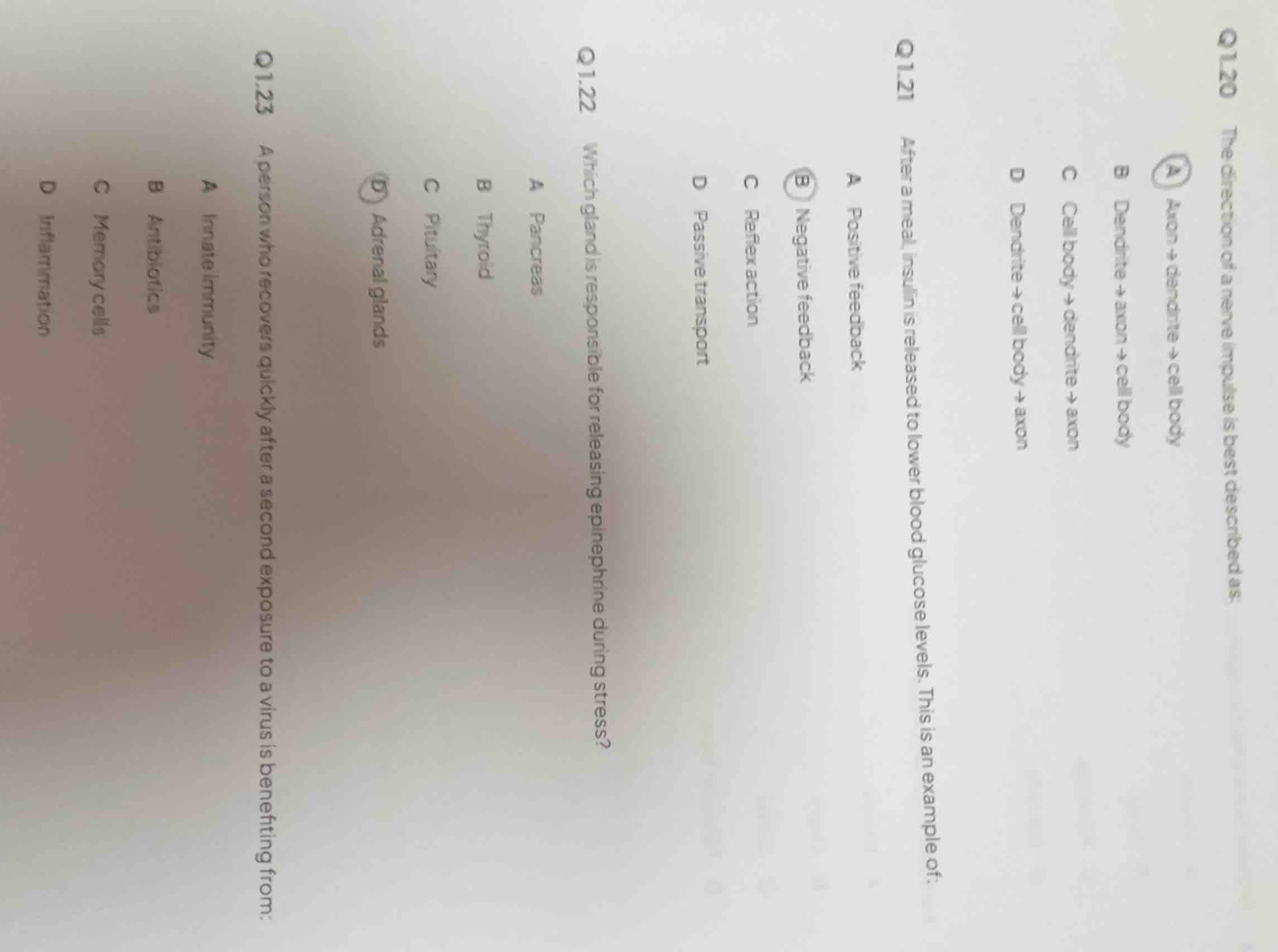
q 1.20 the direction of a nerve impulse is best described as:
a axon -> dendrite -> cell body
b dendrite -> axon -> cell body
c cell body -> dendrite -> axon
d dendrite -> cell body -> axon
q 1.21 after a meal, insulin is released to lower blood glucose levels. this is an example of:
a positive feedback
b negative feedback
c reflex action
d passive transport
q 1.22 which gland is responsible for releasing epinephrine during stress?
a pancreas
b thyroid
c pituitary
d adrenal glands
q 1.23 a person who recovers quickly after a second exposure to a virus is benefiting from:
a innate immunity
b antibiotics
c memory cells
d inflammation
Analyze Q1.20: Nerve impulse direction
Analyze Q1.21: Insulin regulation mechanism
Analyze Q1.22: Epinephrine release during stress
Analyze Q1.23: Rapid recovery after second exposure

Snap & solve any problem in the app
Get step-by-step solutions on Sovi AI
Photo-based solutions with guided steps
Explore more problems and detailed explanations
Question 1.20
- A Axon \(
ightarrow\) dendrite \(
ightarrow\) cell body
- B Dendrite \(
ightarrow\) axon \(
ightarrow\) cell body
- C Cell body \(
ightarrow\) dendrite \(
ightarrow\) axon
- **D Dendrite \(
ightarrow\) cell body \(
ightarrow\) axon (Correct answer)**
Question 1.21
- A Positive feedback
- B Negative feedback (Correct answer)
- C Reflex action
- D Passive transport
Question 1.22
- A Pancreas
- B Thyroid
- C Pituitary
- D Adrenal glands (Correct answer)
Question 1.23
- A Innate immunity
- B Antibiotics
- C Memory cells (Correct answer)
- D Inflammation