QUESTION IMAGE
Question
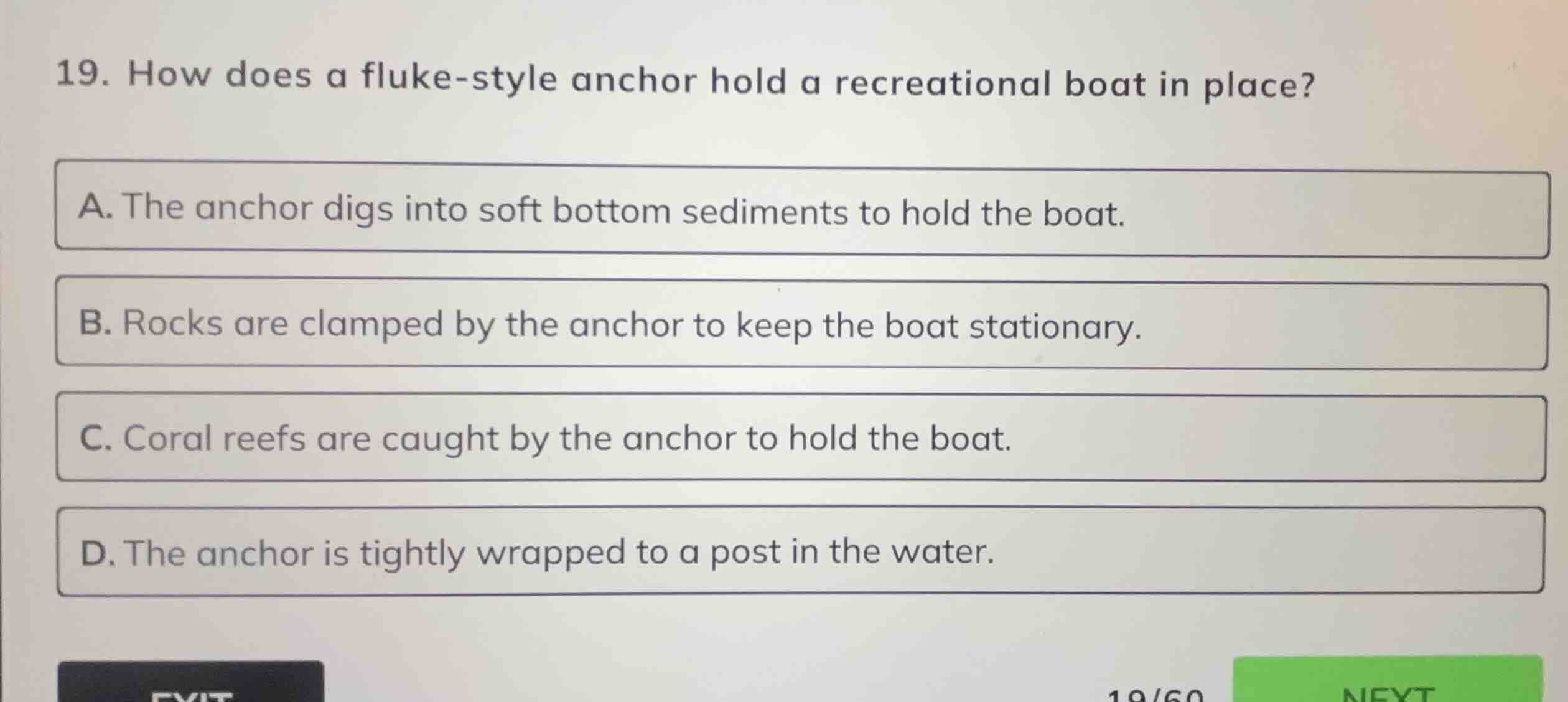
- how does a fluke-style anchor hold a recreational boat in place?
a. the anchor digs into soft bottom sediments to hold the boat.
b. rocks are clamped by the anchor to keep the boat stationary.
c. coral reefs are caught by the anchor to hold the boat.
d. the anchor is tightly wrapped to a post in the water.
Understand the function of a fluke-style anchor
A fluke-style anchor (often referred to as a Danforth anchor) is designed with large, flat, triangular flukes attached to a hinged stock. This design allows the flukes to pivot and bury themselves deep into soft bottom sediments, such as sand, mud, or silt, when tension is applied to the anchor line.
Evaluate the given options
- Option A: "The anchor digs into soft bottom sediments to hold the boat." This directly describes how a fluke-style anchor functions by burying its flukes into sand or mud.
- Option B: "Rocks are clamped by the anchor to keep the boat stationary." Fluke anchors do not clamp rocks; they are notoriously poor at holding on rocky bottoms because they cannot bury themselves.
- Option C: "Coral reefs are caught by the anchor to hold the boat." Anchoring on coral reefs is environmentally destructive, illegal in many areas, and not the design mechanism of a fluke anchor.
- Option D: "The anchor is tightly wrapped to a post in the water." Anchors are deployed to the seabed, not wrapped around posts in the water.
Determine the correct choice
Based on standard Boating Safety Regulations and seamanship guidelines, a fluke-style anchor relies on digging into soft bottom sediments to secure a vessel. Therefore, Option A is the correct answer.

Snap & solve any problem in the app
Get step-by-step solutions on Sovi AI
Photo-based solutions with guided steps
Explore more problems and detailed explanations
- (A) The anchor digs into soft bottom sediments to hold the boat. (Correct answer)
- (B) Rocks are clamped by the anchor to keep the boat stationary.
- (C) Coral reefs are caught by the anchor to hold the boat.
- (D) The anchor is tightly wrapped to a post in the water.