QUESTION IMAGE
Question
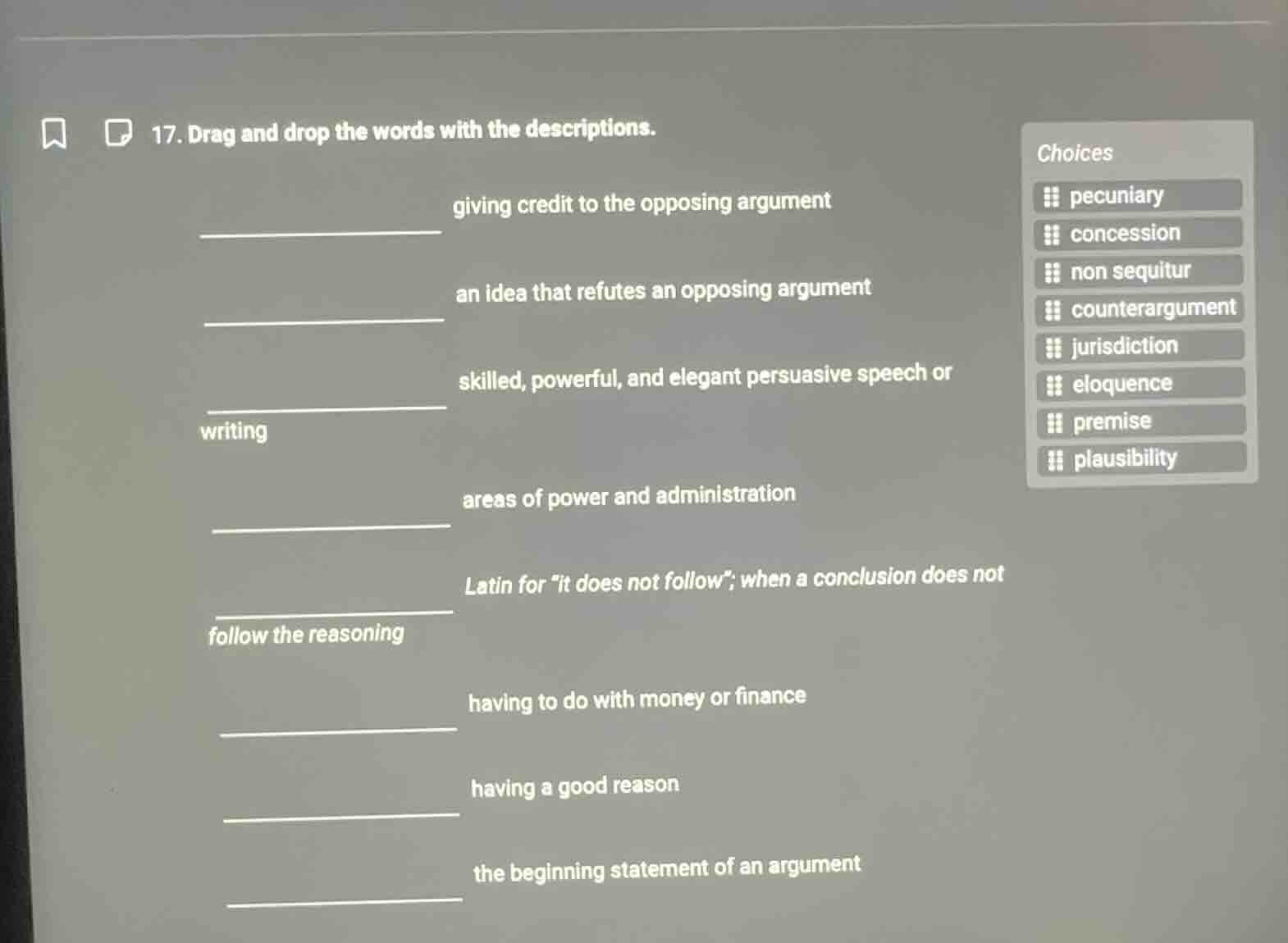
- drag and drop the words with the descriptions.
giving credit to the opposing argument
an idea that refutes an opposing argument
skilled, powerful, and elegant persuasive speech or writing
areas of power and administration
latin for \it does not follow\; when a conclusion does not follow the reasoning
having to do with money or finance
having a good reason
the beginning statement of an argument
choices:
pecuniary
concession
non sequitur
counterargument
jurisdiction
eloquence
premise
plausibility
Match concession and counterargument
Using the Rhetorical Devices knowledge point, we analyze the first two descriptions related to argumentative structures.
- "giving credit to the opposing argument" matches concession, which is the act of yielding or conceding a point to an opponent.
- "an idea that refutes an opposing argument" matches counterargument, which is an argument or set of reasons put forward to oppose an idea or theory developed in another argument.
Match eloquence and jurisdiction
We analyze the next two vocabulary terms based on their definitions.
- "skilled, powerful, and elegant persuasive speech or writing" matches eloquence, which refers to fluent, persuasive, and elegant speaking or writing.
- "areas of power and administration" matches jurisdiction, which is the official power to make legal decisions and judgments, or the territory over which this authority extends.
Match non sequitur and pecuniary
We analyze the next two terms based on logical and financial definitions.
- "Latin for 'it does not follow'; when a conclusion does not follow the reasoning" matches non sequitur, a well-known logical fallacy where the conclusion does not logically follow from the previous argument or premise.
- "having to do with money or finance" matches pecuniary, which means relating to or consisting of money.
Match plausibility and premise
We analyze the final two terms based on reasoning and argument structure.
- "having a good reason" (or being seemingly reasonable or probable) matches plausibility, which refers to the quality of seeming reasonable or probable.
- "the beginning statement of an argument" matches premise, which is a previous statement or proposition from which another is inferred or follows as a conclusion.

Snap & solve any problem in the app
Get step-by-step solutions on Sovi AI
Photo-based solutions with guided steps
Explore more problems and detailed explanations
- Drag and drop the words with the descriptions.
<blank>concession</blank> giving credit to the opposing argument
<blank>counterargument</blank> an idea that refutes an opposing argument
<blank>eloquence</blank> skilled, powerful, and elegant persuasive speech or writing
<blank>jurisdiction</blank> areas of power and administration
<blank>non sequitur</blank> Latin for "it does not follow"; when a conclusion does not follow the reasoning
<blank>pecuniary</blank> having to do with money or finance
<blank>plausibility</blank> having a good reason
<blank>premise</blank> the beginning statement of an argument