QUESTION IMAGE
Question
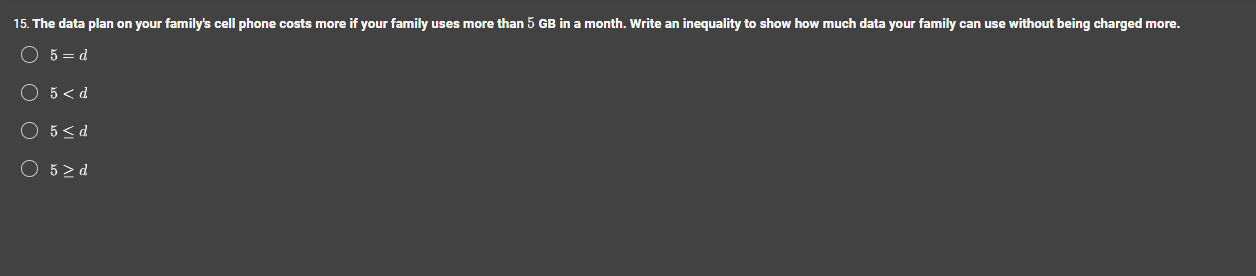
- the data plan on your familys cell phone costs more if your family uses more than \\(5\text{ gb}\\) in a month. write an inequality to show how much data your family can use without being charged more.
\\(\bigcirc\\) \\(5 = d\\)
\\(\bigcirc\\) \\(5 < d\\)
\\(\bigcirc\\) \\(5 \le d\\)
\\(\bigcirc\\) \\(5 \ge d\\)
⚡ Using what you learned: understanding inequalities
Step 1: Identify the variable and the limit
Let \( d \) represent the amount of data your family uses in gigabytes (GB).
The problem states that the plan costs more if your family uses more than \( 5\text{ GB} \). This means:
- Charged more if: \( d > 5 \)
Step 2: Determine the condition for not being charged more
To avoid being charged more, your family must use an amount of data that is not more than \( 5\text{ GB} \).
This means the data usage \( d \) must be less than or equal to \( 5\text{ GB} \):
Step 3: Match with the given options
We can rewrite the inequality \( d \le 5 \) by swapping the sides and reversing the inequality sign:
This matches the fourth option.

Snap & solve any problem in the app
Get step-by-step solutions on Sovi AI
Photo-based solutions with guided steps
Explore more problems and detailed explanations
\( 5 \ge d \)