QUESTION IMAGE
Question
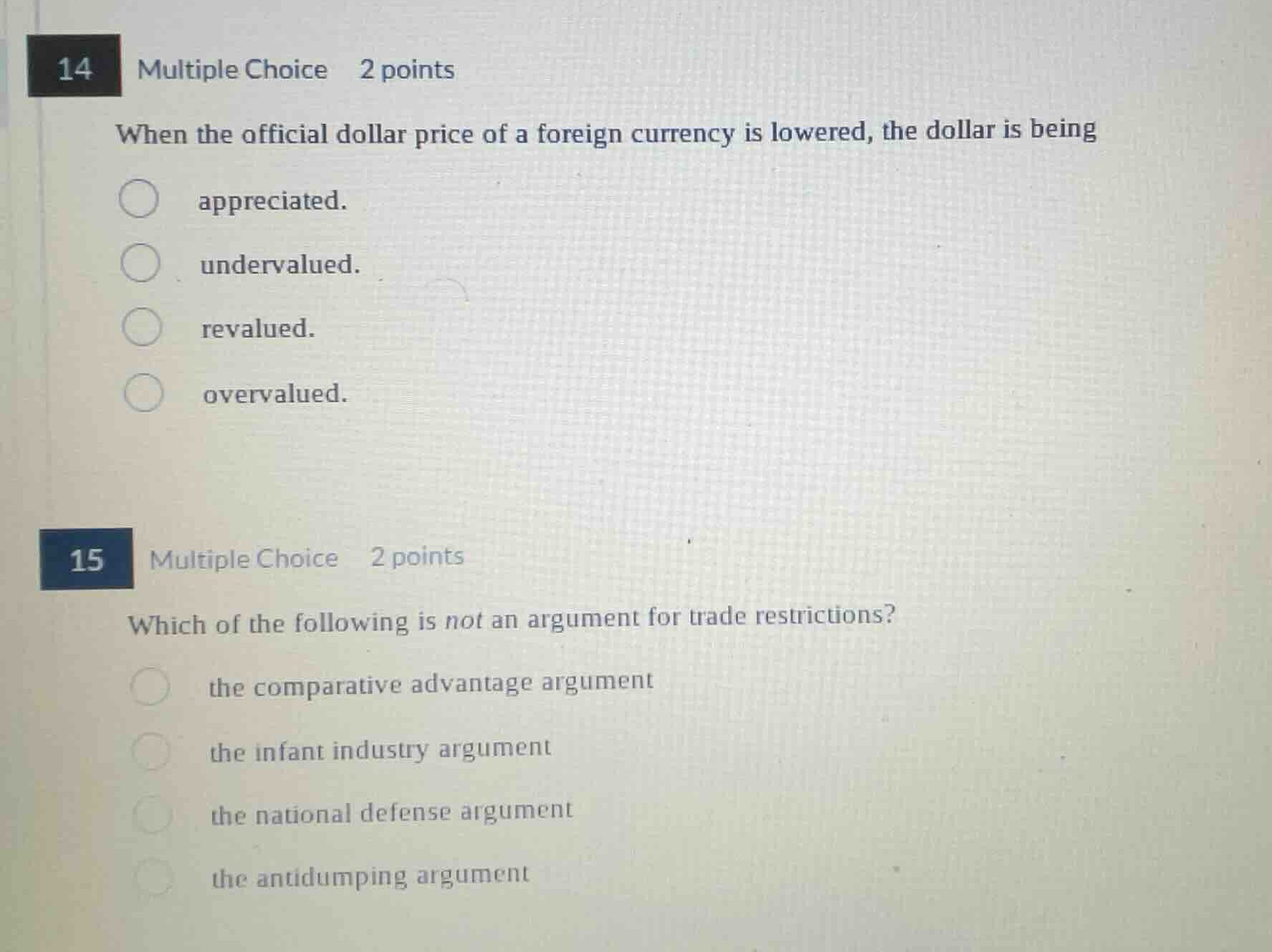
14 multiple choice 2 points
when the official dollar price of a foreign currency is lowered, the dollar is being
appreciated.
undervalued.
revalued.
overvalued.
15 multiple choice 2 points
which of the following is not an argument for trade restrictions?
the comparative advantage argument
the infant industry argument
the national defense argument
the antidumping argument
Analyze Question 14
The question asks about the effect on the dollar when the official dollar price of a foreign currency is lowered.
An "official" price change implies a fixed exchange rate system.
When the price of foreign currency in terms of dollars decreases, it takes fewer dollars to buy one unit of foreign currency.
This means the dollar's purchasing power relative to the foreign currency has increased.
In a fixed exchange rate system, an official increase in the value of a currency is called a revaluation.
Therefore, the dollar is being revalued.
Analyze Question 15
The question asks which option is not an argument for trade restrictions.
The infant industry argument, national defense argument, and antidumping argument are all standard justifications used to support trade barriers.
The comparative advantage argument, however, is the foundational economic principle showing that free trade mutually benefits countries by allowing specialization.
Thus, comparative advantage is an argument for free trade, not trade restrictions.

Snap & solve any problem in the app
Get step-by-step solutions on Sovi AI
Photo-based solutions with guided steps
Explore more problems and detailed explanations
Question 14
- appreciated.
- undervalued.
- revalued. (Correct answer)
- overvalued.
Question 15
- the comparative advantage argument (Correct answer)
- the infant industry argument
- the national defense argument
- the antidumping argument