QUESTION IMAGE
Question
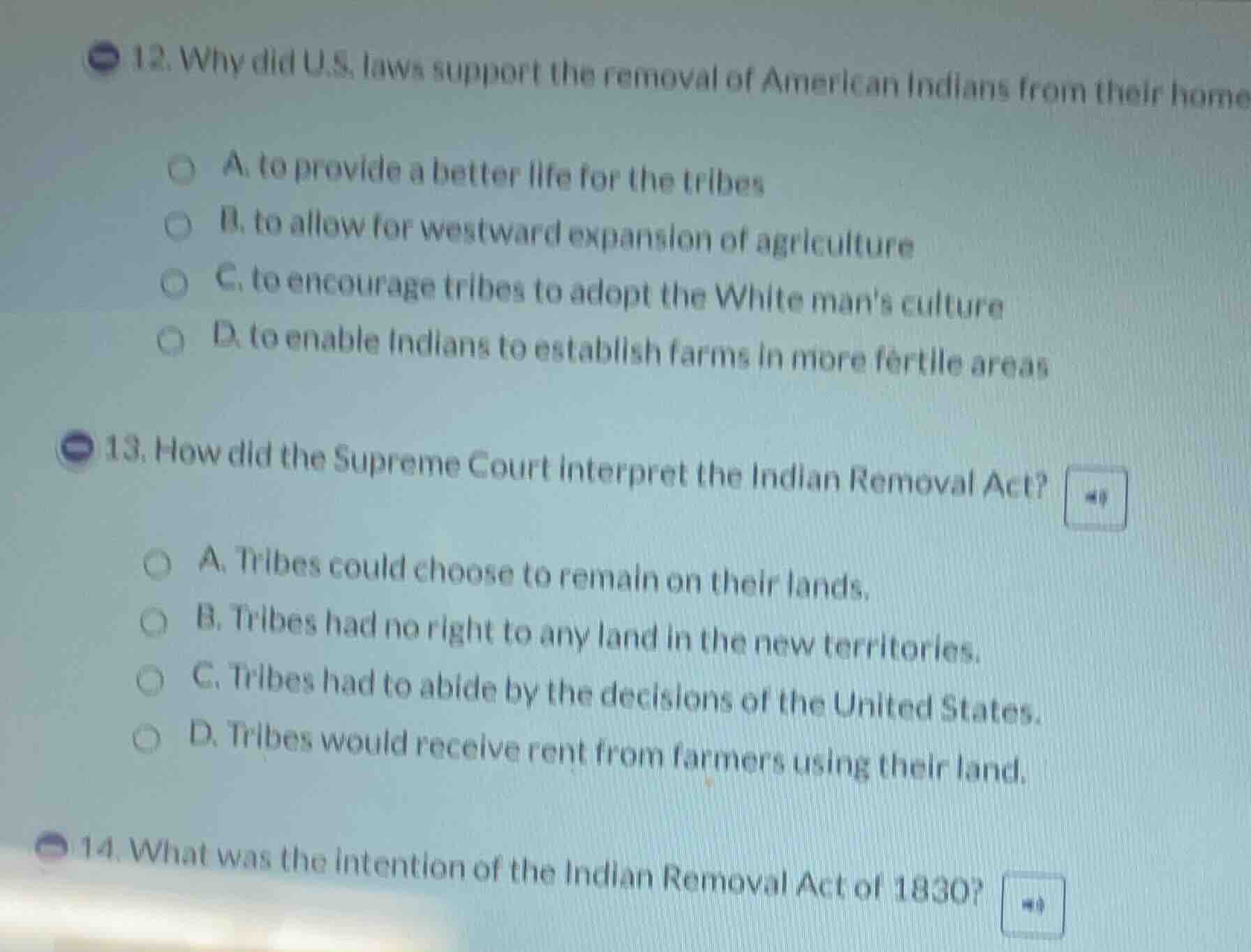
- why did u.s. laws support the removal of american indians from their home
a. to provide a better life for the tribes
b. to allow for westward expansion of agriculture
c. to encourage tribes to adopt the white mans culture
d. to enable indians to establish farms in more fertile areas
- how did the supreme court interpret the indian removal act?
a. tribes could choose to remain on their lands.
b. tribes had no right to any land in the new territories.
c. tribes had to abide by the decisions of the united states.
d. tribes would receive rent from farmers using their land.
- what was the intention of the indian removal act of 1830?
Brief Explanations
- For question 12: U.S. policymakers sought access to fertile lands in the Southeast for white agricultural expansion, which was the core driver behind laws supporting American Indian removal. Claims of "better life" or cultural adoption were secondary justifications, not the main reason.
- For question 13: In cases like Cherokee Nation v. Georgia and Worcester v. Georgia, the Supreme Court ultimately upheld that the U.S. government had authority over tribal lands, meaning tribes were required to follow U.S. decisions regarding removal.
- For question 14 (full context): The explicit intention of the 1830 Indian Removal Act was to relocate Eastern American Indian tribes to lands west of the Mississippi River, opening their ancestral lands for white settlement and agricultural expansion.

Snap & solve any problem in the app
Get step-by-step solutions on Sovi AI
Photo-based solutions with guided steps
Explore more problems and detailed explanations
- B. to allow for westward expansion of agriculture
- C. Tribes had to abide by the decisions of the United States.
- (Full intended answer: To relocate Eastern American Indian tribes to lands west of the Mississippi River to open their ancestral territories for white settlement and agricultural expansion)