QUESTION IMAGE
Question
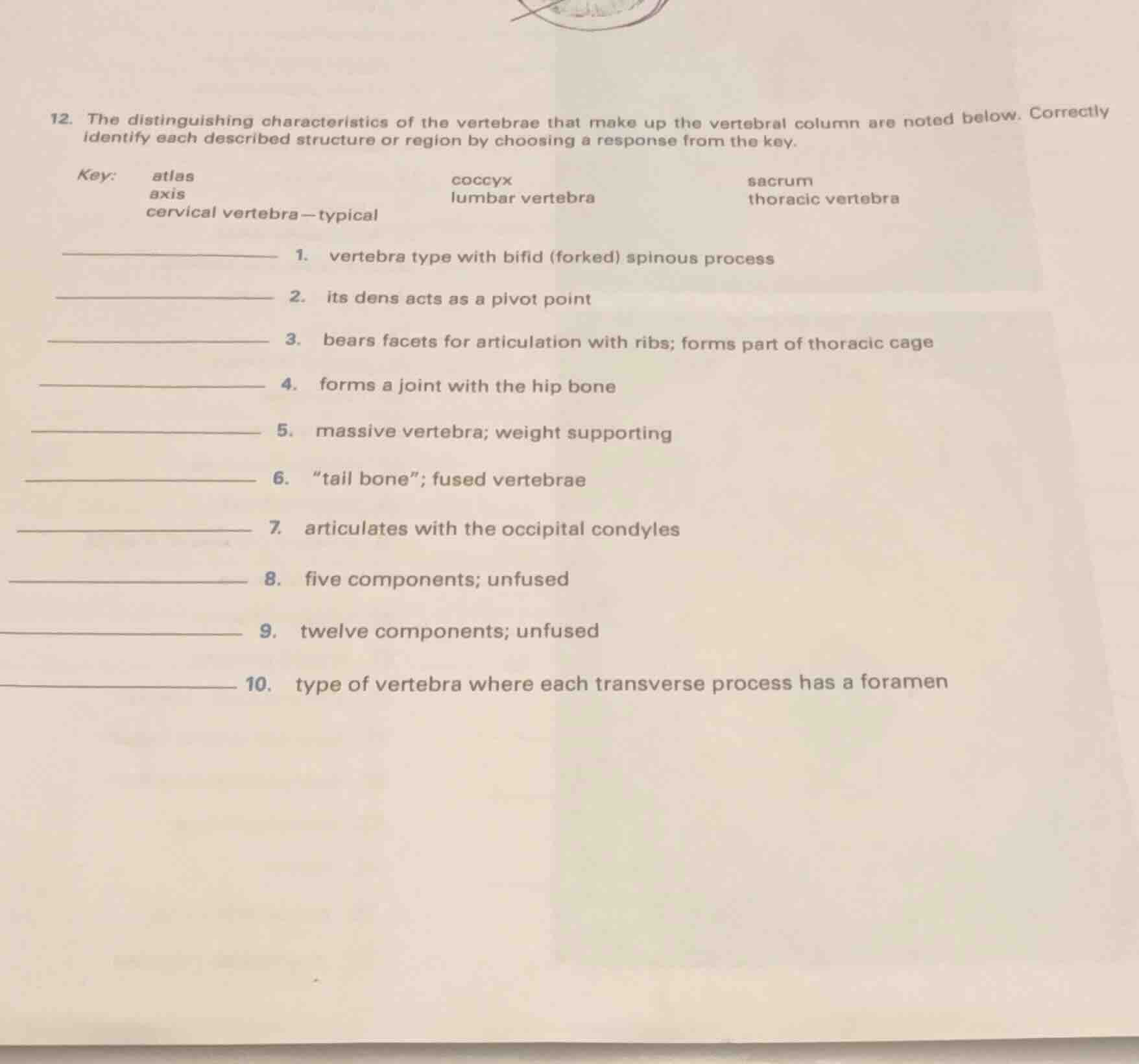
- the distinguishing characteristics of the vertebrae that make up the vertebral column are noted below. correctly identify each described structure or region by choosing a response from the key.
key: atlas
axis
cervical vertebra-typical
coccyx
lumbar vertebra
sacrum
thoracic vertebra
- vertebra type with bifid (forked) spinous process
- its dens acts as a pivot point
- bears facets for articulation with ribs; forms part of thoracic cage
- forms a joint with the hip bone
- massive vertebra; weight supporting
- \tail bone\; fused vertebrae
- articulates with the occipital condyles
- five components; unfused
- twelve components; unfused
- type of vertebra where each transverse process has a foramen
Identify cervical features
We analyze the anatomical characteristics of typical cervical vertebrae. Typical cervical vertebrae (C3–C6) are distinguished by having a bifid (forked) spinous process. Additionally, all cervical vertebrae (C1–C7) feature a transverse foramen in each transverse process to allow the passage of the vertebral arteries. Therefore, item 1 matches "cervical vertebra—typical" and item 10 matches "cervical vertebra—typical".
Identify specialized cervical vertebrae
We examine the unique features of the first two cervical vertebrae, the atlas (C1) and the axis (C2). The axis (C2) features a prominent superior projection called the dens (odontoid process), which acts as a pivot point for rotation of the head. The atlas (C1) lacks a body and spinous process, and its superior articular facets articulate directly with the occipital condyles of the skull. Thus, item 2 matches "axis" and item 7 matches "atlas".
Identify thoracic and lumbar features
We evaluate the characteristics of the thoracic and lumbar regions. Thoracic vertebrae are unique because they bear costal facets for articulation with the ribs and form the posterior part of the thoracic cage. There are twelve unfused thoracic vertebrae. Lumbar vertebrae are massive, robust structures designed for weight-bearing, and there are five unfused lumbar vertebrae. Consequently, item 3 matches "thoracic vertebra", item 5 matches "lumbar vertebra", item 8 matches "lumbar vertebra", and item 9 matches "thoracic vertebra".
Identify pelvic region structures
We analyze the bones at the inferior end of the vertebral column. The sacrum is a triangular bone formed by five fused vertebrae that articulates laterally with the hip bones (ilium) to form the sacroiliac joints. The coccyx, commonly known as the "tailbone", is located at the very end of the column and consists of three to five small, fused vertebrae. Thus, item 4 matches "sacrum" and item 6 matches "coccyx".

Snap & solve any problem in the app
Get step-by-step solutions on Sovi AI
Photo-based solutions with guided steps
Explore more problems and detailed explanations
| No. | Answer |
|---|---|
| 2 | axis |
| 3 | thoracic vertebra |
| 4 | sacrum |
| 5 | lumbar vertebra |
| 6 | coccyx |
| 7 | atlas |
| 8 | lumbar vertebra |
| 9 | thoracic vertebra |
| 10 | cervical vertebra—typical |