QUESTION IMAGE
Question
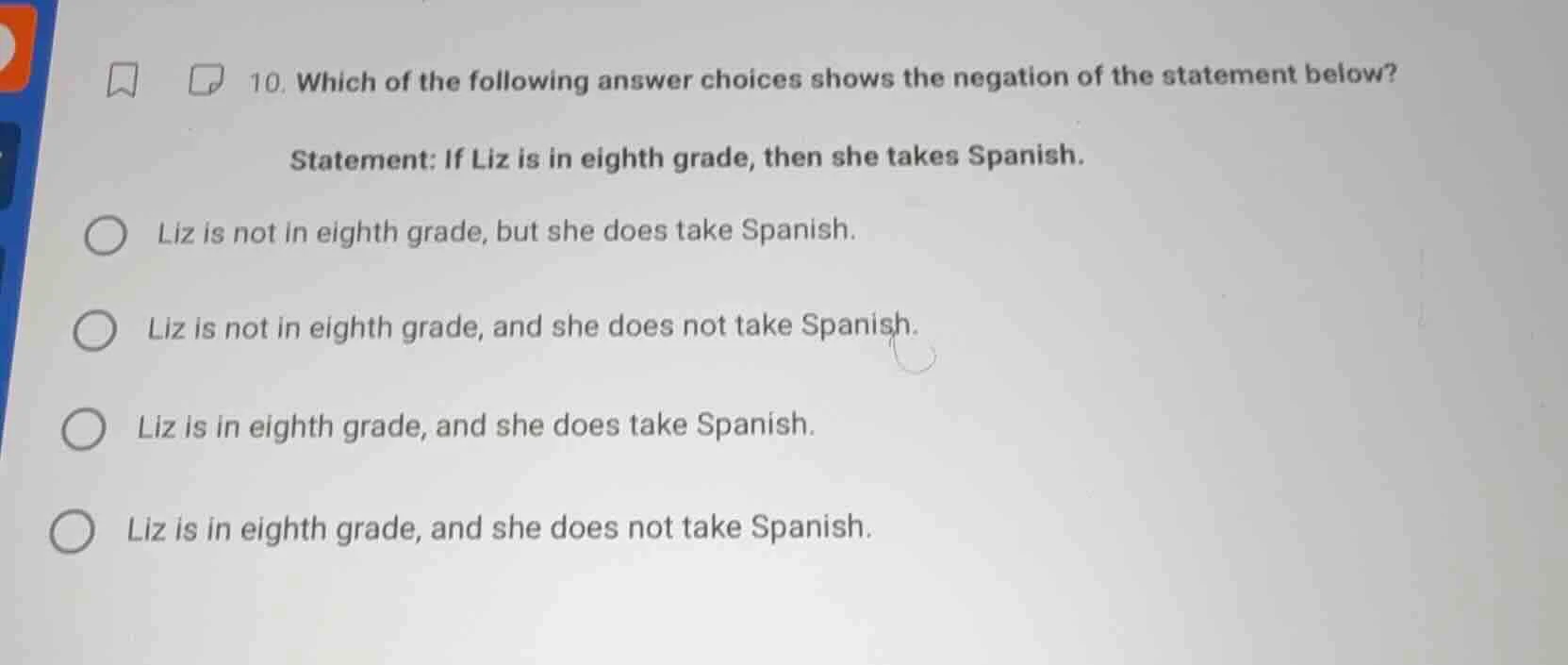
- which of the following answer choices shows the negation of the statement below?
statement: if liz is in eighth grade, then she takes spanish.
liz is not in eighth grade, but she does take spanish.
liz is not in eighth grade, and she does not take spanish.
liz is in eighth grade, and she does take spanish.
liz is in eighth grade, and she does not take spanish.
To find the negation of a conditional statement \( p \to q \) (where \( p \) is "Liz is in eighth grade" and \( q \) is "she takes Spanish"), we use the logical rule that the negation of \( p \to q \) is \( p \land
eg q \).
Step 1: Identify \( p \) and \( q \)
Let \( p \) = "Liz is in eighth grade" and \( q \) = "she takes Spanish". Then \(
eg q \) is "she does not take Spanish".
Step 2: Apply the negation rule for conditionals
The negation of \( p \to q \) is \( p \land
eg q \), which translates to "Liz is in eighth grade, and she does not take Spanish".

Snap & solve any problem in the app
Get step-by-step solutions on Sovi AI
Photo-based solutions with guided steps
Explore more problems and detailed explanations
Liz is in eighth grade, and she does not take Spanish.