QUESTION IMAGE
Question
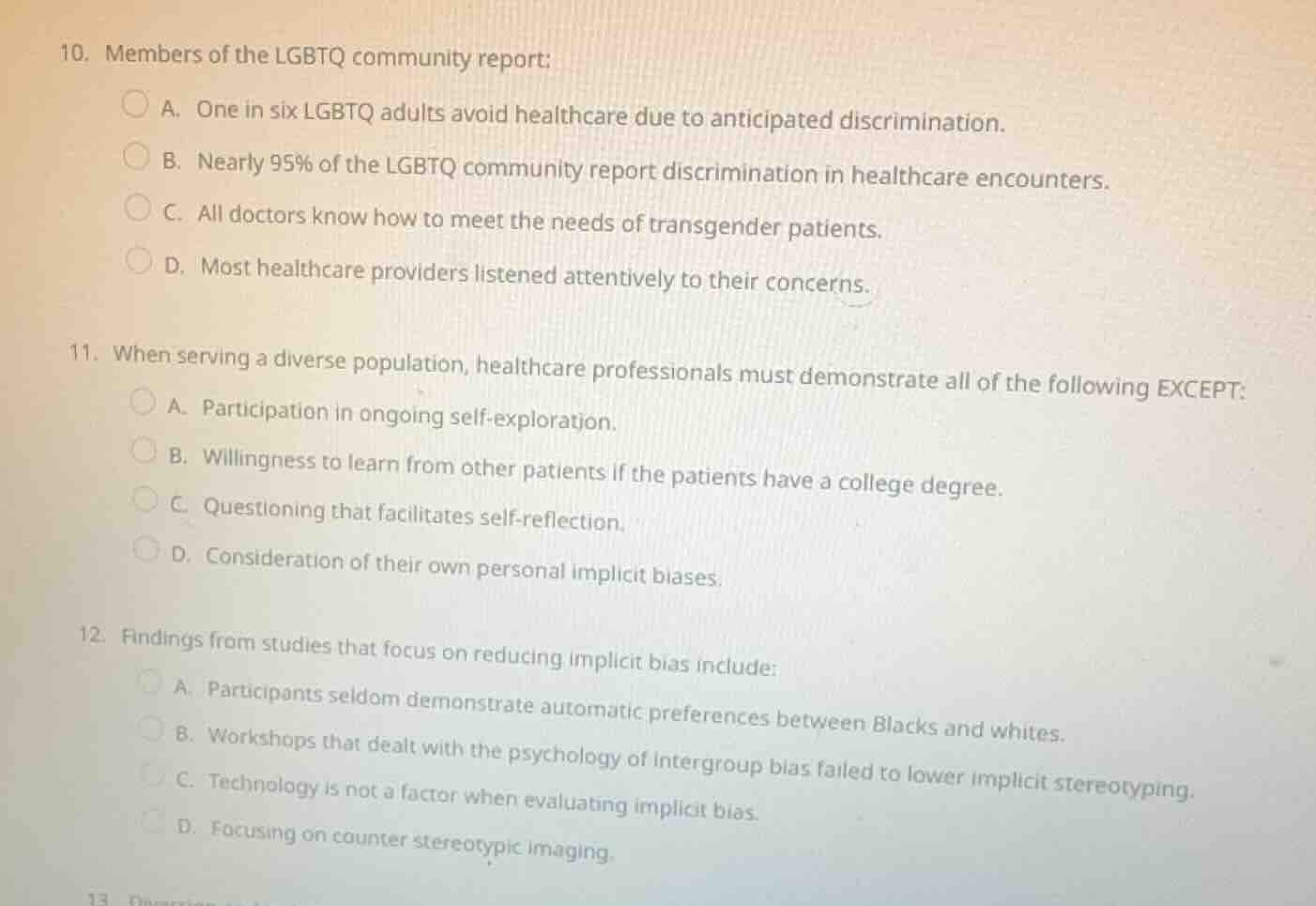
- members of the lgbtq community report:
a. one in six lgbtq adults avoid healthcare due to anticipated discrimination.
b. nearly 95% of the lgbtq community report discrimination in healthcare encounters.
c. all doctors know how to meet the needs of transgender patients.
d. most healthcare providers listened attentively to their concerns.
- when serving a diverse population, healthcare professionals must demonstrate all of the following except:
a. participation in ongoing self-exploration.
b. willingness to learn from other patients if the patients have a college degree.
c. questioning that facilitates self-reflection.
d. consideration of their own personal implicit biases.
- findings from studies that focus on reducing implicit bias include:
a. participants seldom demonstrate automatic preferences between blacks and whites.
b. workshops that dealt with the psychology of intergroup bias failed to lower implicit stereotyping.
c. technology is not a factor when evaluating implicit bias.
d. focusing on counter stereotypic imaging.
Analyze LGBTQ healthcare barriers
We examine the barriers faced by the LGBTQ community in healthcare settings. Studies show that a significant portion of LGBTQ individuals avoid or delay seeking medical care due to fear of discrimination or past negative experiences. Specifically, research indicates that approximately one in six LGBTQ adults avoid seeking healthcare due to anticipated discrimination. Other options are incorrect because nearly 95% is an overstatement of reported discrimination in encounters, and many doctors still lack training on transgender-specific medical needs. Thus, option A is the correct finding. We apply our understanding of LGBTQ Healthcare Barriers to identify this.
Evaluate cultural competency requirements
We evaluate the professional expectations for healthcare providers serving diverse populations. Cultural humility and competency require continuous self-exploration, self-reflection, and awareness of one's own implicit biases. These practices must be applied universally to all patients, regardless of their socioeconomic status or educational background. Therefore, limiting the willingness to learn from patients only to those who "have a college degree" is highly inappropriate and discriminatory. This makes option B the correct "EXCEPT" choice. We utilize our knowledge of Implicit Bias to recognize this.
Identify strategies to reduce implicit bias
We analyze evidence-based interventions designed to reduce implicit bias in healthcare. Research on cognitive interventions shows that focusing on counter-stereotypic imaging—where individuals actively visualize detailed counter-stereotypical examples—is an effective strategy to weaken automatic stereotypic associations. Other options are incorrect because participants frequently demonstrate automatic preferences, workshops have shown success in lowering stereotyping, and technology is indeed used to evaluate bias. Thus, option D is the correct finding. We apply our understanding of Implicit Bias in Healthcare to determine this.

Snap & solve any problem in the app
Get step-by-step solutions on Sovi AI
Photo-based solutions with guided steps
Explore more problems and detailed explanations
Question 10
- A. One in six LGBTQ adults avoid healthcare due to anticipated discrimination. (Correct answer)
- B. Nearly 95% of the LGBTQ community report discrimination in healthcare encounters.
- C. All doctors know how to meet the needs of transgender patients.
- D. Most healthcare providers listened attentively to their concerns.
Question 11
- A. Participation in ongoing self-exploration.
- B. Willingness to learn from other patients if the patients have a college degree. (Correct answer)
- C. Questioning that facilitates self-reflection.
- D. Consideration of their own personal implicit biases.
Question 12
- A. Participants seldom demonstrate automatic preferences between Blacks and whites.
- B. Workshops that dealt with the psychology of intergroup bias failed to lower implicit stereotyping.
- C. Technology is not a factor when evaluating implicit bias.
- D. Focusing on counter stereotypic imaging. (Correct answer)