QUESTION IMAGE
Question
- (06.02 mc)
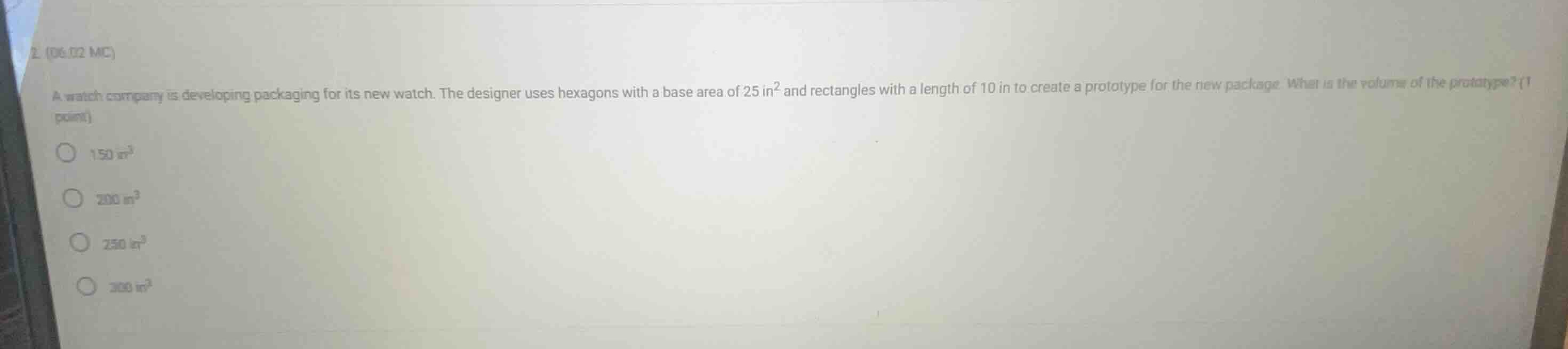
a watch company is developing packaging for its new watch. the designer uses hexagons with a base area of \\(25\text{ in}^2\\) and rectangles with a length of \\(10\text{ in}\\) to create a prototype for the new package. what is the volume of the prototype? (1 point)
- \\(150\text{ in}^3\\)
- \\(200\text{ in}^3\\)
- \\(250\text{ in}^3\\)
- \\(300\text{ in}^3\\)
<pre_analysis>
{
"quality": "clear",
"question_count": 1,
"skills_matched": [
"step_cot",
"multiple_choice_formatter",
"explain_then_answer",
"quick"
],
"needs_drawing": false,
"concepts_used": [],
"new_concepts": [
"Volume of Prisms",
"Hexagonal Prism"
],
"current_concepts": [
"Volume of Prisms",
"Hexagonal Prism"
]
}
</pre_analysis>
<reasoning>
Identify the geometric solid
The packaging prototype is constructed using hexagons as bases and rectangles as lateral faces, which forms a right hexagonal prism.
Determine the given parameters
The base area \(B\) of the hexagonal base is:
\[B = 25\text{ in}^2\]
The length of the rectangles represents the height \(h\) of the prism:
\[h = 10\text{ in}\]
Calculate the volume
The volume \(V\) of a prism is calculated by multiplying the base area by the height:
\[V = B \times h\]
\[V = 25\text{ in}^2 \times 10\text{ in} = 250\text{ in}^3\]
</reasoning>
<answer>
<mcq-option>(A) \(150\text{ in}^3\)</mcq-option>
<mcq-option>(B) \(200\text{ in}^3\)</mcq-option>
<mcq-correct>(C) \(250\text{ in}^3\)</mcq-correct>
<mcq-option>(D) \(300\text{ in}^3\)</mcq-option>
</answer>
<post_analysis>
{
"subject": "Mathematics",
"question_type": "Multiple Choice",
"knowledge_point": [
"Mathematics",
"Geometry",
"Volume of Prisms"
]
}
</post_analysis>
Snap & solve any problem in the app
Get step-by-step solutions on Sovi AI
Photo-based solutions with guided steps
Explore more problems and detailed explanations
<pre_analysis>
{
"quality": "clear",
"question_count": 1,
"skills_matched": [
"step_cot",
"multiple_choice_formatter",
"explain_then_answer",
"quick"
],
"needs_drawing": false,
"concepts_used": [],
"new_concepts": [
"Volume of Prisms",
"Hexagonal Prism"
],
"current_concepts": [
"Volume of Prisms",
"Hexagonal Prism"
]
}
</pre_analysis>
<reasoning>
Identify the geometric solid
The packaging prototype is constructed using hexagons as bases and rectangles as lateral faces, which forms a right hexagonal prism.
Determine the given parameters
The base area \(B\) of the hexagonal base is:
\[B = 25\text{ in}^2\]
The length of the rectangles represents the height \(h\) of the prism:
\[h = 10\text{ in}\]
Calculate the volume
The volume \(V\) of a prism is calculated by multiplying the base area by the height:
\[V = B \times h\]
\[V = 25\text{ in}^2 \times 10\text{ in} = 250\text{ in}^3\]
</reasoning>
<answer>
<mcq-option>(A) \(150\text{ in}^3\)</mcq-option>
<mcq-option>(B) \(200\text{ in}^3\)</mcq-option>
<mcq-correct>(C) \(250\text{ in}^3\)</mcq-correct>
<mcq-option>(D) \(300\text{ in}^3\)</mcq-option>
</answer>
<post_analysis>
{
"subject": "Mathematics",
"question_type": "Multiple Choice",
"knowledge_point": [
"Mathematics",
"Geometry",
"Volume of Prisms"
]
}
</post_analysis>