QUESTION IMAGE
Question
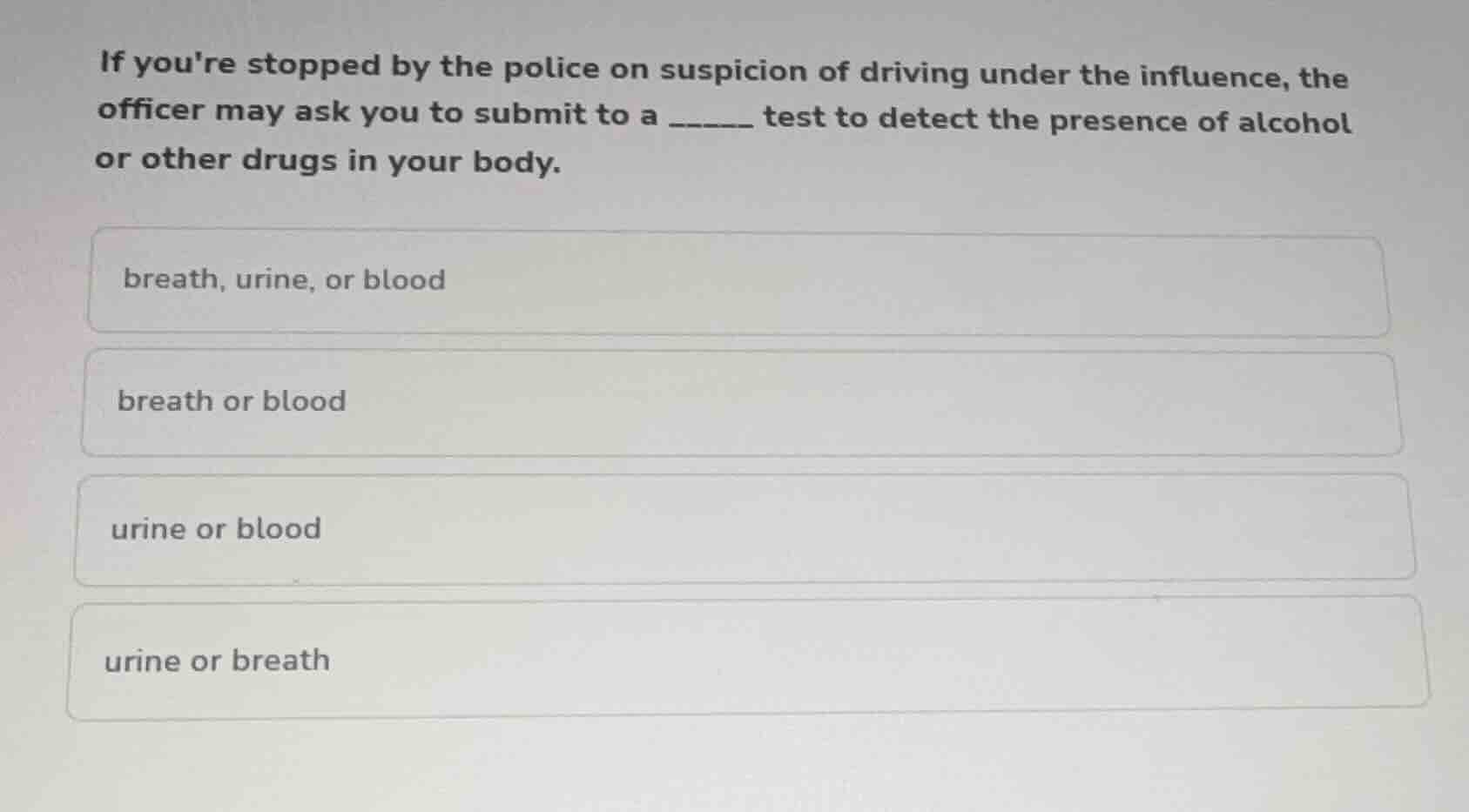
if youre stopped by the police on suspicion of driving under the influence, the officer may ask you to submit to a _____ test to detect the presence of alcohol or other drugs in your body.
breath, urine, or blood
breath or blood
urine or blood
urine or breath
<pre_analysis>
{
"quality": "clear",
"question_count": 1,
"skills_matched": [
"direct_cot",
"multiple_choice_formatter",
"explain_then_answer",
"quick"
],
"needs_drawing": false,
"concepts_used": [],
"new_concepts": [
"Implied Consent Law",
"DUI Testing"
],
"current_concepts": [
"Implied Consent Law",
"DUI Testing",
"Florida Traffic Law"
]
}
</pre_analysis>
<reasoning>
Analyze the legal requirements for DUI testing
Under traffic laws (such as Florida's Implied Consent Law), any person who operates a motor vehicle is deemed to have given consent to submit to approved chemical or physical tests. These tests are used to determine the presence and concentration of alcohol or other controlled substances.
Identify the approved test types
The law specifies that a driver suspected of driving under the influence (DUI) may be asked to submit to a breath test, a urine test, or a blood test depending on the circumstances (e.g., breath for alcohol, urine for drugs, or blood in cases of serious injury or death).
Evaluate the given options
- "breath, urine, or blood": This option correctly lists all three standard chemical tests authorized under implied consent laws.
- "breath or blood": Incomplete, as it omits urine testing.
- "urine or blood": Incomplete, as it omits breath testing.
- "urine or breath": Incomplete, as it omits blood testing.
</reasoning>
<answer>
<mcq-correct>breath, urine, or blood</mcq-correct>
<mcq-option>breath or blood</mcq-option>
<mcq-option>urine or blood</mcq-option>
<mcq-option>urine or breath</mcq-option>
</answer>
<post_analysis>
{
"subject": "Social Science",
"question_type": "Multiple Choice",
"knowledge_point": [
"Social Science",
"Law",
"Traffic Law and Regulations"
]
}
</post_analysis>
Snap & solve any problem in the app
Get step-by-step solutions on Sovi AI
Photo-based solutions with guided steps
Explore more problems and detailed explanations
<pre_analysis>
{
"quality": "clear",
"question_count": 1,
"skills_matched": [
"direct_cot",
"multiple_choice_formatter",
"explain_then_answer",
"quick"
],
"needs_drawing": false,
"concepts_used": [],
"new_concepts": [
"Implied Consent Law",
"DUI Testing"
],
"current_concepts": [
"Implied Consent Law",
"DUI Testing",
"Florida Traffic Law"
]
}
</pre_analysis>
<reasoning>
Analyze the legal requirements for DUI testing
Under traffic laws (such as Florida's Implied Consent Law), any person who operates a motor vehicle is deemed to have given consent to submit to approved chemical or physical tests. These tests are used to determine the presence and concentration of alcohol or other controlled substances.
Identify the approved test types
The law specifies that a driver suspected of driving under the influence (DUI) may be asked to submit to a breath test, a urine test, or a blood test depending on the circumstances (e.g., breath for alcohol, urine for drugs, or blood in cases of serious injury or death).
Evaluate the given options
- "breath, urine, or blood": This option correctly lists all three standard chemical tests authorized under implied consent laws.
- "breath or blood": Incomplete, as it omits urine testing.
- "urine or blood": Incomplete, as it omits breath testing.
- "urine or breath": Incomplete, as it omits blood testing.
</reasoning>
<answer>
<mcq-correct>breath, urine, or blood</mcq-correct>
<mcq-option>breath or blood</mcq-option>
<mcq-option>urine or blood</mcq-option>
<mcq-option>urine or breath</mcq-option>
</answer>
<post_analysis>
{
"subject": "Social Science",
"question_type": "Multiple Choice",
"knowledge_point": [
"Social Science",
"Law",
"Traffic Law and Regulations"
]
}
</post_analysis>