QUESTION IMAGE
Question
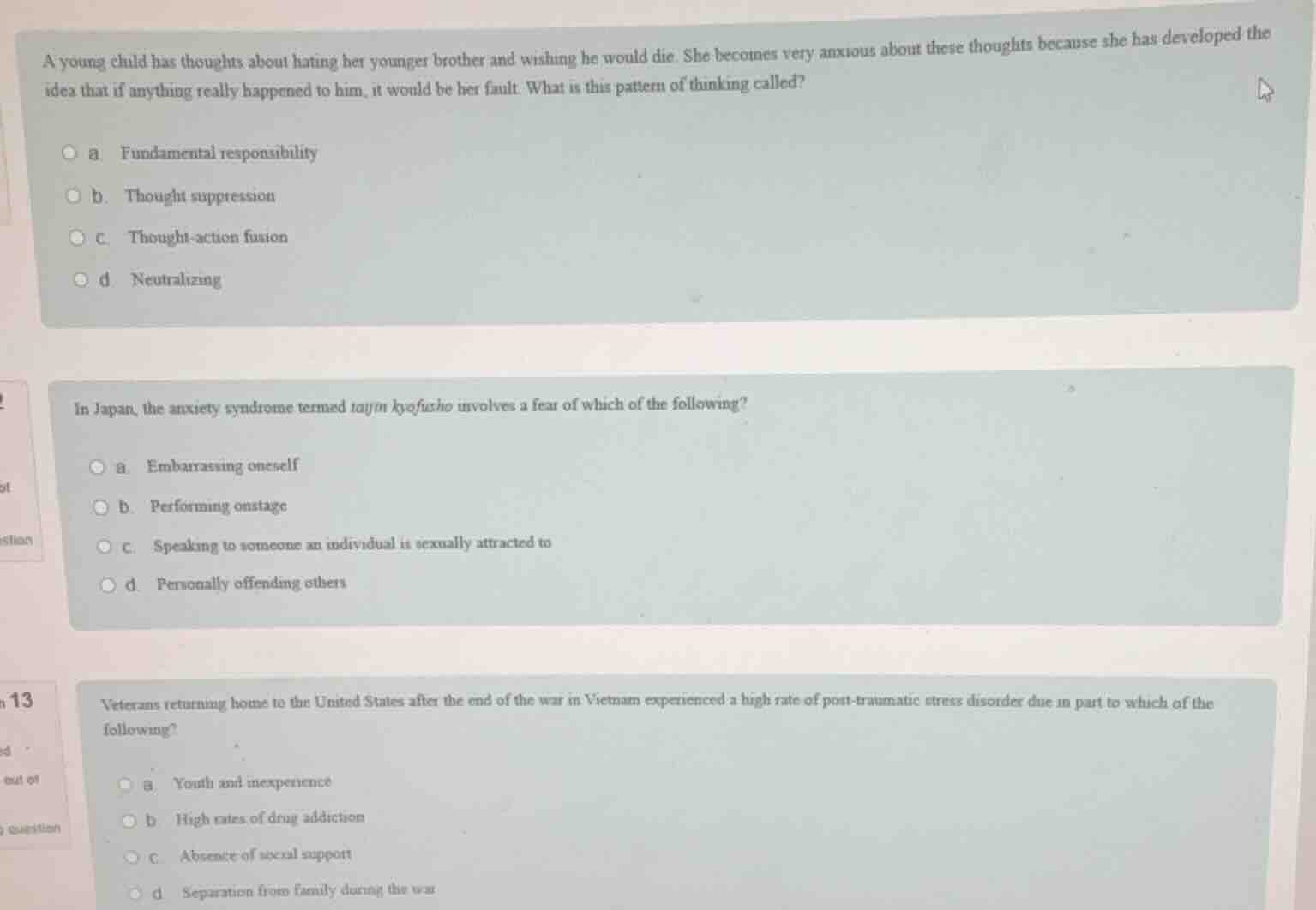
a young child has thoughts about hating her younger brother and wishing he would die. she becomes very anxious about these thoughts because she has developed the idea that if anything really happened to him, it would be her fault. what is this pattern of thinking called?
a. fundamental responsibility
b. thought suppression
c. thought-action fusion
d. neutralizing
in japan, the anxiety syndrome termed taijin kyofusho involves a fear of which of the following?
a. embarrassing oneself
b. performing onstage
c. speaking to someone an individual is sexually attracted to
d. personally offending others
veterans returning home to the united states after the end of the war in vietnam experienced a high rate of post-traumatic stress disorder due in part to which of the following?
a. youth and inexperience
b. high rates of drug addiction
c. absence of social support
d. separation from family during the war
Analyze the first question
The first question describes a child who believes that having negative thoughts about her brother means she is responsible if something bad actually happens to him. This cognitive bias, where a person believes thoughts are equivalent to actions or can directly cause real-world outcomes, is known as Thought-action fusion.
Analyze the second question
The second question asks about taijin kyofusho, a culture-bound anxiety syndrome prevalent in Japan. Unlike Western social anxiety disorder, which primarily involves a fear of embarrassing oneself, taijin kyofusho is characterized by an intense fear of offending, displeasing, or embarrassing others (e.g., through one's gaze, body odor, or facial expressions). Thus, the correct option is Personally offending others.
Analyze the third question
The third question asks about a key contributing factor to the high rates of post-traumatic stress disorder (PTSD) among Vietnam War veterans returning to the United States. A major, well-documented psychosocial factor was the lack of public acceptance and the Absence of social support upon their return home, which significantly hindered their psychological recovery.

Snap & solve any problem in the app
Get step-by-step solutions on Sovi AI
Photo-based solutions with guided steps
Explore more problems and detailed explanations
Question 1
- a. Fundamental responsibility
- b. Thought suppression
- c. Thought-action fusion (Correct answer)
- d. Neutralizing
Question 2
- a. Embarrassing oneself
- b. Performing onstage
- c. Speaking to someone an individual is sexually attracted to
- d. Personally offending others (Correct answer)
Question 3
- a. Youth and inexperience
- b. High rates of drug addiction
- c. Absence of social support (Correct answer)
- d. Separation from family during the war