QUESTION IMAGE
Question
第6問 次の英文を読んで以下の問いに答えなさい。
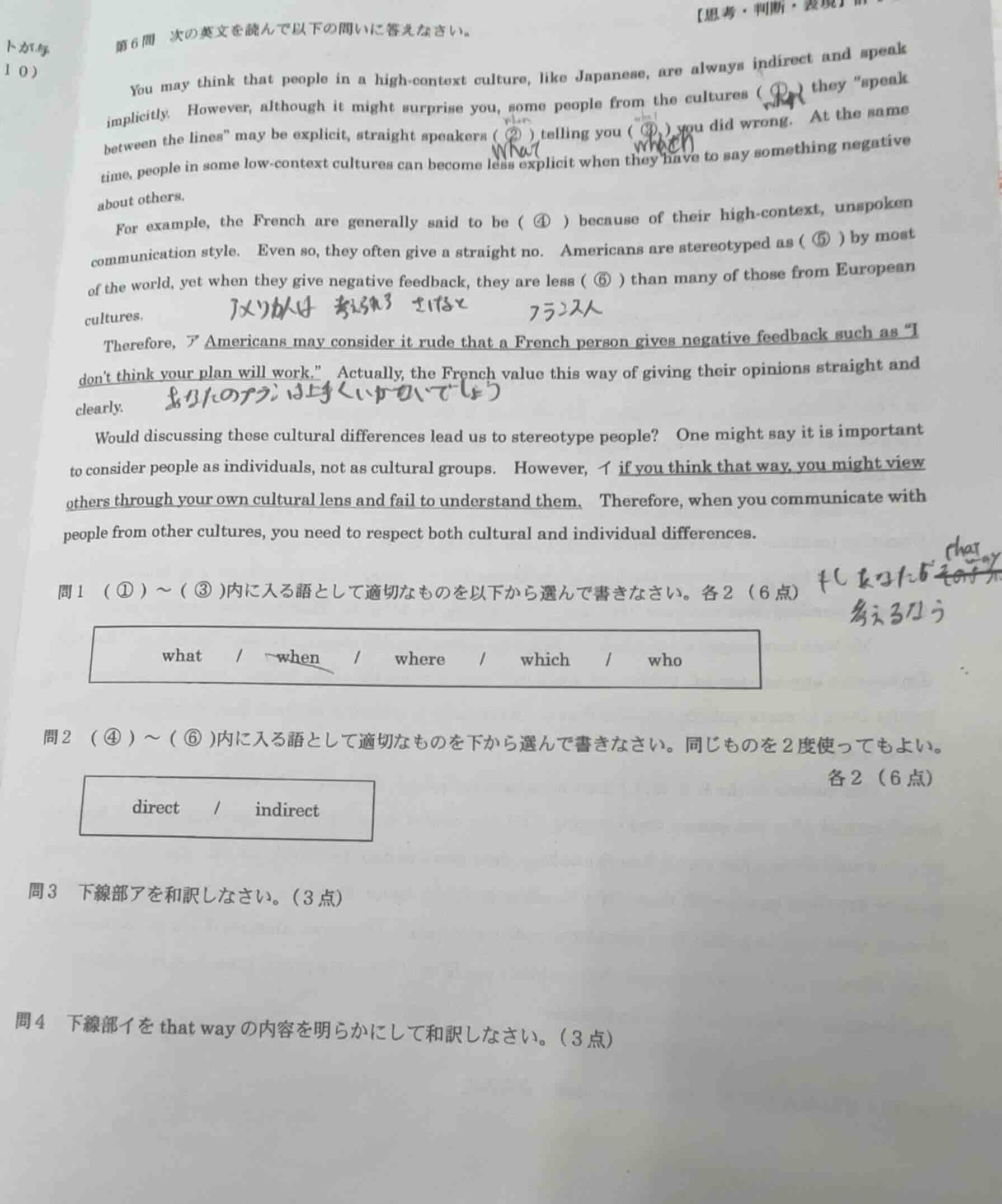
you may think that people in a high-context culture, like japanese, are always indirect and speak implicitly. however, although it might surprise you, some people from the cultures ( ① ) they \speak between the lines\ may be explicit, straight speakers ( ② ) telling you ( ③ ) you did wrong. at the same time, people in some low-context cultures can become less explicit when they have to say something negative about others.
for example, the french are generally said to be ( ④ ) because of their high-context, unspoken communication style. even so, they often give a straight no. americans are stereotyped as ( ⑤ ) by most of the world, yet when they give negative feedback, they are less ( ⑥ ) than many of those from european cultures.
therefore, ア americans may consider it rude that a french person gives negative feedback such as \i dont think your plan will work.\ actually, the french value this way of giving their opinions straight and clearly.
would discussing these cultural differences lead us to stereotype people? one might say it is important to consider people as individuals, not as cultural groups. however, イ if you think that way, you might view others through your own cultural lens and fail to understand them. therefore, when you communicate with people from other cultures, you need to respect both cultural and individual differences.
問1 ( ① ) ~ ( ③ )内に入る語として適切なものを以下から選んで書きなさい。各2(6点)
what / when / where / which / who
問2 ( ④ ) ~ ( ⑥ )内に入る語として適切なものを下から選んで書きなさい。同じものを2度使ってもよい。各2(6点)
direct / indirect
問3 下線部アを和訳しなさい。(3点)
問4 下線部イを that way の内容を明らかにして和訳しなさい。(3点)
問1の文脈と文法構造の分析
空所 (①) 〜 (③) を含む一文を分析します。
"some people from the cultures ( ① ) they "speak between the lines" may be explicit, straight speakers ( ② ) telling you ( ③ ) you did wrong."
- 空所 (①) の検討:
先行詞は "the cultures"(場所・抽象的な環境)です。後ろの節 "they "speak between the lines""(彼らは行間を読む/遠回しに言う)は、主語 (they) と動詞句 (speak between the lines) が揃った完全な文です。したがって、関係副詞の where が適切です。
(「彼らが『行間を読む(遠回しな表現をする)』文化の出身の人々」という意味になります)
- 空所 (②) の検討:
"straight speakers ( ② ) telling you..."
ここでは「〜するときに」という時を表す接続詞、または分詞構文を導く接続詞 when が適切です。"when telling you..." で「あなたに伝えるときに」という意味を形成します。
- 空所 (③) の検討:
"telling you ( ③ ) you did wrong."
動詞 "did" の目的語が欠けている不完全な節を導き、全体として "telling" の間接目的語 "you" に対する直接目的語(名詞節)を作る必要があります。「あなたが間違って行ったこと」という意味にするため、関係代名詞の what が適切です。
問2の文脈と意味の分析
空所 (④) 〜 (⑥) には "direct"(直接的な)または "indirect"(間接的な)が入ります。
- 空所 (④) の検討:
"For example, the French are generally said to be ( ④ ) because of their high-context, unspoken communication style."
「ハイコンテクストで、言葉に表さないコミュニケーションスタイル」を持つため、フランス人は一般的に「間接的」であると言われています。したがって、(④) は indirect です。
- 空所 (⑤) の検討:
"Americans are stereotyped as ( ⑤ ) by most of the world..."
「アメリカ人は世界の大半から( ⑤ )であるというステレオタイプを持たれている」
文脈上、アメリカ人は一般的に「直接的(ストレート)」な表現を好むとされるため、(⑤) は direct が適切です。
- 空所 (⑥) の検討:
"...yet when they give negative feedback, they are less ( ⑥ ) than many of those from European cultures."
「しかし、彼ら(アメリカ人)が否定的なフィードバックを与えるとき、ヨーロッパ文化圏の多くの人々ほど( ⑥ )ではない(=より間接的になる)。」
直前の文で、フランス人(ヨーロッパ文化)はストレートに "no" と言うことがあると述べられています。アメリカ人は否定的なフィードバックの際には、ヨーロッパ人ほど「直接的」ではなくなる(less direct)ため、(⑥) は direct が適切です。
問3の下線部アの和訳
下線部ア: "Americans may consider it rude that a French person gives negative feedback such as "I don't think your plan will work.""
- 構造解析:
- 主語: Americans(アメリカ人は)
- 助動詞 + 動詞: may consider(〜と思うかもしれない、見なすかもしれない)
- 形式目的語: it
- 補語: rude(失礼だと)
- 真目的語: that a French person gives negative feedback such as...(フランス人が...のような否定的なフィードバックを与えることを)
- "such as..." の部分: 「『あなたの計画はうまくいかないと思います』といった」
- 和訳の組み立て:
「アメリカ人は、フランス人が『あなたの計画はうまくいかないと思います』といった否定的なフィードバックを与えることを、失礼だと見なすかもしれない。」
問4の下線部イの和訳と指示内容の明確化
下線部イ: "if you think that way, you might view others through your own cultural lens and fail to understand them."
- "that way"(そのように)の指示内容の特定:
直前の文 "One might say it is important to consider people as individuals, not as cultural groups."(人々を文化的な集団としてではなく、個人として捉えることが重要だと言う人がいるかもしれない)を指します。
つまり、「人々を文化的な集団としてではなく、個人としてのみ捉える(文化的な違いを無視する)こと」を意味します。
- 和訳の組み立て:
- "if you think that way": もしそのように(=文化的な違いを無視して、人々を個人としてのみ捉えるように)考えるなら、
- "you might view others through your own cultural lens": 自分自身の文化的なフィルター(レンズ)を通して他者を見てしまい、
- "and fail to understand them": 彼らを理解できなくなるかもしれない。
- 統合した訳:
「もしそのように(人々を文化的な集団としてではなく個人としてのみ捉えるように)考えるなら、あなたは自分自身の文化的なレンズを通して他者を見てしまい、彼らを理解できなくなるかもしれない。」

Snap & solve any problem in the app
Get step-by-step solutions on Sovi AI
Photo-based solutions with guided steps
Explore more problems and detailed explanations
Question 1
(①) where
(②) when
(③) what
Question 2
(④) indirect
(⑤) direct
(⑥) direct
Question 3
アメリカ人は、フランス人が「あなたの計画はうまくいかないと思います」というような否定的なフィードバックを与えることを、失礼だと見なすかもしれない。
Question 4
【that wayの具体的内容】
人々を文化的な集団としてではなく、個人としてのみ捉える(文化的な違いを考慮しない)こと。
【和訳】
もしそのように(文化的な違いを考慮せず、個人としてのみ捉えるように)考えるなら、あなたは自分自身の文化的なレンズを通して他者を見てしまい、彼らを理解できなくなるかもしれない。