QUESTION IMAGE
Question
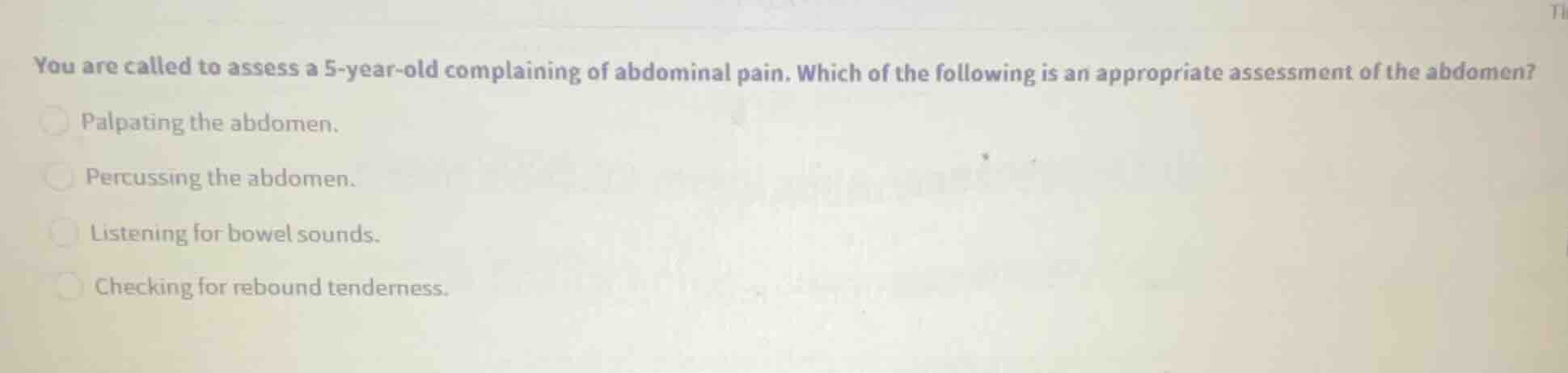
you are called to assess a 5-year-old complaining of abdominal pain. which of the following is an appropriate assessment of the abdomen?
palpating the abdomen.
percussing the abdomen.
listening for bowel sounds.
checking for rebound tenderness.
Identify the clinical context
The scenario involves assessing a 5-year-old pediatric patient complaining of abdominal pain in a prehospital or emergency medical services (EMS) setting. Pediatric patients require gentle, non-invasive, and age-appropriate assessment techniques to avoid causing unnecessary anxiety, pain, or guarding.
Evaluate the assessment options
- Palpating the abdomen: Palpation is a standard, essential component of the prehospital abdominal assessment. It allows the provider to check for localized tenderness, rigidity, guarding, or masses. In a pediatric patient, this should be done gently, starting away from the area of pain.
- Percussing the abdomen: Percussion is generally not performed in the prehospital setting by EMTs/paramedics as it provides limited diagnostic utility in the field and can be difficult to interpret.
- Listening for bowel sounds: Auscultation of bowel sounds is rarely useful or reliable in the prehospital environment due to ambient noise (sirens, engine noise, road noise) and does not alter immediate prehospital management.
- Checking for rebound tenderness: Rebound tenderness (pressing down and releasing quickly to check for peritoneal irritation) is highly painful and can cause severe distress, guarding, and loss of trust in a 5-year-old child. It is generally avoided or modified in pediatric prehospital assessments.
Determine the most appropriate action
Using Pediatric Emergencies assessment principles, gentle palpation of the abdomen is the standard, appropriate, and expected physical exam technique to identify life-threatening abdominal conditions in the field.

Snap & solve any problem in the app
Get step-by-step solutions on Sovi AI
Photo-based solutions with guided steps
Explore more problems and detailed explanations
- Palpating the abdomen. (Correct answer)
- Percussing the abdomen.
- Listening for bowel sounds.
- Checking for rebound tenderness.