QUESTION IMAGE
Question
year 9 (core) linear relationships
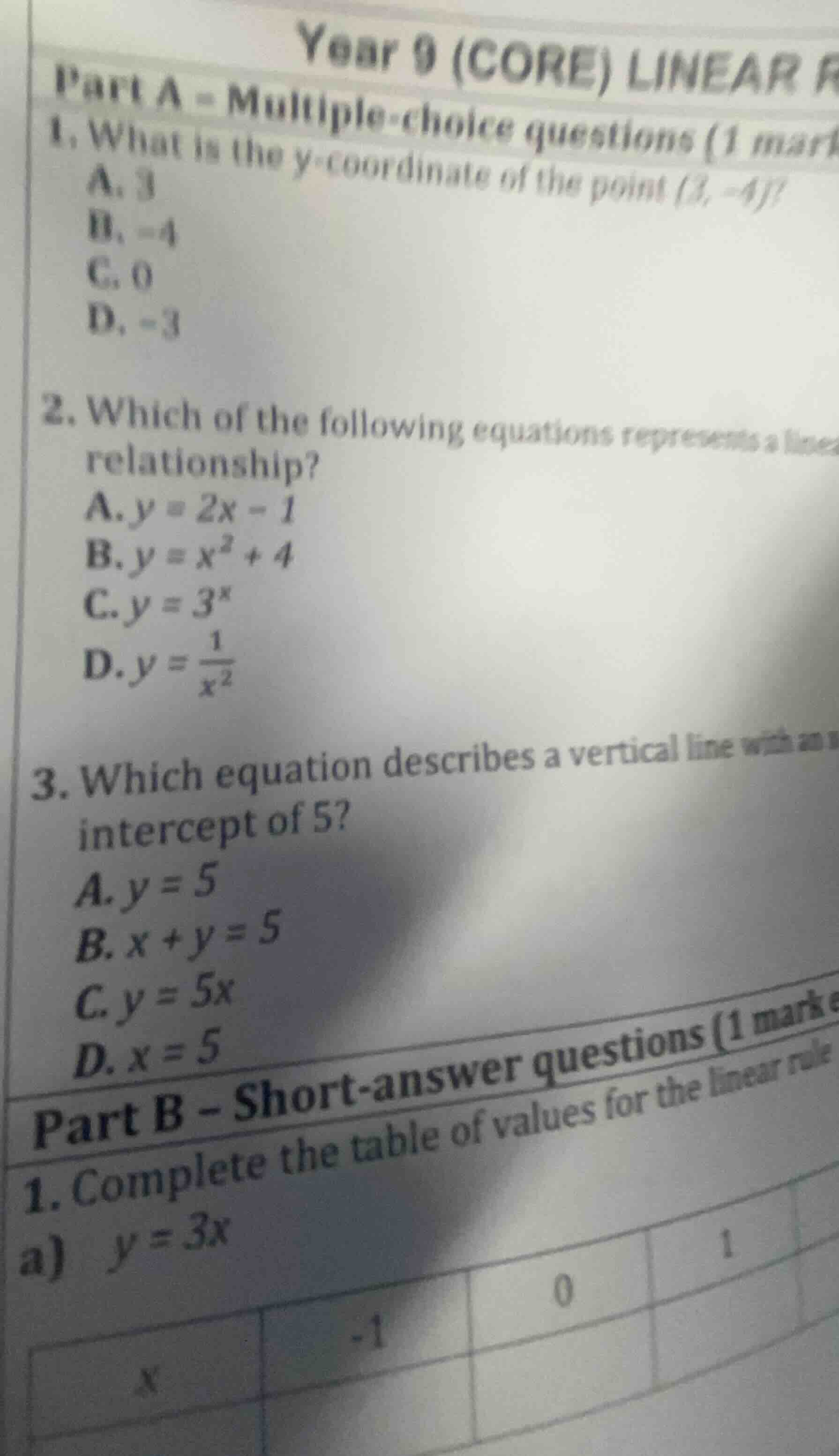
part a - multiple-choice questions (1 mark each)
- what is the y-coordinate of the point \\((3, -4)\\)?
a. 3
b. -4
c. 0
d. -3
- which of the following equations represents a linear relationship?
a. \\(y = 2x - 1\\)
b. \\(y = x^2 + 4\\)
c. \\(y = 3^x\\)
d. \\(y = \frac{1}{x^2}\\)
- which equation describes a vertical line with an x-intercept of 5?
a. \\(y = 5\\)
b. \\(x + y = 5\\)
c. \\(y = 5x\\)
d. \\(x = 5\\)
part b - short-answer questions (1 mark each)
- complete the table of values for the linear rule
a) \\(y = 3x\\)
Identify the y-coordinate of the point
For any ordered pair \((x, y)\), the first number represents the \(x\)-coordinate and the second number represents the \(y\)-coordinate.
Given the point \((3, -4)\):
- The \(x\)-coordinate is \(3\).
- The \(y\)-coordinate is \(-4\).
Determine the linear relationship
A linear relationship is represented by an equation of the form \(y = mx + c\), where the variables \(x\) and \(y\) are to the first power.
- Option A: \(y = 2x - 1\) is in the form \(y = mx + c\). This is linear.
- Option B: \(y = x^2 + 4\) contains \(x^2\), which is quadratic.
- Option C: \(y = 3^x\) contains \(x\) in the exponent, which is exponential.
- Option D: \(y = \frac{1}{x^2}\) contains \(x\) in the denominator with power \(2\), which is non-linear.
Identify the vertical line equation
A vertical line has a constant \(x\)-value for all points on the line. Its equation is always in the form \(x = k\), where \(k\) is the \(x\)-intercept.
- The question asks for a vertical line with an \(x\)-intercept of \(5\).
- This corresponds to the equation \(x = 5\).
Complete the table of values
The given linear rule is \(y = 3x\). We substitute each given \(x\)-value into the rule to find the corresponding \(y\)-value:
- For \(x = -1\):
- For \(x = 0\):
- For \(x = 1\):

Snap & solve any problem in the app
Get step-by-step solutions on Sovi AI
Photo-based solutions with guided steps
Explore more problems and detailed explanations
Part A - Question 1
- A. 3
- B. -4 (Correct answer)
- C. 0
- D. -3
Part A - Question 2
- A. \(y = 2x - 1\) (Correct answer)
- B. \(y = x^2 + 4\)
- C. \(y = 3^x\)
- D. \(y = \frac{1}{x^2}\)
Part A - Question 3
- A. \(y = 5\)
- B. \(x + y = 5\)
- C. \(y = 5x\)
- D. \(x = 5\) (Correct answer)
Part B - Question 1
| \(x\) | \(-1\) | \(0\) | \(1\) |
|---|