QUESTION IMAGE
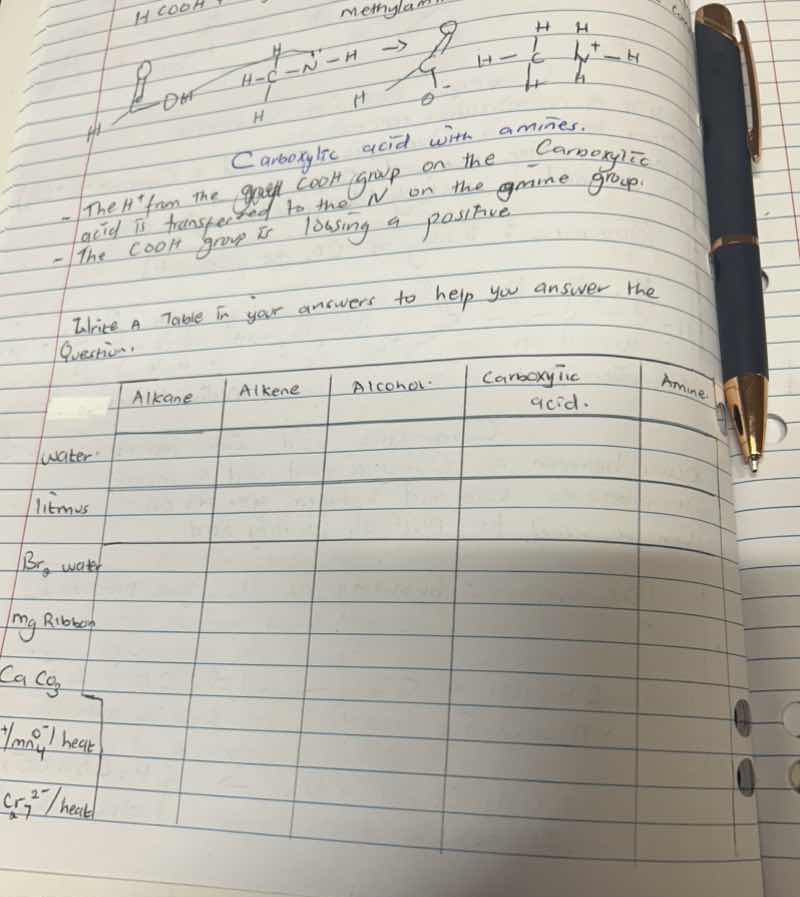
Question
write a table in your answers to help you answer the question.
| alkane | alkene | alcohol | carboxylic acid | amine | |
|---|---|---|---|---|---|
| litmus | |||||
| \\(br_2\\) water | |||||
| mg ribbon | |||||
| \\(caco_3\\) | |||||
| \\(h^+/mno_4^-\\), heat | |||||
| \\(cr_2o_7^{2-}/h^+\\), heat |
Identify the functional groups and reagents
We need to determine the chemical reactions and physical observations when five classes of organic compounds (Alkane, Alkene, Alcohol, Carboxylic acid, Amine) are treated with seven different reagents/tests:
- Water: Solubility/miscibility behavior.
- Litmus: Acid-base properties.
- \(Br_2\) water: Test for unsaturation (alkenes).
- Mg Ribbon: Test for acidic protons (carboxylic acids react to release \(H_2\) gas).
- \(CaCO_3\): Test for relatively strong organic acids (carboxylic acids react to release \(CO_2\) gas).
- \(H^+ / MnO_4^-\) heat: Oxidation test (alkenes and primary/secondary alcohols are oxidized, decoloring the purple solution).
- \(Cr_2O_7^{2-} / H^+\) heat: Oxidation test (primary/secondary alcohols are oxidized, turning orange to green).
Determine reactions for each column
- Alkane:
- Water: Insoluble (two layers).
- Litmus: Neutral (no change).
- \(Br_2\) water: No reaction (remains orange/brown in the dark).
- Mg Ribbon: No reaction.
- \(CaCO_3\): No reaction.
- \(MnO_4^-\): No reaction.
- \(Cr_2O_7^{2-}\): No reaction.
- Alkene:
- Water: Insoluble (two layers).
- Litmus: Neutral (no change).
- \(Br_2\) water: Decolorizes (orange to colorless).
- Mg Ribbon: No reaction.
- \(CaCO_3\): No reaction.
- \(MnO_4^-\): Decolorizes (purple to colorless/brown precipitate).
- \(Cr_2O_7^{2-}\): No reaction (under standard mild conditions, though strong heating can cleave, typically recorded as no reaction compared to alcohols).
- Alcohol (assuming primary/secondary aliphatic alcohol like ethanol):
- Water: Soluble (miscible for short-chain).
- Litmus: Neutral (no change).
- \(Br_2\) water: No reaction.
- Mg Ribbon: Very slow or no visible reaction under standard conditions (unlike carboxylic acids).
- \(CaCO_3\): No reaction.
- \(MnO_4^-\): Decolorizes (purple to colorless, oxidized to carboxylic acid/ketone).
- \(Cr_2O_7^{2-}\): Turns from orange to green (Cr(III)).
- Carboxylic acid:
- Water: Soluble (short-chain).
- Litmus: Acidic (turns blue litmus red).
- \(Br_2\) water: No reaction.
- Mg Ribbon: Effervescence / bubbles of \(H_2\) gas.
- \(CaCO_3\): Effervescence / bubbles of \(CO_2\) gas.
- \(MnO_4^-\): No reaction (resistant to oxidation).
- \(Cr_2O_7^{2-}\): No reaction.
- Amine (assuming short-chain aliphatic amine):
- Water: Soluble (short-chain).
- Litmus: Basic (turns red litmus blue).
- \(Br_2\) water: No reaction (unless aromatic amine like aniline, but aliphatic amines typically do not react).
- Mg Ribbon: No reaction.
- \(CaCO_3\): No reaction.
- \(MnO_4^-\): Can be oxidized, but typically not a standard diagnostic test.
- \(Cr_2O_7^{2-}\): No reaction.
Format the table
We will construct a comprehensive table summarizing these observations clearly.

Snap & solve any problem in the app
Get step-by-step solutions on Sovi AI
Photo-based solutions with guided steps
Explore more problems and detailed explanations
| Reagent / Test | Alkane | Alkene | Alcohol | Carboxylic acid | Amine |
|---|---|---|---|---|---|
| Litmus | No change (neutral) | No change (neutral) | No change (neutral) | Turns red (acidic) | Turns blue (basic) |
| \(Br_2\) water | No reaction (remains orange) | Decolorizes (orange to colorless) | No reaction | No reaction | No reaction |
| Mg Ribbon | No reaction | No reaction | No reaction | Effervescence (\(H_2\) gas) | No reaction |
| \(CaCO_3\) | No reaction | No reaction | No reaction | Effervescence (\(CO_2\) gas) | No reaction |
| \(H^+ / MnO_4^-\) + heat | No reaction | Decolorizes (purple to colorless) | Decolorizes (purple to colorless) | No reaction | No reaction |
| \(Cr_2O_7^{2-} / H^+\) + heat | No reaction | No reaction | Turns from orange to green | No reaction | No reaction |