QUESTION IMAGE
Question
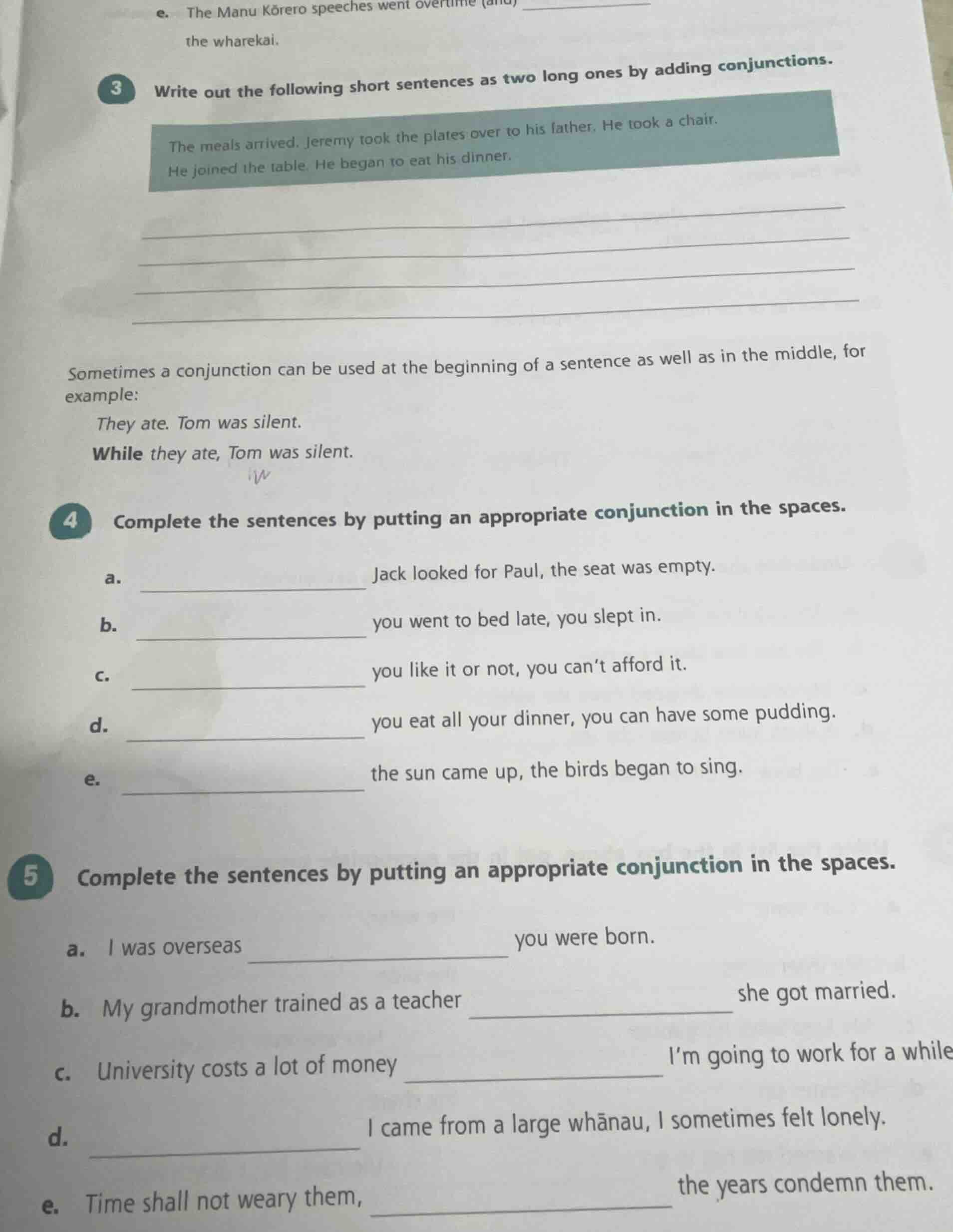
3 write out the following short sentences as two long ones by adding conjunctions.
the meals arrived. jeremy took the plates over to his father. he took a chair. he joined the table. he began to eat his dinner.
sometimes a conjunction can be used at the beginning of a sentence as well as in the middle, for example:
they ate. tom was silent.
while they ate, tom was silent.
4 complete the sentences by putting an appropriate conjunction in the spaces.
a. ________ jack looked for paul, the seat was empty.
b. ________ you went to bed late, you slept in.
c. ________ you like it or not, you cant afford it.
d. ________ you eat all your dinner, you can have some pudding.
e. ________ the sun came up, the birds began to sing.
5 complete the sentences by putting an appropriate conjunction in the spaces.
a. i was overseas ________ you were born.
b. my grandmother trained as a teacher ________ she got married.
c. university costs a lot of money ________ im going to work for a while.
d. ________ i came from a large whānau, i sometimes felt lonely.
e. time shall not weary them, ________ the years condemn them.
Combine short sentences using conjunctions
The task in Question 3 is to combine five short sentences into two longer ones using conjunctions:
"The meals arrived. Jeremy took the plates over to his father. He took a chair. He joined the table. He began to eat his dinner."
We can group the first two actions and the last three actions:
- When the meals arrived, Jeremy took the plates over to his father.
- After taking a chair and joining the table, he began to eat his dinner.
Determine conjunctions for sentence-initial positions
Question 4 asks to complete sentences with a conjunction at the beginning:
a. "[When/Although] Jack looked for Paul, the seat was empty." -> "When" or "Although" works well to show contrast or time. "When" is highly natural.
b. "[Because/Since] you went to bed late, you slept in." -> Shows cause and effect.
c. "[Whether] you like it or not, you can't afford it." -> Standard correlative/subordinating structure "Whether... or not".
d. "[If/Once] you eat all your dinner, you can have some pudding." -> Shows condition.
e. "[When/As] the sun came up, the birds began to sing." -> Shows time relationship.
Determine conjunctions for mid-sentence positions
Question 5 asks to complete sentences with conjunctions in the middle (or beginning for d):
a. "I was overseas [when] you were born." -> Time relation.
b. "My grandmother trained as a teacher [before] she got married." -> Sequential time relation.
c. "University costs a lot of money [so] I'm going to work for a while." -> Cause and effect.
d. "[Although/Though] I came from a large whānau, I sometimes felt lonely." -> Shows concession/contrast.
e. "Time shall not weary them, [nor] the years condemn them." -> Classic quotation from "For the Fallen" using the coordinating conjunction "nor".

Snap & solve any problem in the app
Get step-by-step solutions on Sovi AI
Photo-based solutions with guided steps
Explore more problems and detailed explanations
Question 3
When the meals arrived, Jeremy took the plates over to his father. After he took a chair and joined the table, he began to eat his dinner.
Question 4
a. When Jack looked for Paul, the seat was empty.
b. Because you went to bed late, you slept in.
c. Whether you like it or not, you can't afford it.
d. If you eat all your dinner, you can have some pudding.
e. As the sun came up, the birds began to sing.
Question 5
a. I was overseas when you were born.
b. My grandmother trained as a teacher before she got married.
c. University costs a lot of money, so I'm going to work for a while.
d. Although I came from a large whānau, I sometimes felt lonely.
e. Time shall not weary them, nor the years condemn them.