QUESTION IMAGE
Question
write the expression then simplify.
1
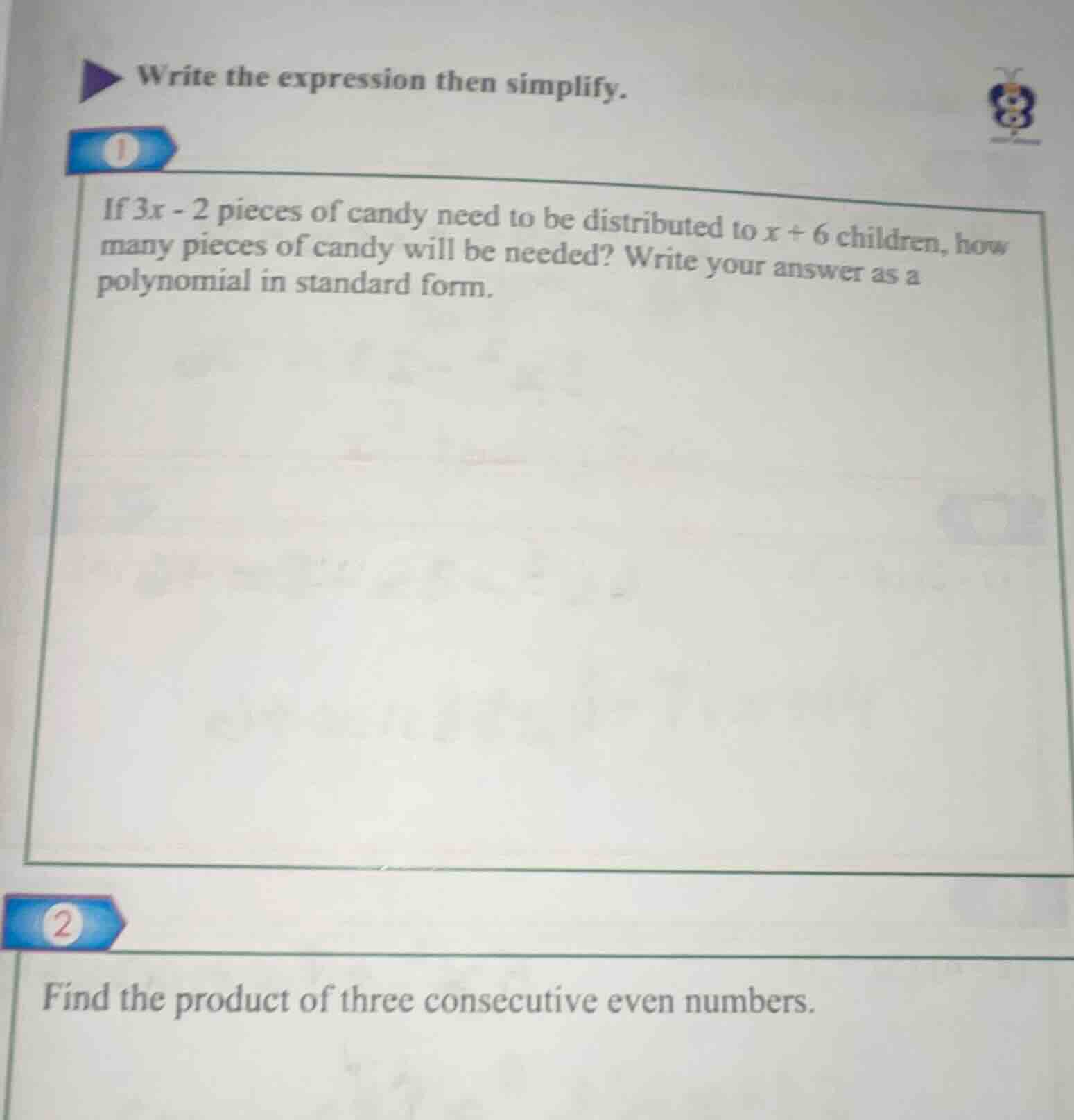
if $3x - 2$ pieces of candy need to be distributed to $x + 6$ children, how many pieces of candy will be needed? write your answer as a polynomial in standard form.
2
find the product of three consecutive even numbers.
Problem 1
Step1: Understand the problem
We need to find the total number of candies when each of \(x + 6\) children gets \(3x - 2\) candies. So we multiply the number of candies per child by the number of children.
Expression: \((3x - 2)(x + 6)\)
Step2: Expand the product
Using the distributive property (FOIL method):
Step3: Combine like terms
Combine the \(x\) terms:
\(3x^{2}+(18x - 2x)-12=3x^{2}+16x - 12\)
Step1: Represent the consecutive even numbers
Let the first even number be \(2n\) (where \(n\) is an integer). Then the next consecutive even number is \(2n + 2\) and the third is \(2n+4\).
Step2: Find the product
The product of the three consecutive even numbers is \((2n)(2n + 2)(2n + 4)\)
First, factor out a 2 from each term:
\(2n\times2(n + 1)\times2(n + 2)=8n(n + 1)(n + 2)\)
We can also expand this:
First, multiply \(n(n + 1)(n + 2)=n(n^{2}+3n + 2)=n^{3}+3n^{2}+2n\)
Then multiply by 8: \(8(n^{3}+3n^{2}+2n)=8n^{3}+24n^{2}+16n\)

Snap & solve any problem in the app
Get step-by-step solutions on Sovi AI
Photo-based solutions with guided steps
Explore more problems and detailed explanations
\(3x^{2}+16x - 12\)