QUESTION IMAGE
Question
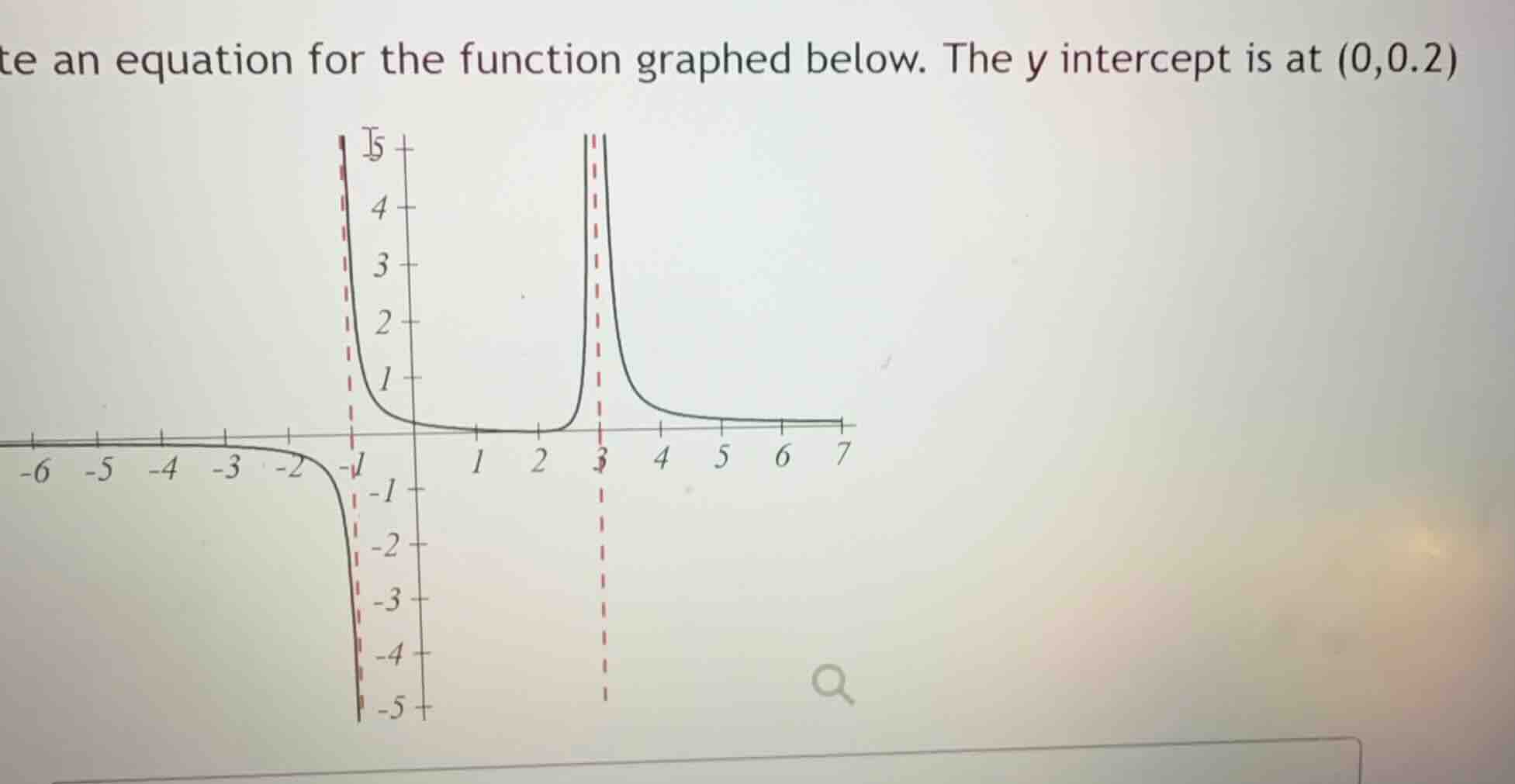
write an equation for the function graphed below. the y intercept is at \\((0,0.2)\\)
🆕 New Concept Discovered: Rational Functions from Graphs
Finding equations using asymptotes, intercepts, and behavior
Step 1: Identify Vertical Asymptotes and Multiplicity
By observing the dashed vertical lines on the graph:
- There is a vertical asymptote at \( x = -1 \). The graph goes to \( -\infty \) on the left and \( +\infty \) on the right. Because the graph changes sign across the asymptote, this factor has an odd multiplicity (typically 1). This gives a factor of \( (x + 1) \) in the denominator.
- There is a vertical asymptote at \( x = 3 \). The graph goes to \( +\infty \) on both the left and right sides of this asymptote. Because the graph does not change sign (it points in the same direction on both sides), this factor has an even multiplicity (typically 2). This gives a factor of \( (x - 3)^2 \) in the denominator.
Combining these, the denominator of our rational function is:
Step 2: Identify Horizontal Asymptote
As \( x \to \pm\infty \), the graph approaches the x-axis, which means there is a horizontal asymptote at \( y = 0 \). This indicates that the degree of the numerator is strictly less than the degree of the denominator.
Step 3: Identify x-Intercepts and Multiplicity
The graph touches or crosses the x-axis at \( x = 2 \).
- At \( x = 2 \), the graph touches the x-axis and turns around (it does not cross it). This indicates an even multiplicity (typically 2) for this root.
- This gives a factor of \( (x - 2)^2 \) in the numerator.
Now we can write the general form of the rational function:
Step 4: Find the Leading Coefficient
We are given that the y-intercept is at \( (0, 0.2) \), which means \( f(0) = 0.2 = \frac{1}{5} \). We substitute \( x = 0 \) into our equation to solve for \( a \):
Multiply both sides by 9:
Divide by 4:
Substituting \( a \) back into the function gives:

Snap & solve any problem in the app
Get step-by-step solutions on Sovi AI
Photo-based solutions with guided steps
Explore more problems and detailed explanations