QUESTION IMAGE
Question
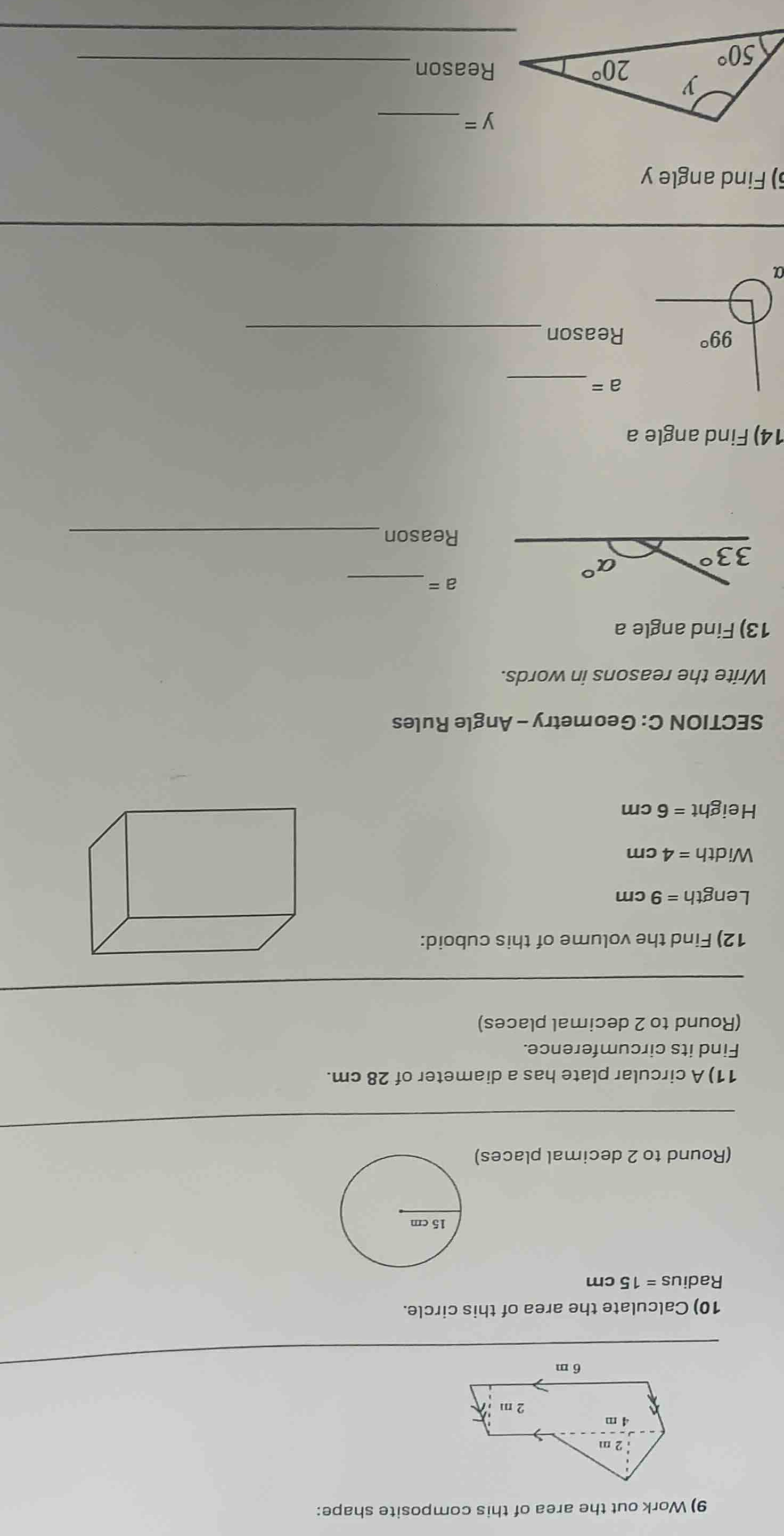
- work out the area of this composite shape:
- calculate the area of this circle.
radius = 15 cm
(round to 2 decimal places)
- a circular plate has a diameter of 28 cm.
find its circumference.
(round to 2 decimal places)
- find the volume of this cuboid:
length = 9 cm
width = 4 cm
height = 6 cm
section c: geometry - angle rules
write the reasons in words.
- find angle a
a = ______
reason ______
- find angle a
a = ______
reason ______
- find angle y
y = ______
reason ______
<pre_analysis>
{
"quality": "clear",
"question_count": 7,
"skills_matched": [
"step_cot",
"explain_then_answer",
"tutor"
],
"needs_drawing": false,
"concepts_used": [
"Area Decomposition"
],
"new_concepts": [
"Volume of a Cuboid",
"Circle Circumference",
"Circle Area"
],
"current_concepts": [
"Area Decomposition",
"Circle Area",
"Circle Circumference",
"Volume of a Cuboid",
"Angle Rules"
]
}
</pre_analysis>
<reasoning>
The provided image is upside down. Let's orient ourselves and solve each numbered question from 9 to 15.
Calculate composite shape area
Using the Area Decomposition knowledge point.
The shape is decomposed into a central rectangle and two triangles on the sides:
- Central rectangle:
\[
\text{Width} = 4\text{ m},\quad \text{Height} = 6\text{ m}
\]
\[
\text{Area}_{\text{rect}} = 4 \times 6 = 24\text{ m}^2
\]
- Left triangle:
\[
\text{Base} = 2\text{ m},\quad \text{Height} = 6\text{ m}
\]
\[
\text{Area}_{\text{left}} = \frac{1}{2} \times 2 \times 6 = 6\text{ m}^2
\]
- Right triangle:
\[
\text{Base} = 2\text{ m},\quad \text{Height} = 6\text{ m}
\]
\[
\text{Area}_{\text{right}} = \frac{1}{2} \times 2 \times 6 = 6\text{ m}^2
\]
- Total Area:
\[
\text{Total Area} = 24 + 6 + 6 = 36\text{ m}^2
\]
Calculate area of the circle
The circle has a radius \(r = 15\text{ cm}\).
- Formula:
\[
\text{Area} = \pi r^2
\]
- Calculation:
\[
\text{Area} = \pi \times 15^2 = 225\pi \approx 706.8583\text{ cm}^2
\]
- Rounded to 2 decimal places:
\[
\text{Area} \approx 706.86\text{ cm}^2
\]
Calculate circumference of the plate
The circular plate has a diameter \(d = 28\text{ cm}\).
- Formula:
\[
\text{Circumference} = \pi d
\]
- Calculation:
\[
\text{Circumference} = \pi \times 28 \approx 87.9646\text{ cm}
\]
- Rounded to 2 decimal places:
\[
\text{Circumference} \approx 87.96\text{ cm}
\]
Calculate volume of the cuboid
The cuboid has dimensions: length = \(9\text{ cm}\), width = \(4\text{ cm}\), height = \(6\text{ cm}\).
- Formula:
\[
\text{Volume} = \text{Length} \times \text{Width} \times \text{Height}
\]
- Calculation:
\[
\text{Volume} = 9 \times 4 \times 6 = 216\text{ cm}^3
\]
Find angle a (Question 13)
The diagram shows a straight line intersected by another line, forming a linear pair.
- Rule:
Angles on a straight line add up to \(180^\circ\).
- Calculation:
\[
a = 180^\circ - 33^\circ = 147^\circ
\]
Find angle a (Question 14)
The diagram shows angles around a point.
- Rule:
Angles around a point add up to \(360^\circ\).
- Calculation:
\[
a = 360^\circ - 99^\circ = 261^\circ
\]
Find angle y (Question 15)
The diagram shows a triangle with interior angles \(20^\circ\), \(50^\circ\), and \(y\).
- Rule:
The sum of interior angles in a triangle is \(180^\circ\).
- Calculation:
\[
y = 180^\circ - (20^\circ + 50^\circ) = 110^\circ
\]
</reasoning>
<answer>
Question 9
\(36\text{ m}^2\)
Question 10
\(706.86\text{ cm}^2\)
Question 11
\(87.96\text{ cm}\)
Question 12
\(216\text{ cm}^3\)
Question 13
\(a = 147^\circ\)
Reason: Angles on a straight line add up to \(180^\circ\).
Question 14
\(a = 261^\circ\)
Reason: Angles around a point add up to \(360^\circ\).
Question 15
\(y = 110^\circ\)
Reason: Angles in a triangle add up to \(180^\circ\).
</answer>
<post_analysis>
{
"subject": "Mathematics",
"question_type": "Multi-part",
"knowledge_point": [
"Mathematics",
"Geometry",
"Area Decomposition"
]…
Snap & solve any problem in the app
Get step-by-step solutions on Sovi AI
Photo-based solutions with guided steps
Explore more problems and detailed explanations
<pre_analysis>
{
"quality": "clear",
"question_count": 7,
"skills_matched": [
"step_cot",
"explain_then_answer",
"tutor"
],
"needs_drawing": false,
"concepts_used": [
"Area Decomposition"
],
"new_concepts": [
"Volume of a Cuboid",
"Circle Circumference",
"Circle Area"
],
"current_concepts": [
"Area Decomposition",
"Circle Area",
"Circle Circumference",
"Volume of a Cuboid",
"Angle Rules"
]
}
</pre_analysis>
<reasoning>
The provided image is upside down. Let's orient ourselves and solve each numbered question from 9 to 15.
Calculate composite shape area
Using the Area Decomposition knowledge point.
The shape is decomposed into a central rectangle and two triangles on the sides:
- Central rectangle:
\[
\text{Width} = 4\text{ m},\quad \text{Height} = 6\text{ m}
\]
\[
\text{Area}_{\text{rect}} = 4 \times 6 = 24\text{ m}^2
\]
- Left triangle:
\[
\text{Base} = 2\text{ m},\quad \text{Height} = 6\text{ m}
\]
\[
\text{Area}_{\text{left}} = \frac{1}{2} \times 2 \times 6 = 6\text{ m}^2
\]
- Right triangle:
\[
\text{Base} = 2\text{ m},\quad \text{Height} = 6\text{ m}
\]
\[
\text{Area}_{\text{right}} = \frac{1}{2} \times 2 \times 6 = 6\text{ m}^2
\]
- Total Area:
\[
\text{Total Area} = 24 + 6 + 6 = 36\text{ m}^2
\]
Calculate area of the circle
The circle has a radius \(r = 15\text{ cm}\).
- Formula:
\[
\text{Area} = \pi r^2
\]
- Calculation:
\[
\text{Area} = \pi \times 15^2 = 225\pi \approx 706.8583\text{ cm}^2
\]
- Rounded to 2 decimal places:
\[
\text{Area} \approx 706.86\text{ cm}^2
\]
Calculate circumference of the plate
The circular plate has a diameter \(d = 28\text{ cm}\).
- Formula:
\[
\text{Circumference} = \pi d
\]
- Calculation:
\[
\text{Circumference} = \pi \times 28 \approx 87.9646\text{ cm}
\]
- Rounded to 2 decimal places:
\[
\text{Circumference} \approx 87.96\text{ cm}
\]
Calculate volume of the cuboid
The cuboid has dimensions: length = \(9\text{ cm}\), width = \(4\text{ cm}\), height = \(6\text{ cm}\).
- Formula:
\[
\text{Volume} = \text{Length} \times \text{Width} \times \text{Height}
\]
- Calculation:
\[
\text{Volume} = 9 \times 4 \times 6 = 216\text{ cm}^3
\]
Find angle a (Question 13)
The diagram shows a straight line intersected by another line, forming a linear pair.
- Rule:
Angles on a straight line add up to \(180^\circ\).
- Calculation:
\[
a = 180^\circ - 33^\circ = 147^\circ
\]
Find angle a (Question 14)
The diagram shows angles around a point.
- Rule:
Angles around a point add up to \(360^\circ\).
- Calculation:
\[
a = 360^\circ - 99^\circ = 261^\circ
\]
Find angle y (Question 15)
The diagram shows a triangle with interior angles \(20^\circ\), \(50^\circ\), and \(y\).
- Rule:
The sum of interior angles in a triangle is \(180^\circ\).
- Calculation:
\[
y = 180^\circ - (20^\circ + 50^\circ) = 110^\circ
\]
</reasoning>
<answer>
Question 9
\(36\text{ m}^2\)
Question 10
\(706.86\text{ cm}^2\)
Question 11
\(87.96\text{ cm}\)
Question 12
\(216\text{ cm}^3\)
Question 13
\(a = 147^\circ\)
Reason: Angles on a straight line add up to \(180^\circ\).
Question 14
\(a = 261^\circ\)
Reason: Angles around a point add up to \(360^\circ\).
Question 15
\(y = 110^\circ\)
Reason: Angles in a triangle add up to \(180^\circ\).
</answer>
<post_analysis>
{
"subject": "Mathematics",
"question_type": "Multi-part",
"knowledge_point": [
"Mathematics",
"Geometry",
"Area Decomposition"
]
}
</post_analysis>