QUESTION IMAGE
Question
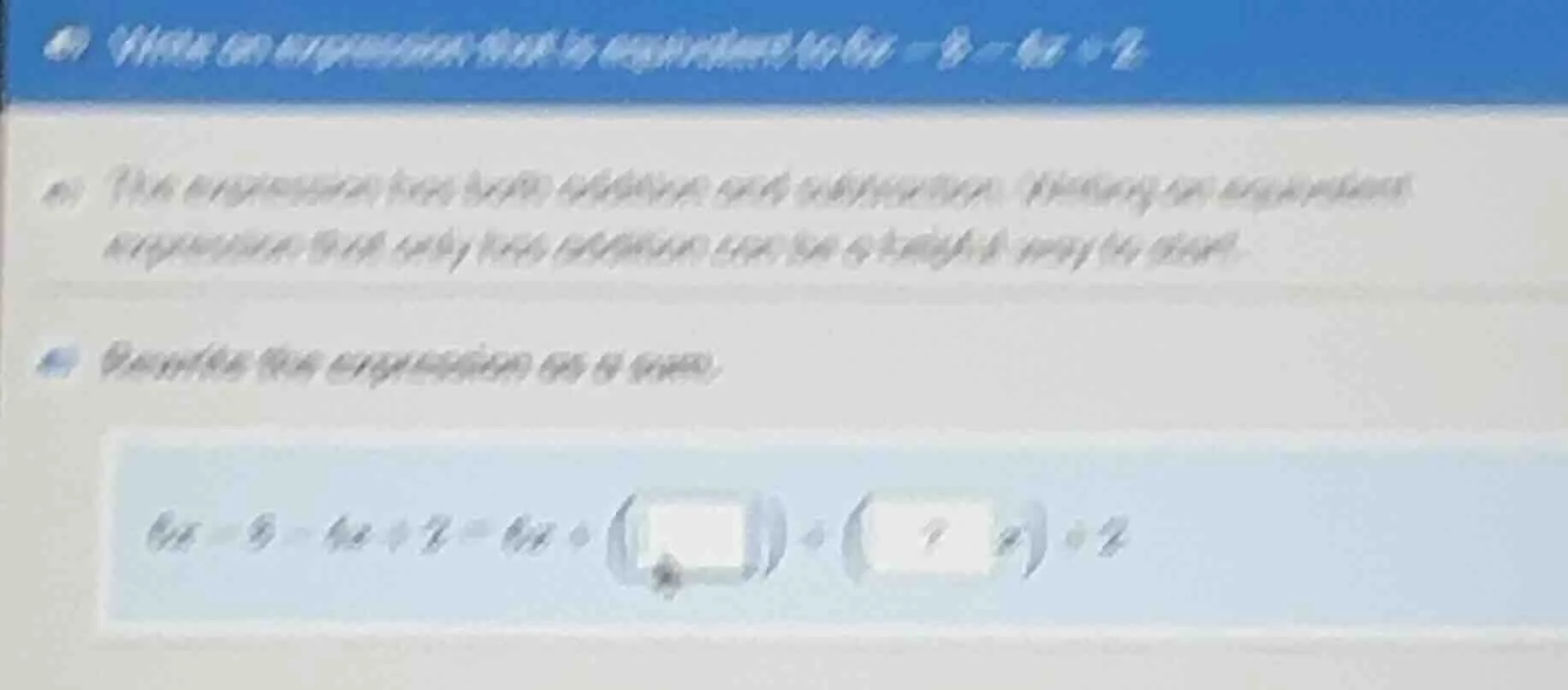
- work on expressions that is equivalent to 6x - 8 - 4x + 2.
a) the expression has both addition and subtraction. writing an equivalent expression that only uses addition can be a helpful way to start.
b) rewrite the expression as a sum.
6x - 8 - 4x + 2 = 6x + (□) + (-4x) + 2
Step1: Analyze the term -8
We know that subtracting a number is the same as adding its opposite. So, \(-8\) can be written as \(+(-8)\) and \(-4x\) can be written as \(+(-4x)\) when re - expressing the subtraction as addition. Looking at the equation \(6x - 8-4x + 2=6x+(\quad)-(\quad x)+2\), for the first blank, since we have \(6x-8\), and we are re - writing subtraction as addition of the opposite, \(-8\) is equivalent to \(+(-8)\), but in the form of the equation, we can also think in terms of the sign. The original term is \(-8\), so when we rewrite the expression \(6x - 8-4x + 2\) as \(6x+(\quad)-(\quad x)+2\), the first blank should be \(- 8\) (because \(6x-8=6x+(-8)\)) and the second blank: for \(-4x\), when we write it as \(-(\quad x)\), we have \(-4x=- (4x)\). Wait, let's re - examine the equation structure. The equation is \(6x - 8-4x + 2=6x+(\quad)-(\quad x)+2\). Let's break down each term:
The term \(-8\) in \(6x - 8\) can be written as \(+(-8)\), but in the given form \(6x+(\quad)-(\quad x)+2\), the first blank is for the constant term after \(6x\) with the operation of addition (but actually, it's the same as subtracting 8, so the first blank is \(-8\))? Wait, no. Let's use the concept of adding the opposite. \(a - b=a+(-b)\) and \(a - c x=a+(-c x)\). So, \(6x-8 - 4x + 2=6x+(-8)+(-4x)+2\). But the given form is \(6x+(\quad)-(\quad x)+2\). So, \(6x-8-4x + 2=6x+(-8)-(4x)+2\). So the first blank is \(-8\) and the second blank is \(4\) (because \(-4x=-(4x)\)).
Step2: Verify the substitution
Let's substitute the values. If we put \(-8\) in the first blank and \(4\) in the second blank, we have:
Left - hand side: \(6x-8 - 4x+2=(6x - 4x)+(-8 + 2)=2x-6\)
Right - hand side: \(6x+(-8)-(4x)+2=(6x-4x)+(-8 + 2)=2x-6\)
So the first blank is \(-8\) and the second blank is \(4\). But the problem shows the second blank has a "?" and the first blank is empty. Wait, maybe I misread. Wait the equation is \(6x - 8-4x + 2=6x+(\quad)-(\quad x)+2\). Let's re - express each subtraction as adding the opposite:
\(6x-8-4x + 2=6x+(-8)+(-4x)+2\)
Now, rewrite \(-4x\) as \(-(4x)\), so we have \(6x+(-8)-(4x)+2\). So the first blank is \(-8\) and the second blank is \(4\).

Snap & solve any problem in the app
Get step-by-step solutions on Sovi AI
Photo-based solutions with guided steps
Explore more problems and detailed explanations
The first blank is \(-8\) and the second blank is \(4\). So the completed equation is \(6x - 8-4x + 2=6x+(-8)-(4x)+2\)