QUESTION IMAGE
Question
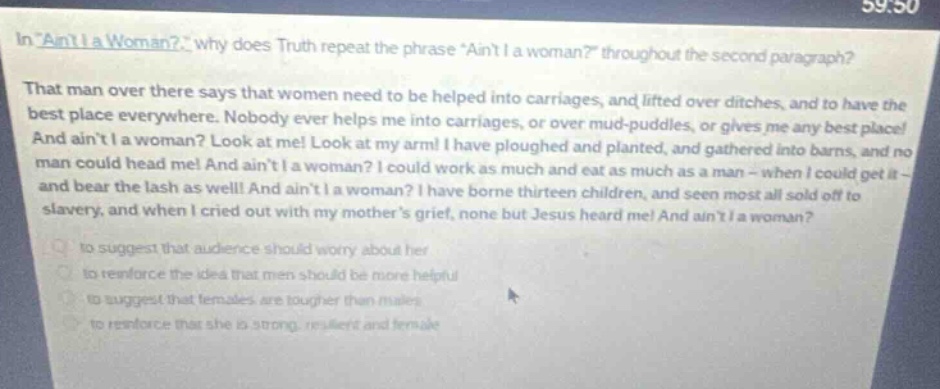
in \aint i a woman?,\ why does truth repeat the phrase \aint i a woman?\ throughout the second paragraph?
that man over there says that women need to be helped into carriages, and lifted over ditches, and to have the best place everywhere. nobody ever helps me into carriages, or over mud-puddles, or gives me any best place! and aint i a woman? look at me! look at my arm! i have ploughed and planted, and gathered into barns, and no man could head me! and aint i a woman? i could work as much and eat as much as a man - when i could get it - and bear the lash as well! and aint i a woman? i have borne thirteen children, and seen most all sold off to slavery, and when i cried out with my mothers grief, none but jesus heard me! and aint i a woman?
to suggest that audience should worry about her
to reinforce the idea that men should be more helpful
to suggest that females are tougher than males
to reinforce that she is strong, resilient and female
⚡ Using what you learned: inferential comprehension and textual evidence
Step 1: Analyze the text and the rhetorical question
In the second paragraph of her speech, Sojourner Truth contrasts the common 19th-century claim that women are delicate and need to be protected ("helped into carriages, and lifted over ditches") with her own lived experience as an enslaved Black woman.
She lists her physical strength and hardships:
- She has ploughed, planted, and gathered into barns.
- She could work and eat as much as a man.
- She has endured physical punishment ("bear the lash").
- She has borne thirteen children and suffered the grief of seeing them sold into slavery.
After each of these statements of immense strength and endurance, she asks the rhetorical question: "And ain't I a woman?"
Step 2: Determine the purpose of the repetition
By repeating this question immediately after describing her labor, resilience, and motherhood, Truth achieves two main goals:
- She establishes her identity as a female (challenging the idea that womanhood is defined only by the delicate treatment white women received).
- She highlights her incredible strength and resilience in surviving labor, physical abuse, and emotional grief.
Therefore, the repetition serves to reinforce that she is strong, resilient, and female.
Step 3: Evaluate the options
- Option 1: "to suggest that audience should worry about her" — Incorrect. Truth is establishing her strength and demanding equal rights, not asking for pity or worry.
- Option 2: "to reinforce the idea that men should be more helpful" — Incorrect. She is challenging the definition of womanhood and the denial of her rights, not asking men to help her into carriages.
- Option 3: "to suggest that females are tougher than males" — Incorrect. She compares her strength to a man's ("work as much and eat as much as a man") to show equality, not to claim superiority.
- Option 4: "to reinforce that she is strong, resilient and female" — Correct. This perfectly captures how she uses her personal history of labor and motherhood to assert both her womanhood and her strength.

Snap & solve any problem in the app
Get step-by-step solutions on Sovi AI
Photo-based solutions with guided steps
Explore more problems and detailed explanations
to reinforce that she is strong, resilient and female