QUESTION IMAGE
Question
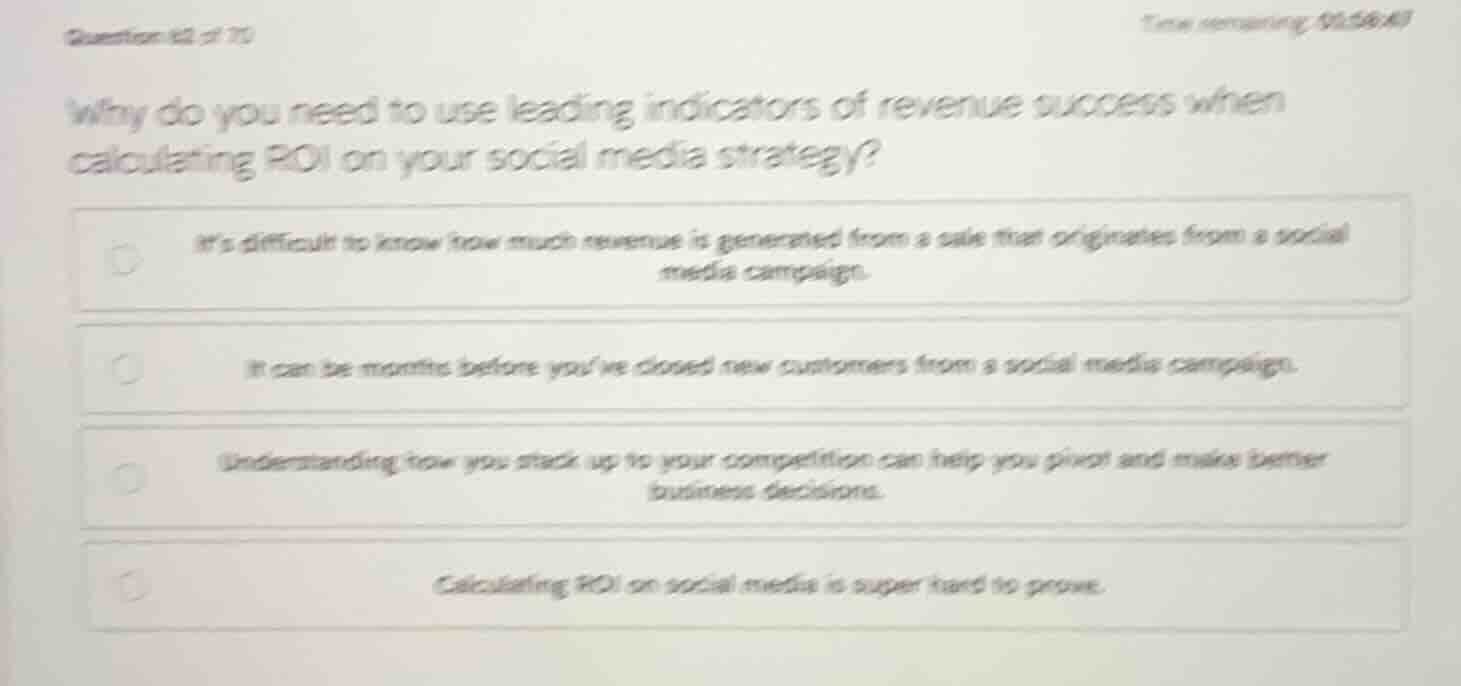
why do you need to use leading indicators of revenue success when calculating roi on your social media strategy?
- its difficult to know how much revenue is generated from a sale that originates from a social media campaign.
- it can be months before youve closed new customers from a social media campaign.
- understanding how you stack up to your competition can help you pivot and make better business decisions.
- calculating roi on social media is super hard to prove.
🆕 New Concept Discovered: Leading vs. Lagging Indicators
Predicting future outcomes before final results are realized.
Step 1: Understand the difference between leading and lagging indicators
In business and marketing, lagging indicators measure final outcomes that have already happened (such as actual revenue generated or closed sales).
Leading indicators are early signals or predictive metrics (such as website traffic, sign-ups, or leads generated) that point toward future success. They help you understand if you are on the right track before the final outcome occurs.
Step 2: Analyze the role of leading indicators in social media ROI
Social media marketing often sits at the very top of the sales funnel. When a user interacts with a social media campaign, they do not always buy immediately. The journey from discovering a brand on social media to actually purchasing a product can take a long time.
Because of this delay, relying only on immediate revenue (a lagging indicator) to calculate Return on Investment (ROI) would make it look like the campaign is failing in the short term. Therefore, you need leading indicators of revenue success because it can be months before you've closed new customers from a social media campaign. Leading indicators help prove the campaign is working during this waiting period.
Step 3: Evaluate the given options
- Option 1: "It's difficult to know how much revenue is generated from a sale that originates from a social media campaign."
Incorrect. While attribution can be challenging, modern tracking tools (like UTM parameters) make this possible. This is not the primary reason we rely on leading indicators.
- Option 2: "It can be months before you've closed new customers from a social media campaign."
Correct. Because of the long sales cycle, leading indicators are necessary to measure early progress and predict future revenue before the final sales are closed.
- Option 3: "Understanding how you stack up to your competition can help you pivot and make better business decisions."
Incorrect. This describes competitive analysis, not the relationship between leading indicators and revenue ROI.
- Option 4: "Calculating ROI on social media is super hard to prove."
Incorrect. This is a generalized, informal statement and does not explain the specific function of leading indicators.

Snap & solve any problem in the app
Get step-by-step solutions on Sovi AI
Photo-based solutions with guided steps
Explore more problems and detailed explanations
It can be months before you've closed new customers from a social media campaign. (The second option)